

The New York mayor is opening the roof of the David N. Dinkins Municipal Building to the public, but has plenty of work ahead to make the city below more affordable and accessible.
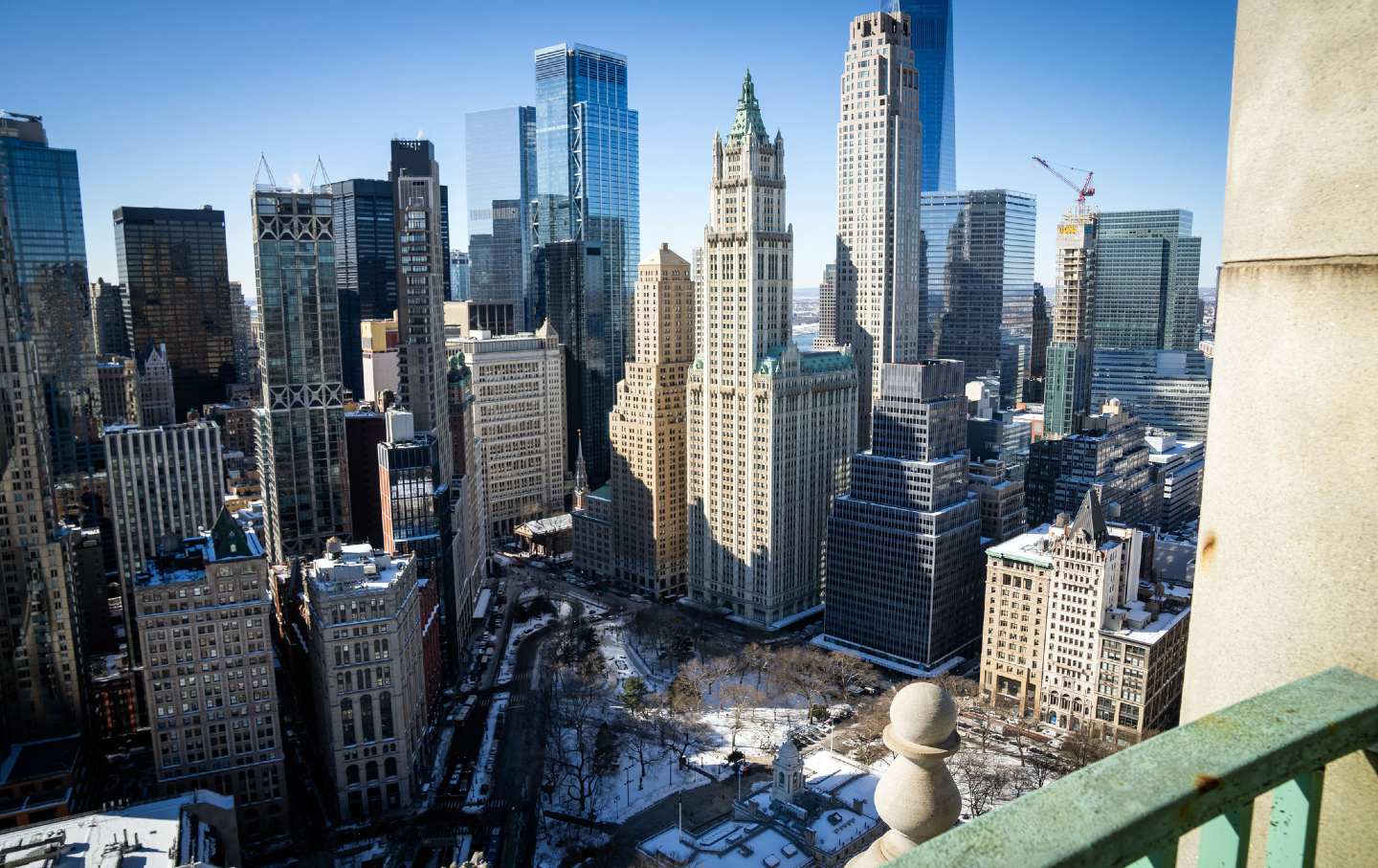
The view of south Manhattan from the roof of the David Dinkins Municipal Building
(Ed Reed/Mayoral Photography Office)
The metal detector at the entrance to the North Tower of 1 Centre Street—the 40-story Beaux Arts pile known formally as the David N. Dinkins Municipal Building—wasn’t working on Monday, which meant reporters arriving for Mayor Zohran Mamdani’s press conference had to submit to a manual search. But the sight that greeted us upon arriving at the 25th floor rooftop was worth the wait, and the bitter cold: a spectacular view of lower Manhattan from river to river, pressed into service as the backdrop for an announcement by the mayor—flanked by the comptroller, public advocate, and Manhattan borough president—that, starting in June, both the rooftop and the building’s majestic 36th-floor cupola would be open to the public free of charge.
“In many ways, Mayor Dinkins was ahead of his time,” said Mamdani, citing his predecessor’s frequent references to “the ‘gorgeous mosaic’ that is New York.”
“Mayor Dinkins paved the way for so many who followed,” Mamdani continued. “He was not only the first Black mayor, [but] he was also the first to have been a member of the Democratic Socialists of America and his politics of compassion, kindness and generosity remain a guide for me and so many others, as we lead from City Hall.”
Having covered the Dinkins administration at the time, I can attest that he was a thoroughly decent, and at times even morally courageous man whose record is apt to be more generously appraised by historians than his actions were by the press of his day. But he was also a one-term mayor whose failures—on not just public safety but also the efficient and effective delivery of city services—opened the door to Rudy Giuliani and the politics of resentment that still contaminates our public life.
Though it would have been tactless to say so while celebrating his legacy, Dinkins offers a cautionary tale both about the enduring racial bias that holds non-white politicians to a higher standard, and the perils of neglecting the details of day-to-day governance for the distractions of soaring vision and lofty rhetoric. As a spectacle, the mayor’s rooftop extravaganza was first-rate; he even promised, ahead of the Super Bowl, “We will never light this building up for the Patriots.” But at the end of his first month on the job, during which he was repeatedly asked—and declined—to grade his own performance, it would be difficult to justify anything higher than an A-.
The Mamdani administration was admirably efficient in meeting the headline task of clearing the streets from late January’s monster snow storm—a forbidding and at times fatal hurdle for some new mayors. But the city’s bus stops, crosswalks, and sidewalks were another story. Not all of this was the mayor’s fault. Property owners, not the city, are responsible for maintaining safe sidewalks; bus stops with shelters are supposed to be shoveled out by JC Decaux (the advertising agency); crosswalks near city parks are the responsibility of the parks department.
Current Issue
Nor was it the mayor’s, or the city’s, fault that some New Yorkers died in the cold. In 2022, the last year for which figures are available on the city’s data portal, 54 city residents perished as a result of exposure to the cold—a sharp rise from 34 the previous year, and at a time when the Adams administration was aggressively clearing homeless encampments from the city’s streets.
But a mayor needs to be able to walk and chew gum at the same time. Given the ample advance warning, not just of the historic scale of the blizzard but of the likely duration of the cold spell afterward, and the sharp rise in reported deaths, from seven right after the January 25 storm to the current count of 17, press coverage of this issue—including a tough Daily News front page—seems fair.
Likewise, while the mayor has been fulsome in expressing his appreciation for the Sanitation Department’s efforts in keeping the streets passable, the department’s claim that they are “currently running about 24 hours behind on trash collection,” which the mayor repeated on Monday, is simply not credible to anyone who walks the streets outside of Manhattan. On my street in Cobble Hill—well within the “Commie Corridor” that propelled Mamdani to Gracie Mansion—the mountains of uncollected trash have sat there for over a week.
And though Mamdani was smart to kick off Black History Month by spotlighting his DSA-dues-paying predecessor, the political class that produced, nurtured, and celebrated David Dinkins is still smarting over Mamdani’s failure to appoint a Black deputy mayor. The New York Times article calling attention to this omission overshadowed the appointment that same day of veteran activist Afua Attah-Mensah as head of the Mayor’s Office of Equity and Racial Justice. Even if you agree with Nation contributing writer Ross Barkan that the outrage over this issue is “contrived”—which, for the record, I do not—an administration that has shown an ambition elsewhere to move beyond the politics of representation should, and easily could, have done better. Mamdani certainly doesn’t lack for opportunities: Eric Adams began his term with four deputy mayors, but left office with seven.
In addition to providing bread and circuses (or, in Mamdani’s case, kebabs and TikToks) and heeding the daily grind of service delivery, a mayor who wants more than one term needs to always attend to politics. In a couple of weeks, the mayor’s preliminary budget will offer the first real picture of his priorities: where he proposes to add resources and where he is willing to make sacrifices—an inevitability given the city’s project $12 billion deficit.
At the same time—and far from coincidentally—on February 17 the mayor will journey to Albany for Tin Cup Day, when he’ll plead to the governor, and the state legislature, for the funds needed to deliver his agenda. His efforts there may well be aided by his endorsement of the governor’s reelection bid—a move that, while it may disappoint some on the left, comes as no surprise given challenger Antonio Delgado’s weak performance.
The following week, on February 25, Our Time NYC—the continuation of the mayor’s campaign that organizes to support his agenda—has called for a “Field Trip” it’s describing as an “Albany Takeover” to make the case for taxing the rich.
Popular
“swipe left below to view more authors”Swipe →
All of those events will offer the mayor a chance to show that he can do more than just talk a great game, either by persuading the governor that their shared priorities require new, and ongoing, sources of revenue—or by showing the depth of his political support should she resist his arguments. In the meantime, he’ll need to keep the city running—and get the sidewalks, as well as the streets, clear.
Your support makes stories like this possible
From Minneapolis to Venezuela, from Gaza to Washington, DC, this is a time of staggering chaos, cruelty, and violence.
Unlike other publications that parrot the views of authoritarians, billionaires, and corporations, The Nation publishes stories that hold the powerful to account and center the communities too often denied a voice in the national media—stories like the one you’ve just read.
Each day, our journalism cuts through lies and distortions, contextualizes the developments reshaping politics around the globe, and advances progressive ideas that oxygenate our movements and instigate change in the halls of power.
This independent journalism is only possible with the support of our readers. If you want to see more urgent coverage like this, please donate to The Nation today.
D.D. Guttenplan
D.D. Guttenplan is a special correspondent for The Nation and the former host of The Nation Podcast. He served as editor of the magazine from 2019 to 2025 and, prior to that, as an editor at large and London correspondent. His books include American Radical: The Life and Times of I.F. Stone, The Nation: A Biography, and The Next Republic: The Rise of a New Radical Majority.