
A long-shot campaign to restore public funding for abortion turned into the movement’s biggest success in a generation.
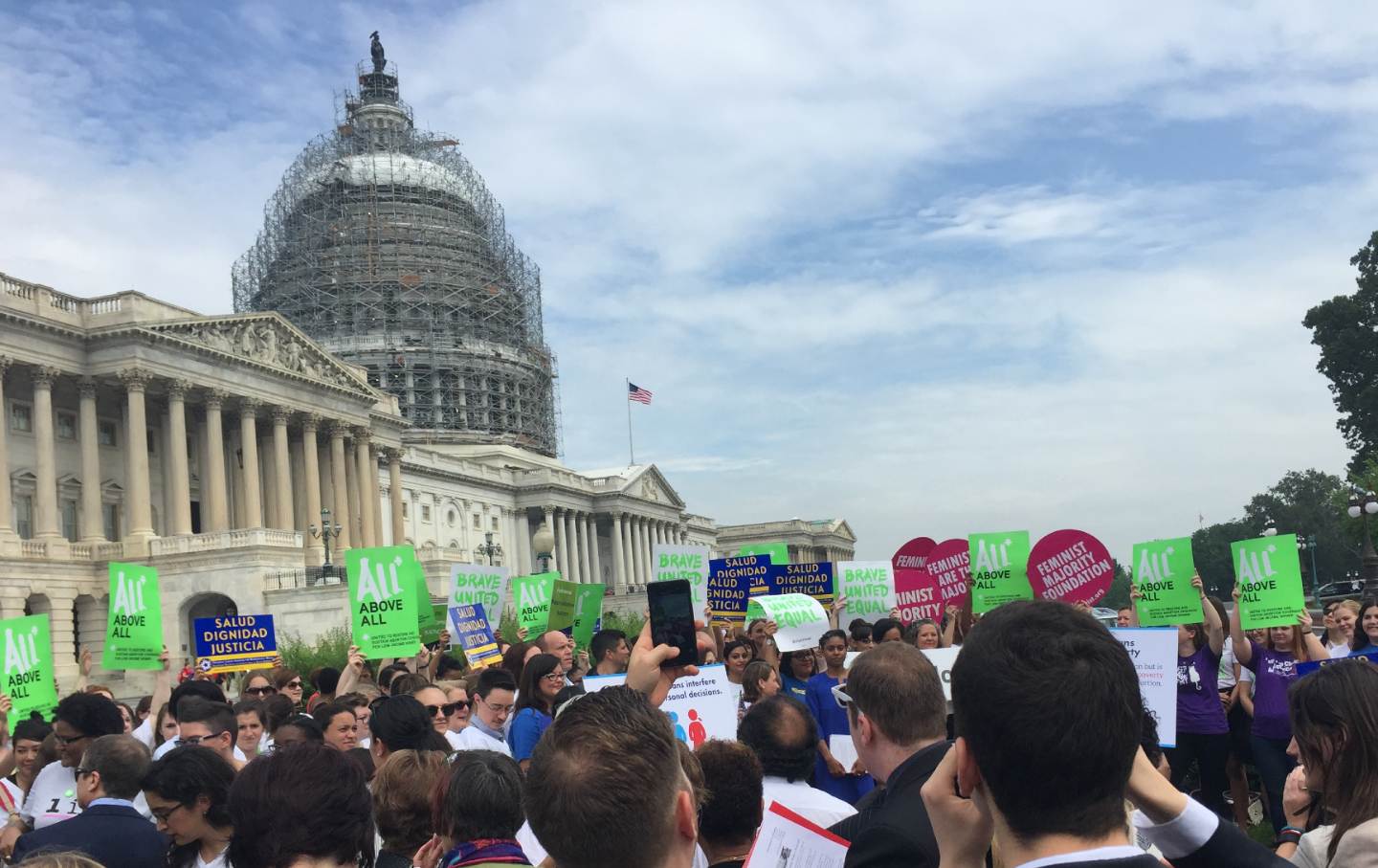
Reproductive justice advocates rallied on Capitol Hill on July 8, 2015, the day that Representative Barbara Lee introduced the Equal Access to Abortion Coverage in Health Insurance (EACH) Act.
(Jessi Leigh Swenson)
Nancy Keenan, the president of NARAL Pro-Choice America, was in San Francisco in early 2010 when she was jolted awake by a call from a Washington, DC, area code. It was 4:30 in the morning, California time. Half-asleep, Keenan answered. It was Jim Messina, deputy chief of staff for President Obama. Fellow Montanans, Messina and Keenan had known each other for years.
“Keenan,” Messina said. “It’s Jim.” “Hi, Jim,” Keenan replied sleepily.
Then she heard President Obama’s voice on the line.
In stark terms, he laid out some of the highest stakes Keenan had faced during her six years at the helm of the leading pro-choice political organization. Obama’s health reform law, which would extend healthcare coverage to millions of uninsured Americans, was nearing passage after months of political struggle. Obama had been fighting not just Republicans but also a contingent of anti-choice Democrats led by Michigan Representative Bart Stupak who were withholding their support over abortion.
A major sticking point was whether insurance plans created by the health reform law—which would be subsidized by the federal government—would cover abortions. Decades earlier, just three years after Roe v. Wade granted the right to abortion nationwide, abortion opponents had launched a successful attack on Medicaid funding, arguing that while abortion was legal, taxpayer funds should not cover it. The Hyde Amendment, named for Illinois Representative Henry Hyde, passed in 1976. (The ban actually wasn’t Hyde’s idea, but he became the face of it because he was charming and popular.) Hyde was candid about his wishes. “I certainly would like to prevent, if I could legally, anybody having an abortion, a rich woman, a middle-class woman, or a poor woman,” he famously said in 1977. “Unfortunately, the only vehicle available is the…Medicaid bill.”
As I traced the death of abortion rights for my book Killers of Roe, I came to see the Democrats’ failure to mount a real opposition to the Hyde Amendment as the key to understanding how they could lose Roe itself, decades later. Congress has renewed it each year, with varying exceptions for a pregnant person’s health and for rape and incest. Over time, policymakers have extended Hyde-like bans to Peace Corps volunteers, military service members and their families, people in federal prison and immigrant detention, federal employees, Children’s Health Insurance Program enrollees, and Native Americans who rely on the Indian Health Service.
Current Issue

Hyde had shaped the abortion rights movement into a mutual aid operation, forcing many of its most dedicated activists to spend their days raising millions of dollars to plug the gap left by federal funds. It was never enough. By 2010 the Hyde Amendment had caused more than a million people who couldn’t afford an abortion to give birth instead.
It wasn’t just Republicans who supported the Hyde Amendment. Of the senators and representatives who voted for it, 60 percent were Democrats. The ban passed Congress on the eve of the 1976 election, when Democrats including Jimmy Carter were courting a burgeoning new political force of evangelical voters. “[A]s you know there are many things in life that are not fair, that wealthy people can afford and poor people can’t,” Carter mused when asked about the ban in 1977. “But I don’t believe that the Federal Government should take action to try to make these opportunities exactly equal, particularly when there’s a moral factor involved.”
Taking on Hyde became a tough sell even within pro-choice organizations.
“I can attest that by and large, donors, board members, people on the street—they were all like, ‘Well, you know, funding, that’s a different thing; that’s different from having a policy that says abortion is legal,’” Gloria Feldt, who served as president of Planned Parenthood from 1996 to 2005, told me.
Into the 1990s and 2000s, many Democrats continued to embrace Hyde as a “compromise” position. Joe Biden voted against exempting rape and incest victims from the Hyde Amendment in 1977 and 1981 before finally caving to pressure and denouncing the ban in 2019. Bill Clinton expressed opposition to taxpayer funding of abortion while he was governor of Arkansas before calling for Hyde’s repeal when he ran for president.
Barack Obama, too, had opposed the Hyde Amendment on the campaign trail, raising hopes that he would repeal it at last. Yet to win support for healthcare reform, he quickly conceded that the Hyde Amendment would stand. Pro-choice lobbyists realized early on that Obama was not going to let abortion get in the way of his wider agenda. Before he was elected, he had promised that signing the Freedom of Choice Act to codify Roe would be “the first thing that I’d do.” But once in office, with a Democratic trifecta in the House and Senate that he would lose the following year, he declared that FOCA was “not the highest legislative priority.” His priority was healthcare reform.
But Obama’s surrender on Hyde did not convince abortion opponents. Stupak had pushed the Democratic-majority House to accept an amendment that heavily restricted private coverage of abortion on the new insurance exchanges.
Finally, after months of maneuvering, Obama had struck a deal he hoped would salvage the bill while letting antiabortion Democrats save face. Keenan didn’t recall the precise details of what she and her team saw that day after the early morning phone call, but the terms of the final deal would become public soon enough. The Affordable Care Act would allow states to ban abortion coverage in plans sold on its exchanges. And to placate Stupak and his ilk, Obama would issue an executive order affirming that the ACA would adhere to the Hyde Amendment.
“‘Nancy, we’re close on the healthcare act,’” Keenan recalled Obama saying. “‘And as you know, it’s all hung up on this issue of abortion. And we have some language we think will get us there.’”
The White House wanted Keenan to give her blessing.
Keenan recalled that Planned Parenthood was asked to do so, too.
“It was the two big ones, NARAL and Planned Parenthood, that had to really be the ones that said we could live with it,” Keenan told me.
Not that they were given much choice.
It was clear that if they objected, they would be torpedoing a bill that extended health insurance to millions. And so, Keenan recalled, NARAL said they could live with it. Not long afterward, the House passed a compromise bill, and Obama signed the executive order reaffirming the Hyde Amendment. It was yet another surrender on Hyde from a pro-choice Democrat.
And in its wake, a new long-shot campaign would grow into the abortion rights movement’s greatest surprise success story in a generation.
The first major challenge to the Hyde Amendment since the Supreme Court upheld the policy in 1980 had come almost two decades earlier. After the outrage over Anita Hill’s treatment by the Biden-led Senate Judiciary Committee, the 1992 election saw a record 47 women elected to the House, and four new women in the Senate. With these new allies, the Black Women’s Health Project saw the opportunity to challenge the dogma on Medicaid funding for abortion. The group was leading a movement to repeal the Hyde Amendment, the Campaign for Abortion Rights for Everyone (CARE). They had reason to hope they would prevail. In 1993, Clinton submitted a budget to Congress that omitted the ban. Democrats, with a majority in both chambers, had their chance to repeal it at last.
Yet, in a raucous debate over the appropriations bill in the House that, according to one press account, “exploded in a near shoving match,” they refused.
“I’ve been here for five months, and things are still run by white men in blue suits,” Florida Representative Corinne Brown, one of 10 Black women in the 435-member House, railed, decrying “white Southern males” who “think they know what’s best for poor women.”
Representative Henry Hyde claimed he was defending Black babies against eugenicist abortion advocates. When another of the body’s 10 Black women, Illinois Representative Cardiss Collins, expressed her offense, Hyde shot back: “I probably know your district better than you do. Talk to your ministers.” He later apologized and had his remarks stricken from the record, but not before offending the Black caucus and driving at least one member to tears.
But Hyde did make a concession that dealt those agitating for repeal a partial victory—while winning over moderates. He agreed to restore the rape and incest exceptions that had been removed under Reagan in 1981. In return, the Democratic-led House voted 255–178 to keep the Hyde Amendment.
Democrats still had another shot to expand abortion rights that year.
Senator Carol Moseley Braun, the first Black woman elected to the Senate, had cosponsored the Freedom of Choice Act, a bill to enshrine the right to abortion in federal law. The bill took on new urgency after a close call the year before, when the Supreme Court issued its decision in Planned Parenthood v. Casey, allowing states to limit abortion unless their laws caused an “undue burden.” But the bill soon exposed a rift within the movement over the two perennial third rails of abortion politics: public funding and parental consent for minors. Planned Parenthood and NARAL, the two organizations with the most influence, supported a version of the bill that would have enshrined Roe without touching those third rails. A coalition including the National Black Women’s Health Project and NOW believed the bill did not go far enough.
“If we have to continue to fight [the abortion issue] in 50 state capitals, then I am not clear what the point is with moving ahead with the Freedom of Choice Act,” NOW’s president Patricia Ireland declared. So Moseley Braun withdrew her support of the bill.
The backlash was swift. “The Freedom of Choice Act may not accomplish all the goals the pro-choice movement would wish, but it’s a constructive start, and it should not be held hostage to Senator Moseley Braun’s rigid, all-or-nothing stance,”The New York Times wrote.
“If, ultimately, we accept nothing because we cannot get everything, we hand opponents of choice a victory they did not win,” NARAL president Kate Michelman concurred.
Michelman had her own vision of how to win. Under her watch in the mid-1980s, NARAL had begun to tack toward Reaganite language about getting the government out of personal decisions, in order to court moderate voters. The messaging embodied in slogans like “Who Decides?” emphasized letting families choose. Decrying government control succeeded in part because it tapped into white resentment over the government’s role in school desegregation and gun control. And while Michelman may not have intended it, the “choice” message could be used to promote parental consent laws and ban public funding of abortion. After all, if the government is supposed to stay out of private healthcare decisions, then why should it fund those decisions?
Black women, whose choices had been curtailed by forced sterilization and coercive family planning practices, had long pursued a vision more sweeping than “choice.” In 1994, after the Clinton administration failed to adequately address reproductive health care in its own ill-fated health-reform plan, a dozen Black women gathered to chart a framework they called reproductive justice. It included the right to have children, the right to not have children, and the right to nurture children in a safe and healthy environment. It was a harder framework to sell in the post-Reagan era, because, unlike “choice,” it wasn’t compatible with notions of small government. But it was the frame that met the needs of Black women.
The “choice” framework, on the other hand, could be twisted to justify what was arguably the crowning achievement of Reaganism, which took place under a Democratic president in 1996: the gutting of “welfare as we know it.” In his book Bearing Right, Will Saletan argued that NARAL’s messaging inadvertently bolstered the conservative logic that led Clinton to overhaul welfare, ending cash payments to families in favor of block grants to states. “Protecting taxpayers and passing responsibility to families meant, among other things, welfare reform,” Saletan wrote. That reform made it far harder for many people to afford the second tenet of reproductive justice: the right to have the kids you want. As Sara Matthiesen wrote in her book Reproduction Reconceived, the establishment of the right to abortion in 1973 coincided with changes like the decimation of the social safety net and the rise of mass incarceration, so that many low-income people gained the illusion of reproductive “choice” at the very moment when the ability to make a decision about child rearing free from social and economic coercion was becoming more elusive.
In the end, the lesson that many people took from FOCA’s failure was that fighting to repeal Hyde could put even modest gains at risk.
Perhaps that was why, 16 years later, leading pro-choice groups did not mount a major campaign to repeal the Hyde Amendment through the Affordable Care Act (ACA). But in 2009, even after the concession on Hyde, 64 House Democrats voted for Bart Stupak’s amendment to ban the use of federal subsidies for any plans sold on the new healthcare exchanges that covered abortion—including private plans. Women who wanted abortion coverage would have to purchase separate riders.
Some advocates felt they had been duped. “We were trying to diffuse the situation, knowing that the time to fight on the notion of federal funding for abortion was not this political moment—the healthcare reform bill is hard enough,” Laura MacCleery, then director of government affairs at the Center for Reproductive Rights, told the Associated Press in November 2009. “Now I’m thinking we might have recognized that we were going to have this fight, and we should have stood firm a year ago and we might not have found ourselves here.”
After the Stupak amendment passed the House, pro-choice groups and allies like House Speaker Nancy Pelosi were ready to stand their ground. The late Cecile Richards, who was president of Planned Parenthood at the time, wrote in her memoir that the organization’s board voted unanimously to oppose any version of the Affordable Care Act that banned abortion coverage. “If there is an abortion ban in the Affordable Care Act, there won’t be an Affordable Care Act,” House Speaker Nancy Pelosi reassured her.
At the time, Clare Coleman had just become president of the National Family Planning and Reproductive Health Association, an alliance of clinics that provide birth control to low-income patients under the Title X program signed into law by Nixon. Ahead of a meeting with White House chief of staff Rahm Emanuel, she urged the movement to take a fighting stand. “We’ve all got to go in there and say we’ll oppose the bill, and we’ll light ourselves on fire in front of the White House, and we’ll tell everybody that you’ve betrayed us,” Coleman recalled saying. “This guy only understands arson. You go in and you say, ‘We’re going to burn it all down.’”
But movement leaders were not ready for arson.
In the end, the ACA would transform healthcare in this country, ending the exclusion of people with preexisting conditions and granting coverage of contraception with no copay. While the Stupak Amendment didn’t make it into the final law, the bill allowed states to ban abortion under policies sold in their new insurance exchanges. As of 2025, half of states do so.
The entire saga had publicly demonstrated the limits of the pro-choice movement’s alliance with the Democratic Party.
“The conditions that allowed healthcare reform to totally exclude abortion existed before it happened,” Frances Kissling, the former president of Catholics for Choice, told The Nation at the time. “The difference now is that everyone knows we’re powerless.”
But a new way of building power would form in the wake of this defeat.
In May 2010, weeks after the Affordable Care Act passed, groups committed to abortion funding called a convening in Washington, DC, that was attended by dozens of movement leaders, including representatives from NARAL and Planned Parenthood. The summit was organized by the National Network of Abortion Funds (NNAF), the National Latina Institute for Reproductive Health, SisterSong: Women of Color Reproductive Health Collective, and Black Women for Reproductive Justice. It wasn’t the first time these groups had tackled the idea of repealing the Hyde Amendment.
“Women of color were always saying, ‘We need to repeal the Hyde Amendment,’” Dr. Toni M. Bond, a cofounder of the reproductive justice framework and former board president of NNAF, told me. “And women of color were always told, ‘Oh, it’s not the right time.’”
NNAF joined the first Hyde repeal campaign led by the National Black Women’s Health Project in the 1990s and continued to press the issue, which they understood because their member funds were paying for abortions when Medicaid didn’t. They launched a repeal campaign in 2000 and another in 2006, on the ban’s 30th anniversary.
In 2010, the way public funding had been scapegoated in the Affordable Care Act debate created a new sense of urgency for the cause. Ahead of the convening, facilitators with the consultant firm Management Assistance Group surveyed some 60 leaders across the reproductive health, rights, and justice movement about the issue of public funding of abortion.
“During healthcare reform, ‘tremendous ground’ was lost on the issue of abortion funding, as well as on access to abortion more broadly,” notes summarizing the feedback from these advocates read. “White House could not be counted on and was unwilling to expend any political capital on the issue. Congressional Democrats, even those who are considered pro-choice, did not stand up for access to abortion for poor women—nor for middle-class women.”
In the aftermath of this defeat, not everyone at the 2010 convening agreed that tackling Hyde was a good idea. “People were asked to actually take a position and put their cards on the table: What is your position on going after Hyde for real?” Megan Peterson, who was then the deputy director of NNAF, told me. “And there were people who…did not want it to be a priority.” One high-level pro-choice operative got so angry she left the room.
But organizers from the National Network of Abortion Funds and the National Latina Institute for Reproductive Health were ready for a major push. They formed the Coalition for Abortion Access and Reproductive Equity (CAARE), named for the original 1990s coalition. CAARE’s steering committee included Choice USA (now URGE), Advocates for Youth, and the Reproductive Health Technologies Project. They realized that leadership on Hyde would have to come from a set of groups that didn’t have political clout to lose, “groups who had no skin in the game, and therefore were going to be able to be a little bit riskier, bolder, and also who represented the communities that are most impacted by Hyde,” Destiny Lopez, who would become a co-leader of the coalition’s public-facing campaign, All* Above All, told me.
Silvia Henriquez was hired in 2011 as manager of the CAARE campaign. She recruited Kierra Johnson, who was then with Choice USA, and is now president of the National LGBTQ Task Force. “I’m pulling together some people to talk about the Hyde Amendment,” Johnson recalled Henriquez telling her. “I want you there.”
Soon CAARE was encountering resistance everywhere. The ACA’s passage had hinged on Democratic assurances that Hyde was the law of the land. And now these activists were questioning that? Even sympathetic Democrats in Congress were skeptical. “The number of times I heard ‘the law of the land,’” Johnson told me, “the number of times that I heard: ‘Well, it’s the status quo. We’re not changing the status quo’!”
The odds were steep. After the ACA passed, Republicans were fighting even its incremental gains, which they decried as “socialism.” Now this upstart coalition was mounting a campaign that seemed to unite all of Republicans’ favorite talking points. “Our issues sat at the nexus of, like, every social evil: abortion, poverty, racism, sex, and then government programs, and all the racism that goes into who’s on government programs,” Ravina Daphtary, who joined the campaign in 2012, told me.
The larger pro-choice groups were focused on a bill to enshrine Roe called the Women’s Health Protection Act, which did not reverse Hyde or parental involvement laws. Laurie Rubiner, a former Planned Parenthood lobbyist, was now chief of staff to Senator Richard Blumenthal, WHPA’s lead sponsor. She said repealing Hyde through WHPA just wasn’t possible. After all, Democrats who considered themselves pro-choice still supported the ban. “It wasn’t going to happen, unfortunately,” Rubiner told me.
It was the same rift over strategy that had opened in the 1990s. “It’s not unlike a lot of issues that we confront: Do you try to get everything, or do you try to get a piece?” Rubiner said. “They’re hard conversations.” She added, “And now we get nothing.”
Once again, no one within the movement doubted that repealing Hyde was right, but no one thought it was possible, not even Daphtary. In 2012 the group hired her as a state strategist who would take a page from the opposition’s playbook, pushing for restoring public funding in cities and states, one by one. “I was like, ‘Sure, I’ll get on board,’” she told me. “But I didn’t think it was going to happen or go anywhere.”
Daphtary felt like the early skepticism surrounding the effort was in part about turf. Two groups had dominated the landscape in Washington for years, and now a coalition that included many young women of color was disrupting the status quo. “Sometimes it was about Hyde,” she recalled, “and sometimes it was just about, ‘Who the hell do you think you are?’”
Dozens of reproductive health and justice organizations were rallying behind the idea of repealing Hyde, even if those on the Hill were skeptical. The effort soon grew into a professional operation with philanthropic support, fiscal sponsorship from the New Venture Fund, lobbyists from the top firm Forbes Tate, and a new brand developed with the public relations company Conway Strategic. They called the campaign All* Above All and adopted the slogan “Be Bold.”
“I see urgency sweeping reproductive rights and justice groups—and a new commitment to put the lives of poor women, women of color, and young women center stage in a way that was unthinkable a few years ago,” Stephanie Poggi, then executive director of the National Network of Abortion Funds, wrote of the campaign in September 2013. “A movement that was primarily focused on not losing more ground is now setting its sights on ensuring that every woman can make and carry out her own decision about abortion.”
In November 2013, the campaign planned its first lobby day to educate members of Congress about the need to repeal Hyde. On the same day, Planned Parenthood convened a press conference to promote WHPA. It felt to some like an effort to undermine the nascent campaign. (A former Planned Parenthood official who was there at the time told me the organization would not undermine a coalition partner that way.)
To deal with resistance, All* Above All developed a Do No Harm code, asking Congress members and pro-choice groups who didn’t wholeheartedly support the strategy to at least not actively sabotage it. In exchange, they agreed not to seek support from Democrats facing tight reelections. They began to poll voters and to test new ways of framing the issue. Instead of talking about taxpayer funding of abortion, they talked about how someone’s ability to access abortion shouldn’t be determined by income or zip code. While members of Congress might consider the issue settled, polls showed, “the American people don’t consider it settled,” Kimberly Inez McGuire, an early leader in the effort, told me.
Soon incremental victories began to mount. In 2012, Florida voters rejected a ballot amendment that would have banned the state from spending public funds for abortion. In 2016, a Boston city councilor named Ayanna Pressley partnered with All* Above All to pass a City Council resolution urging Congress to repeal the Hyde Amendment. She would go on to become one of the campaign’s greatest champions in Congress. In 2017, Illinois Republican Governor Bruce Rauner signed a law that repealed state restrictions on Medicaid coverage of abortion. Right away, at the Chicago clinic Family Planning Associates, Dr. Allison Cowett noticed a change. She started to see patients with seven or so kids coming in for the first time.
“I’m thinking, ‘What’s bringing you?’” Cowett told me. “And they’re like, ‘What’s bringing me is now I can get an abortion.’”
There were incremental wins at the federal level, too. In 2012, Congress loosened the ban on abortion coverage for military personnel and their dependents, allowing it in cases of rape or incest and in 2014, they did so for Peace Corps volunteers. By then All* Above All had settled on a bolder strategy to change the conversation around the Hyde Amendment: introducing a standalone bill to repeal the ban and all related federal restrictions. The bill was a way to send a strong message and to educate Congress and the public about the harms of the ban. But their doubters didn’t think they could get even 15 or 20 sponsors in the House.
Popular
“swipe left below to view more authors”Swipe →
As a lead sponsor, they courted California Representative Barbara Lee, a Black woman with a compelling story of traveling to Mexico for an abortion before it was legal. Lee had been a congressional aide when the ban passed and could remember Henry Hyde’s patronizing words about saving “little ghetto kid[s]” from abortion. But she would be swimming upstream by introducing a bill to repeal the Hyde Amendment. Right before she was supposed to do so in early 2014, Lee learned that All* Above All hadn’t won all the support from Democratic leaders that she believed they needed. In a tense meeting, Lee chastised the campaign for being unprepared. Jessi Leigh Swenson, the federal policy director for the National Abortion Federation, had been called into the meeting because she was being considered for a leadership role with the coalition behind All* Above All, which organizers were still calling CAARE.
“We got reamed out,” Swenson told me. “Barbara Lee is a wicked smart politician and she knows how to do hard things correctly.”
Later that year, Swenson became co-leader of CAARE’s federal strategy coalition. The team conducted a “forensic analysis” of the setback with Lee. They determined that they needed to build grassroots momentum while further educating progressive and pro-choice members of Congress. Even among their allies, “‘Hyde is law of the land’ comments still pepper floor and committee debate,” an internal strategy memo noted. “This needs to be fixed.”
The summer after their setback, the campaign rented a truck decked out with lime-green accents and the words: “Unite to lift the bans that deny abortion coverage.” The Be Bold Road Trip visited 12 cities, including Oakland, where they gathered signatures from Lee’s constituents.
By July 2015, they were ready. Defying the doubters, they had amassed a stunning 71 cosponsors. Planned Parenthood and NARAL signed on at the last minute, a leading advocate at the time recalled.
“They realized, OK, the train was leaving the station and they weren’t going to be on it,” the advocate said.
(A former senior Planned Parenthood official who was with the organization at the time said it was not unusual for the group to sign on to campaigns at the last minute because they always review the final version of any language.)
With their press conference launching what’s now called the EACH Act, the campaign had moved the third rail of abortion politics into the center.
The following year, two leading Democratic presidential contenders, Bernie Sanders and Hillary Clinton, denounced Hyde on the campaign trail, and in a major shift, the Democratic Party’s platform called for a repeal of the ban. By 2019, when he was running for president, even Joe Biden was forced to flip, declaring, in line with the campaign’s messaging, “If I believe healthcare is a right, as I do, I can no longer support an amendment that makes that right dependent on someone’s zip code.” In 2021, the EACH Act was introduced in the Senate, and for the first time in more than 40 years, the House passed a version of the appropriations bill that didn’t include Hyde.
Neither EACH nor WHPA has so far passed into law. But the conversation on public funding has transformed.
“We made some serious headway and shift faster than I’ve seen any campaign in the repro movement, ever,” Johnson told me. “The way we changed the whole game,” she added, laughing, “now these members of Congress act like they always supported [Hyde’s repeal]. I mean, it’s the cutest thing.”
Clare Coleman, who worked as chief of staff to the late pro-choice stalwart Representative Nita Lowey from 1999 to 2005, agreed.
“There was no appetite, I can tell you, among House Democrats at least, to try to undo Hyde,” Coleman told me. “And it was really funny, when All* Above All came to be…and began to lead from a reproductive justice perspective, and talk about how racist Hyde was, there were lots of House members who suddenly went to the floor with some version of: ‘We’ve always known that the Hyde Amendment was racist.’”
The makeup of power in the movement changed, too.
“The work on the Hyde Amendment was a huge part of kicking the doors down for women-of-color-led reproductive justice policy organizations,” Kimberly Inez McGuire, who is now the executive director of United for Reproductive and Gender Equity (URGE), told me.
In 2023, All* Above All would face its own racial reckoning over accusations of anti-Blackness that culminated in layoffs of its staff. Today, the organization’s president is a Black woman named Nourbese Flint. In the summer of 2025, I asked Flint what her side could learn from the killers of Roe.
“I think they have radical imagination,” she said. “Their radical imagination is why we are here; they dreamed it to believe it.… I think there’s a lesson learned in having a radical imagination for our communities.”
Today, Roe is gone, and the Trump administration and Republican-led states have continued to devise ever-more-draconian ways to restrict access. But All* Above All paved the way for deploying more radical imagination on the abortion rights side. In the first three months after Dobbs, a record 17 states and at least 24 municipalities passed legislation or issued policies to protect and expand abortion access, according to the National Institute for Reproductive Health. Since Dobbs, Rhode Island, Colorado, Nevada, and Delaware have passed provisions to fund abortion under Medicaid.
The abortion rights movement’s response to the slow killing of Roe had long been to fend off the cuts with defensive maneuvers, mostly by challenging state laws in court. But All* Above All broke the loop through which abortion politics usually played. They started with what was right, and then, step by step, they made what was right feel possible.
Support independent journalism that does not fall in line
Even before February 28, the reasons for Donald Trump’s imploding approval rating were abundantly clear: untrammeled corruption and personal enrichment to the tune of billions of dollars during an affordability crisis, a foreign policy guided only by his own derelict sense of morality, and the deployment of a murderous campaign of occupation, detention, and deportation on American streets.
Now an undeclared, unauthorized, unpopular, and unconstitutional war of aggression against Iran has spread like wildfire through the region and into Europe. A new “forever war”—with an ever-increasing likelihood of American troops on the ground—may very well be upon us.
As we’ve seen over and over, this administration uses lies, misdirection, and attempts to flood the zone to justify its abuses of power at home and abroad. Just as Trump, Marco Rubio, and Pete Hegseth offer erratic and contradictory rationales for the attacks on Iran, the administration is also spreading the lie that the upcoming midterm elections are under threat from noncitizens on voter rolls. When these lies go unchecked, they become the basis for further authoritarian encroachment and war.
In these dark times, independent journalism is uniquely able to uncover the falsehoods that threaten our republic—and civilians around the world—and shine a bright light on the truth.
The Nation’s experienced team of writers, editors, and fact-checkers understands the scale of what we’re up against and the urgency with which we have to act. That’s why we’re publishing critical reporting and analysis of the war on Iran, ICE violence at home, new forms of voter suppression emerging in the courts, and much more.
But this journalism is possible only with your support.
This March, The Nation needs to raise $50,000 to ensure that we have the resources for reporting and analysis that sets the record straight and empowers people of conscience to organize. Will you donate today?
Amy Littlefield
Amy Littlefield is The Nation’s abortion access correspondent and a journalist who focuses on reproductive rights, healthcare, and religion. Her latest book is Killers of Roe: My Investigation Into the Mysterious Death of Abortion Rights (Hachette).