
By Flavia Tomaello, https://flaviatomaello.blog/, Instagram @flavia.tomaello
The silhouette of the Acropolis dominates the Athenian landscape with a presence that transcends the centuries. Around this universal symbol, the city is currently experiencing a gastronomic renaissance that combines memory, creativity and a profound revaluation of the territory. Within that dynamic scene, Makris Athens by Domes occupies a prominent place.
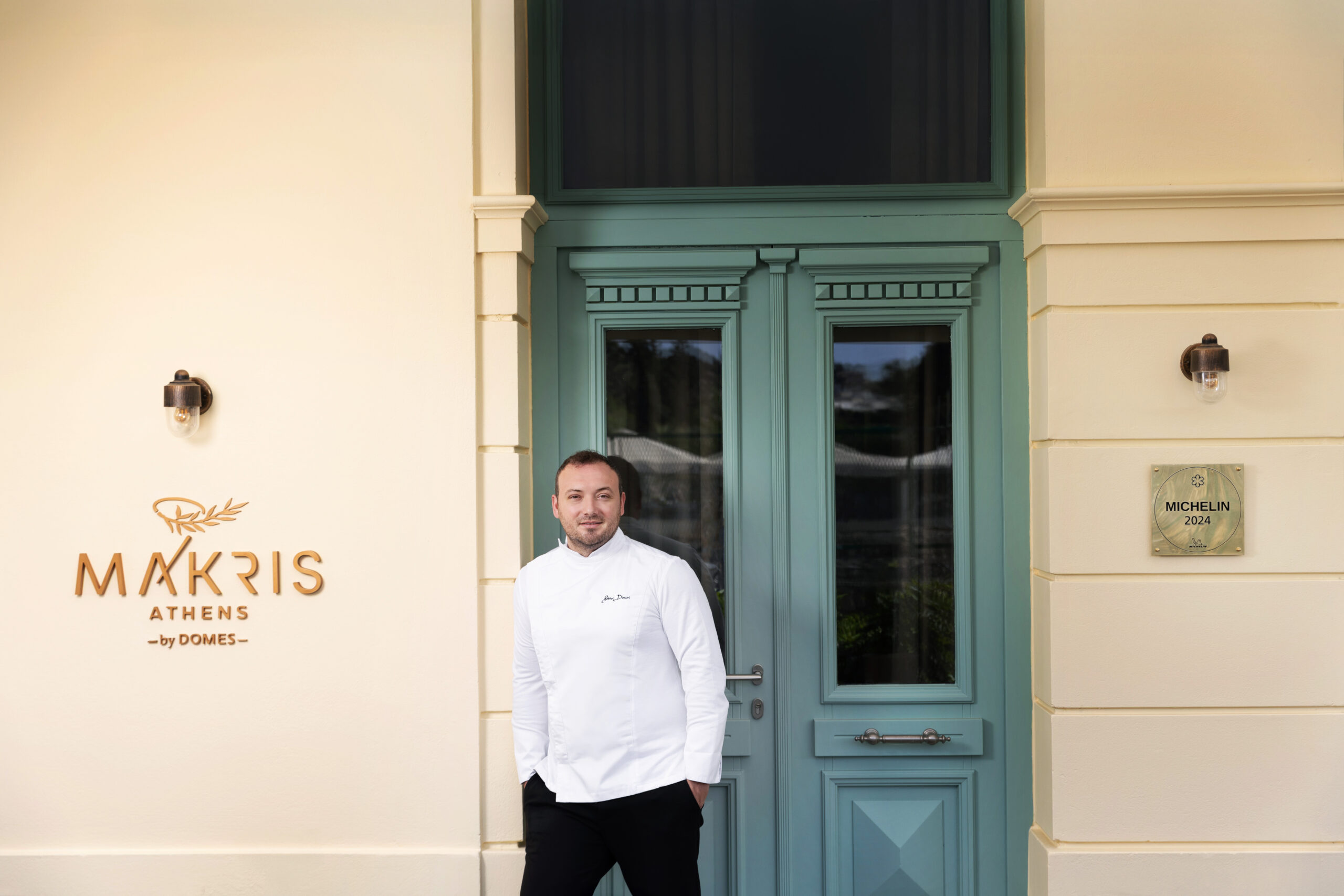
In the Thissio neighborhood, one of the most evocative corners of the Greek capital, this Michelin-starred restaurant offers a culinary experience that connects past and present. From their tables, the gaze is naturally directed towards the Acropolis as the gastronomic tour reveals the richness of Greek ingredients through a contemporary interpretation.
The person responsible for this proposal is chef Petros Dimas, who has built a culinary identity based on technical precision and an intimate relationship with the origin of the products. His cuisine unfolds like a story that explores seasonality, the Mediterranean landscape and the agricultural memory of Greece.
Each tasting menu is presented as a carefully thought-out sequence in which aromatic herbs, organic vegetables and local products take center stage. The result is an elegant cuisine that seeks to clearly express the personality of each ingredient.
The chef’s career reveals the origin of that sensitivity. Petros Dimas was born in the north of Epirus and moved to Athens when he was very young with his family. The capital became the daily scene of his growth, although much of his relationship with food developed in another environment.
The family owned a farm in the region of ancient Corinth. That rural landscape deeply marked his childhood. There he learned to recognize the aromas of fresh herbs, the intensity of freshly harvested vegetables and the rhythm of the seasons. That closeness to the land became over time one of the pillars of his culinary philosophy.
His interest in gastronomy led him to train at the LE MONDE Hospitality and Tourism Institute in Athens. That academic period represented the starting point of a career that would lead him to work in some of the most prestigious kitchens in Europe.
His first professional steps included experiences in influential restaurants within Greece such as Varoulko Seaside and Hytra Restaurant and Bar of the Onassis Foundation. He later took on responsibilities at The Dalliance House before moving to the UK to continue its development.
London expanded its culinary perspective. There he joined the team at Pollen Street Social in Mayfair and later worked at Aquavit in St. James’s. The next stage took him to Switzerland, where he served as sous chef at Kings Social House within the historic Badrutt’s Palace Hotel in St. Moritz.
The meeting with Domes Resorts & Reserves would mark a decisive moment in his career. Dr. George Spanos, executive director of the group, sought to promote a gastronomic project that reflected a contemporary vision of Greek cuisine. Dimas was chosen to lead that concept under the name Makris.
The first restaurant opened in Corfu in 2018 and quickly achieved recognition. Over time the project expanded to other locations of the group, including Crete and Milos. Finally, the proposal reached Athens, where it found an ideal setting to consolidate its identity.
Makris Athens by Domes opened its doors in the historic heart of the city and earned a Michelin star in its first year, a recognition that confirmed the impact of its culinary approach.
When the chef remembers the origins of his relationship with cooking, he inevitably returns to the land of his childhood. «I was born in northern Epirus, but when I was two years old I moved to the capital with my family. I grew up in Athens, but my family’s roots and much of my childhood were closely linked to the land we owned in ancient Corinth. My parents had a small organic farm there, and many of the ingredients we cooked with came directly from that land. As a child, you don’t realize how formative those experiences are, the aroma of the herbs after the rain, the rhythm of the harvest, the simplicity of the vegetables picked just a few hours before. Today, that relationship with the land is the basis of my cooking. Even at Makris, many ingredients come from that same farm.”
The link between the rural landscape and urban life continues to be present in their way of cooking. «There is a constant convergence. Corinth gave me an instinctive understanding of ingredients, seasonality, patience and humility towards nature. Athens gave me perspective, energy and a sense of cultural continuity. When I cook, the countryside speaks through the ingredient itself, the tomato, the herb, the olive oil. But the city influences how that ingredient is interpreted, refined and presented. Athens is full of history and ideas, so it encourages me to look at tradition from a contemporary perspective, experimenting with organic and quality ingredients the ones I grew up with.”
Cuisine as an interpretation of the territory
Petros Dimas’ culinary approach is based on a direct relationship with the origin of food. For the chef, understanding the history of each product transforms the way he cooks. «It happens the moment you understand its origin. When you know the farmer, when you know the land, when you know how the climate affected that crop, suddenly it’s no longer anonymous. At that moment, it carries responsibility. You feel that the chef’s role is not to master the ingredient, but to reveal it. That’s when cooking becomes a narrative and sometimes even an ethical decision.»
The Greek capital also influences the way it interprets its culinary heritage. «Athens is a lively and energetic city. For me, the mistake would be to try to recreate the past exactly as it was. Instead, I try to capture the essence of Greek ingredients and culture, but express them through contemporary thought and technique.»
The recent evolution of Hellenic gastronomy combines introspection and openness to the world. «I think it’s about achieving both simultaneously. I think for many years, it was often reduced to a few familiar dishes. Now chefs are rediscovering the depth of our ingredients, nutrition and traditions, while communicating them in a way the world can understand. What’s important is authenticity, if you stay true to your product and your identity, translation happens naturally.»
Working closely with producers has also changed their perception of control within the kitchen. «It teaches humility. Nature is not predictable, and that is precisely what makes cooking exciting. A chef can control technique and precision, but the ingredient comes with its own personality. Accepting that reality allows you to cook with more sensitivity.»
In his reflection on Greek tradition the concept of balance frequently appears. «The most important idea is balance, the relationship between ingredients, harmony between flavors and respect for natural products. Ancient Greek cuisine valued simplicity and clarity. Those principles are surprisingly modern.»
Technique occupies a specific place within that culinary philosophy. «The technique must be invisible. If the diner focuses more on the technique than the ingredient, then something has gone wrong. Technique is simply a language that allows the ingredient to speak more clearly.»
Among the products that he considers especially valuable, he mentions some herbs characteristic of the Greek landscape. «The Greek herbs are extraordinary and not yet fully explored, wild oregano, mountain thyme and marjoram. In addition, a wide variety of vegetables are grown on small farms around Attica. These ingredients have an incredible aromatic complexity.»
Environmental changes also influence your vision of the gastronomic future. «Climate change forces us to rethink agriculture and sustainability. Chefs must collaborate even more closely with producers and adapt to new realities, different harvest times, different varieties. I believe that the future of Greek gastronomy depends on the protection of the land and the biodiversity that defines our cuisine.»
The culinary experience can excite people of any culture when authenticity remains intact. «A diner may not know the exact memory of an ingredient, but they can still feel its authenticity. The emotion in food is universal. The details of the story may be local, but the experience of flavor, generosity and hospitality can be understood anywhere.»
By the time the dish reaches the table, the main objective remains clear. «A feeling of honesty. Whether it becomes an emotion, a memory or simply pleasure depends on the diner. But I hope that the ingredient itself continues to be the protagonist.»
His reflection on gastronomic luxury is also based on transparency. «Totally. True luxury today is transparency, knowing where the ingredients come from, respecting them and presenting them with integrity. Especially in Greece, where the land is so generous, authenticity is more powerful than extravagance. But also in the restaurant itself, I usually invite my diners to eat comfortably, to touch the plates and eat some snacks with their hands. Luxury should be comfort, otherwise it loses its meaning.»
When thinking about the future, imagine a Greek gastronomy capable of occupying a prominent place on the international scene. «I would like Greek cuisine to demonstrate that a country with such a deep history can continue to be innovative and not be left behind. Greece has an extraordinary biodiversity, cultural heritage and culinary philosophy. If we respect those roots and continue to evolve, Greek gastronomy can become one of the most important voices in contemporary cuisine.»
Discover more from LatamNoticias
Subscribe to get the latest posts sent to your email.