

He March 24 It is shaping up to be a day of high political tension after it became known that the national government is preparing a series of digital content aimed at installing a message of «closure and reconciliation.» As it turned out, the official strategy consists of the dissemination of audiovisual pieces that show dialogues between children of soldiers and children of militants, an initiative that seeks to shift the axis of Memory, Truth and Justice towards a position that its detractors describe as denialist.
The “possible dialogue” strategy
The intervention, coordinated by the Presidency’s communication teams, would resume the logic of previous years but with a twist towards the idea of »moving towards the future.» On this occasion, the dissemination of two central videos is expected that, far from condemning the institutional breakdown of 1976, will attempt to equate the experiences of the victims of State terrorism with those of the families of military personnel, proclaiming a kind of harmony based on oblivion.
This communication line is not new: in 2024, testimonies had already been included that sought to classify the actions of guerrilla organizations as crimes against humanity, while in 2025 the narrative was delegated to figures from ultra-conservative sectors. For this round anniversary, the Government is betting on a choral aesthetic to soften a message that, deep down, questions the democratic consensus built since 1983.
Crisis in the Undersecretary of Human Rights
The internal climate in the Ministry of Justice adds another layer of complexity to this March 24. Minister Juan Bautista Mahiques faces difficulties in finding a replacement for the current Undersecretary of Human Rights, Joaquín Mogaburu. Official sources indicate that the vacancy has become difficult to fill due to the political cost of managing an area that has been dehierarchized and that holds openly critical positions towards traditional human rights organizations.
Despite the attempts of Javier Milei’s administration to «close» this chapter of history, the figures from the Argentine Justice Department are conclusive: since 2006, more than 1,200 convictions have been handed down for crimes against humanity and there are currently twelve oral proceedings underway.
A massive response in the streets
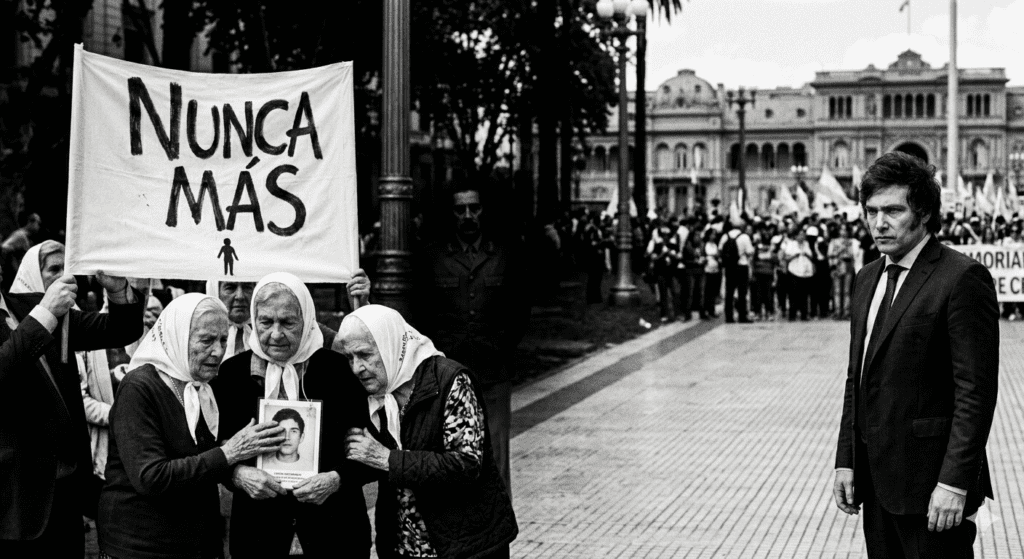
Faced with the provocations of the official story, it is expected that the marches towards Plaza de Mayo and other parts of the country will be massive. Human rights organizations, unions and social movements have called under the historical slogan of «Never Again», reaffirming that memory cannot be the subject of decrees or campaign videos.
While the Casa Rosada seeks to impose a «reconciliation» by decree, civil society is preparing to respond with a mobilization that promises to mark a milestone half a century after the beginning of the bloodiest dictatorship in Argentina.