

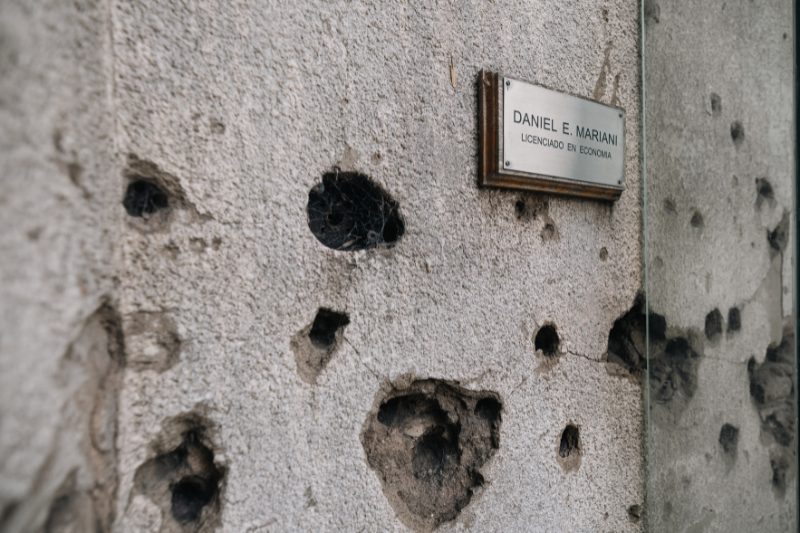
Graciela remembers her years in activism: «Living through the coup of ’76 was terrible. I was 24 years old and at that time I was a member of the PST – Socialist Workers Party – it was my first membership. Although it was a completely legal game, the military came by, shot at the front and well, we had to hide and protect ourselves. We didn’t have to hide, but we still took refuge in the basement of the premises, because otherwise they would kill you».
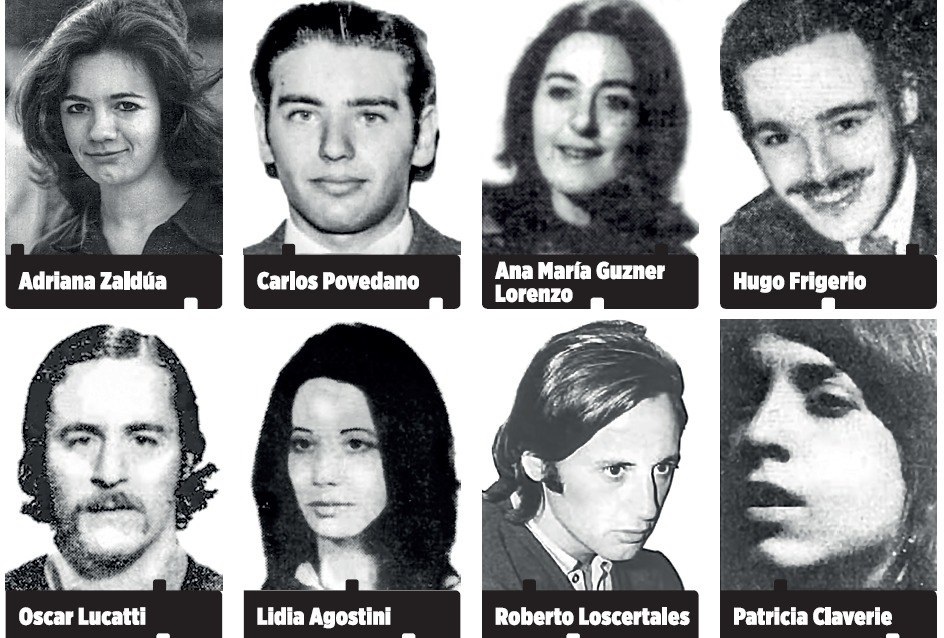
The Socialist Workers Party was a non-guerrilla left-wing political organization. Only in La Plata were they murdered 8 militants in the La Plata Massacre carried out in 1975 by the Triple A (Argentine Anticommunist Alliance, far-right paramilitary group) under the government of María Estela Martínez de Perón, one year before Jorge Rafael Videla’s coup on March 24, 1976.
His house was close to the 7th Infantry Regiment (located in Plaza Malvinas), and «There were shootings almost every night towards the regiment’s guard, and the regiment in turn repelled. And since in my house all the rooms faced the street except the largest bathroom, the whole family had to ground themselves in that bathroom. Inclusive A shot hit the back of my parents’ double bed.For example».
« After the shootings of the Regiment guard, they went out to search all the houses in the neighborhood, which although they knew the neighbors (because they had been neighbors for many years), they also searched. And there too We had to ground ourselves, allow them entry and so on. »
It is important to remember that said regiment had a crucial role in the coordination of repressive policies in the city of La Plata, developed in close connection with clandestine detention centers «La Cacha«, «Eighth Police Station«, «1 y 60«, and the Penitentiary Unit 9.
Furthermore, the Regiment participated in the November 1976 attacks on three homes of Montoneros militants, located on streets 63, 139 and 30, and the military unit also provided large-caliber weapons used in the attacks, where several people were murdered and minors were kidnapped. Nicolas Berardi y Clara Anahí Mariani Teruggi.
It was also used as a birthplace on the forged certificates of the appropriated grandchildren. Sebastian Casado Tasca y Silvia Cugura Casadowhose mothers were detained and then disappeared in «La Cacha.»
Civilian hunt
Even doing everyday activities was always a risk. «To go by bus, of course it was impossible to forget your ID, because if you didn’t have it you would be suspicious. «They would stop you, the soldiers would get on the bus and search it.»
« You were walking and military forces suddenly appeared from behind the trees, with weapons in hand, also while you were calmly walking along the path. they made you put your hands on the wall to check you »
In his story, one can perceive the misrepresentation by the military of many situations through discursive means, in order to justify their actions: «You were walking down the street and you came across what the forces called a «confrontation» that was actually a chase, and They carried out shootings in the middle of the street those they had already marked, generally young people, and they did it there for everyone to see, in the light of day.
«One had to protect oneself in a hallway or somewhere to avoid being shot. You couldn’t walk past a police station on the sidewalk; some put up a fence»
« If the police station told you to stop, you had to stop. A neighbor was returning from a birthday with his 10-year-old daughter and a piece of cake in his car. He had the windows down, he was shot because he didn’t obey the «stop» and the car fell right on the sidewalk of my house: they killed him »
Family traditions and celebrations were also monitored and controlled by the militias. «If you wanted to celebrate a birthday, they did not allow a gathering of more than five people, which reminds me of Patricia Bullrich who also ordered the same thing in Mauricio Macri’s government. You had to notify the nearest police station where the celebration was going to be».
Fahrenheit 451
The authoritarian measures were not only applied to the actions of the civilian population, but the circulation of any bibliographic, journalistic or artistic material that implied a challenge to the regime was also controlled.
«In the houses, books, magazines, everything that the dictatorship considered could be »dangerous» were burned. For example, the socialist newspaper La Vanguardia, which was an old newspaper that many university students from the time of ’45 collected. All that literature had to be burned because
« If they found you any book that they considered could be suspicious, they stopped you »
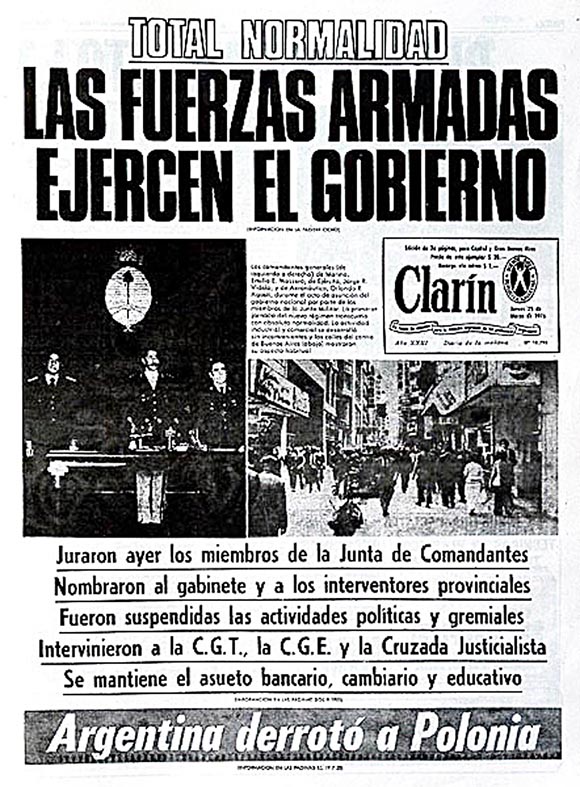
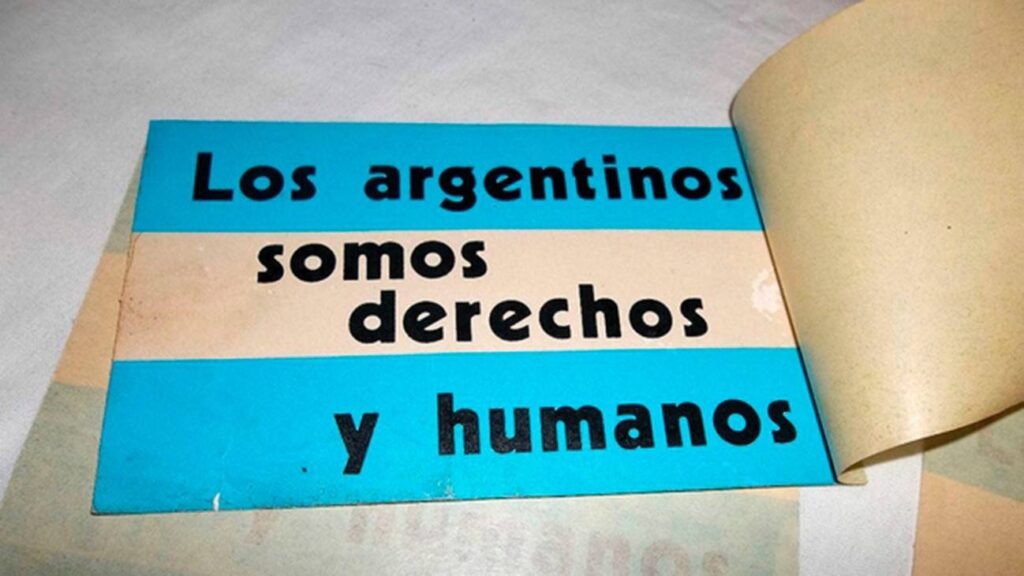
As for the media, these were «totally related. There was talk that it was a «national reorganization», there was talk of «subversives», «terrorists», that in Argentina we were «right and human», this publicity was made especially with the ’78 World Cup. They also said that the missing people were walking around Europe».
The health field was not exempt from risks: «There you found out that a psychologist or a gynecologist had been kidnapped, simply for treating women belonging to the revolutionary movements who needed medical attention and they kidnapped the professional who treated them, simply to spread fear.».
When we asked him about the disappearance of family members or acquaintances, he stated that «Personally, I do not have direct relatives who are missing, but I do have colleagues, one from the PST. They were people who were simply militant, did not belong to any armed movement», referring to the persecution of civilians that did not imply a factual threat.
Fear, a habit
Regarding her general perception of the blow, Graciela states that lived in fear. «Fear for friends, fellow activists, classmates, workers, the workers who were so decimated, the issue of the Malvinas, for the boys who went to fight, in short, fear encompassed everything. But one had to continue with daily life, either working or studying.»
« My family told me to take care of myself, because well, Young people at that time never thought that the dictatorship would reach this point.. And the older people, who have had more experience and who have lived through other repressive governments, advised us in that way. »
The number of missing persons during the last dictatorship continues to be a topic of debate, since in fact the murders and kidnapping of militants and civilians were state crimes that were not usually documented or registered. Graciela firmly maintains that «Not only were there 30,000 missing: To that figure we must add 50,000 deaths. There are 30,000 missing and 50,000 dead».
This figure may be possible taking into account that graves with bodies of murdered civilians continue to be found, such as recent discovery of 12 corpses in the former Clandestine Detention and Torture Center of La Perla, province of Córdoba.
Can democracy and neoliberalism coexist?
For Graciela the return of democracy and the election of Raúl Alfonsín «It was a joy in the heart. Returning to the democratic system, with all its defects, but with a leader like Alfonsín was an impressive joy for all the people, a liberation. It was breathing again, being able to raise my head again, look at the sun, hope. After having gone through a dictatorship, it was enormous happiness.»
Drawing a parallel between the ’76 coup and current Argentine democracy, the interviewee affirms that «Currently the Armed Forces are not needed, Today we have another type of totalitarianism and absolutism that comes from the government.
In the present The Armed Forces do not have to intervene, except of course the police forces of repression for demonstrations against the economic measures that Milei takes, as is the case with retirees, with the repression of the disabled when they go out to protest and against anyone who demonstrates.
Today is another model by which the right is imposed: it is imposed with the external debt, with all the economic measures, with deindustrialization, with the financial cycle, with the loss of employment, with repression, with arbitrary arrests, but all of these are political decisions of the government.
Of course, there is persecution of opponents, poverty and social inequality increased, there is a dismantling of the State, all of this is the same as in the dictatorship, but instead of using the Armed Forces, directly they do it through politics.»
For Graciela «Neoliberal democracy is not democracy, because financial and corporate power is once again concentrated in a few hands.
So, a democracy governed by a neoliberal political and economic project is not democratic, and we are living and suffering from it.»
« You cannot be neoliberal and democratic, because concentration of power leads to totalitarian government »
The democratic system has to guarantee many human rights, not only the right to vote. And the only thing this democracy did is guarantee to go once every four years to put a vote in the ballot box. It is the only right that guarantees you, but all other rights are not guaranteed by this democracy. So it’s not.»
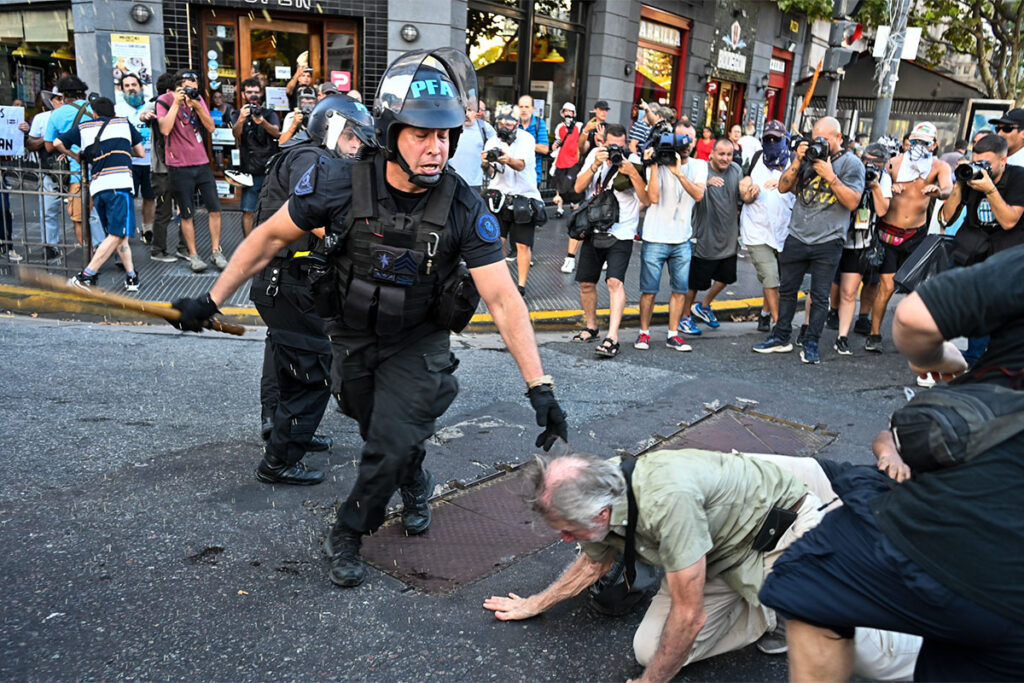
Individualism, media power and fragmentation
«Another difference that I notice is that at that time there was a social sensitivity that has been lost today: even if one was well, one worried about those who were not well, but that has been broken.
Even in the way we protest and try to defend our acquired rights, we do it separately. The retirees on the one hand, the disabled on the other: that support network over the years caused it to crack.
Currently the People have no interest in politics, I don’t see mental maturation. There was no longer any discussion or discernment about reality. There is no active subject as it was in the 70’s, Today we are manipulated by the media.»
« I regret that so much effort from an entire generation like that of the 70’s is overshadowed. But progress is being made »
His message to young people is that «positive results are achieved collectively. “Humanity has had many crises and has always come out ahead.”