

Our Back Pages / May 28, 2026
A look back through The Nation’s coverage of Frank’s long and storied political career suggests the late congressman was always a man containing multitudes.
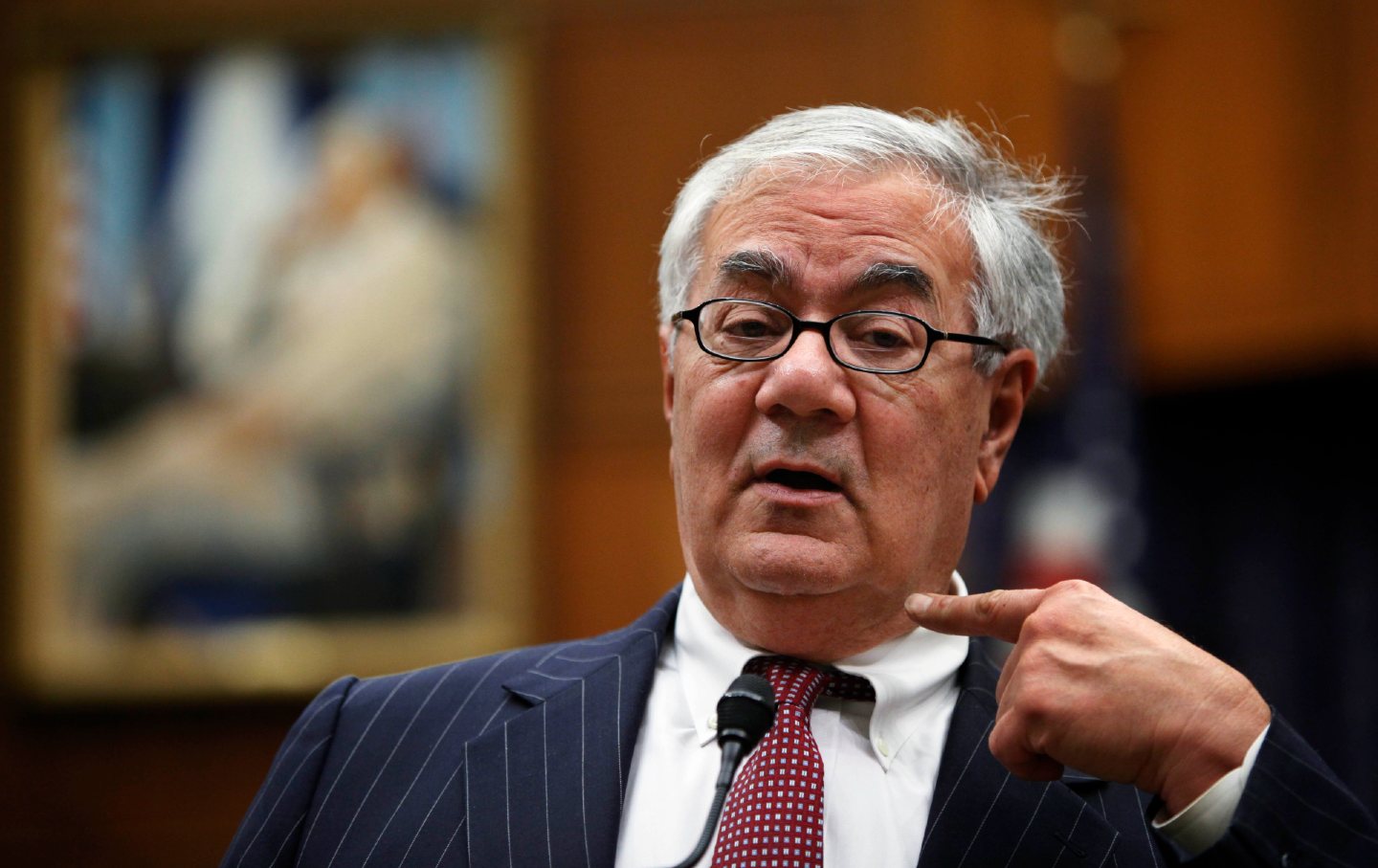
Former Massachusetts representative Barney Frank gestures during a news conference on Capitol Hill in Washington on January 13, 2010,
(Manuel Balce Ceneta / AP Photo)
Former Massachusetts representative Barney Frank died this month at the age of 86. Most obituaries have emphasized Frank’s pioneering role as an openly gay politician first, and his legislative accomplishments second, among them the 2010 Dodd-Frank financial reform package, a valiant if imperfect effort to root out the abuses that had led to the financial crisis of 2008. Even from his hospice bed, Frank continued to dole out advice to Democrats. Mystified as to why his own preferred candidate for Senate in Maine, Governor Janet Mills, lost out to the insurgent outsider Graham Platner, Frank criticized the progressive left for combining a critique of economic inequality with an impolitic emphasis on “racial and cultural things.” A look back through The Nation’s coverage of Frank’s long and storied political career—admiring, at times sympathetic, but far from uncritical—suggests the late congressman was always a man containing multitudes; a brilliant, brash politician whose famous wit could be directed both at the left and the right.
In 1987, Frank called up a reporter from The Boston Globe and asked her to visit his office with no stated purpose. During the interview, Frank did something that at the time was still unthinkable: he told the reporter he was gay. (The cartoonist Eric Orner depicted the scene in his 2022 graphic biography of Frank, Smahtguy, excerpted in The Nation.)
“To anyone who’s been around Capitol Hill for more than a month,” the late journalist Nicholas von Hoffman wrote in The Nation at the time, “the news came as one of the year’s biggest unsurprises.”
Frank, von Hoffman observed, was “one of the smartest men in national politics.” He had seen how reports of an extramarital affair had doomed Democratic Senator Gary Hart’s bid for the party’s 1988 presidential nomination. Frank wanted to avoid something similar happening to him, so he got out in front of it before one of those news organizations von Hoffman called the “gonad-seeking practitioners of sex-snoop journalism” outed him. The rules had changed: Politicians’ private sex lives were now fair game. Frank wanted to control the narrative.
As Frank’s career continued, he became an occasional contributor to The Nation, starting with a letter to the editor in August 2000. The progressive left at the time was torn between supporters of Ralph Nader’s Green Party bid for the presidency and nose-holding voters for Al Gore. A Gore supporter, Frank took issue with a Nation article that quotes Nader dismissing the severe consequences that a George W. Bush presidency would have on social issues. Frank wrote that Nader had “never in his career paid any attention to the abortion or gay rights issues.”
Current Issue

Frank was early to spot some of the key contradictions and hypocrisies in American life that have come to structure the very reality we live in, and he was a rare sitting legislator unafraid to name them. In 2006, he wrote in The Nation that he was skeptical of Democrats who wanted to change the focus of the party’s critique of Bush from specific areas of policy disagreement, like the destructive and illegal war in Iraq and worsening economic inequality, to more abstract charges that the administration harbored secret plans to overthrow democracy in America. Words like “authoritarianism” should not be “thrown around” or “used lightly,” Frank argued, seemingly anticipating the fascism debate that has divided the left in the Trump era.
Yet Frank argued that while the United States under Bush remained a democracy, it was clearly in the process of a significant transition. Some of the fundamental pillars of the constitutional order were being eroded by aggressive executive-branch overreach. Frank argued that the country was turning into what scholars call a “plebiscitary democracy,” one in which “a leader is elected but once elected has almost all of the power.” Congressional Republicans seemed remarkably eager to give up their own powers in deference to a president claiming effectively limitless authority to do what he wanted. “Never in American history has Congress been so willing to give away its constitutional function,” Frank wrote.
I am not charging authoritarianism. It still is a free country, and I encourage people to use that freedom and to be critical and to organize. But we are still talking about a very, very different mode of governance, the mode of governance in which, instead of the checks and balances and the collaboration and the input of a lot of people, you get one man making the decisions…. What we have is an Administration that is radically trying to change the nature of our democracy.
In March 2009, at the dawn of the Obama presidency, when Republicans hypocritically began calling for budget cuts after years of giving Bush blank checks to fight wars on abstract nouns, Frank sarcastically proposed that anyone who called for budget restraint be required to also mention out-of-control military spending. Even liberal and progressive institutions sometimes called for reining in social spending like Medicare and Social Security, while refusing, Frank noted, to “talk about one area where substantial budget reductions would have the doubly beneficial effect of cutting the deficit and diminishing expenditures that often do more harm than good.” In his Nation editorial, Frank condemned what he called a “weaponized Keynesianism that says military spending is important because it provides jobs and boosts the economy.”
There was always money available for a new war, Frank observed—but never for new programs to guarantee healthcare to all: “If we do not reduce the military budget, either we accustom ourselves to unending and increasing budget deficits, or we do severe harm to our ability to improve the quality of our lives through sensible public policy.” Somehow, in their infinite wisdom, American policymakers in the years since have elected to do both.
Soon after drafting and passing the Dodd-Frank financial reform package in 2010, Frank decided not to seek reelection to Congress in 2012. At the time, The Nation’s John Nichols called Frank “not a perfect progressive on every issue but a steady liberal.” He noted that Frank’s signature bill “pulled punches that should have been thrown at the big banks and the Wall Street speculators.”
Popular
“swipe left below to view more authors”Swipe →
Longtime Nation contributor Jon Wiener emphasized the point in 2015, taking Frank to task for an episode the retired congressman described in his memoir as the “stupidest” decision he ever made. The year was 1966. Frank was a student leader at Harvard’s Kennedy School when he invited defense secretary Robert McNamara to speak on campus. At the time, Wiener was a member of the Harvard chapter of Students for a Democratic Society, which protested McNamara’s appearance. Wiener wrote that Frank’s account of the episode left a lot out, such as that the student protesters wanted McNamara to debate an anti-war activist publicly rather than speak only to a select group of students in private.
Frank wrote admiringly in his memoir about McNamara’s composure when he was surrounded by student protesters. He even praised students who initiated a petition to apologize to McNamara for his treatment on campus—rather than the students who protested McNamara’s senseless, destructive war. In concluding that the rowdy student protesters had hurt the Democratic Party in the 1966 midterm elections and thereby “opened the door to Nixon,” Frank took exactly the wrong lesson from the incident, Wiener argued: “Barney Frank is wrong about the ‘stupidest’ thing he did. It wasn’t bringing McNamara to Harvard—it was his failure to join the movement calling for an end to the Vietnam War.”
Frank’s record, then, is one of a man who understood power clearly: how it worked, who had it, who was lying about it. But Frank was sometimes less reliable when it came to solidarity with the people who were trying to challenge power. He saw the abuses of the Bush years with unsparing clarity, named Wall Street’s pathologies and depredations with rare acuity, and came out as gay in an era when doing so took genuine courage. But when protesters surrounded McNamara’s car, Frank wanted them to apologize. That instinct to protect established institutions even as he criticized them runs through his career and still defines the Democratic Party he proudly served for decades.
Your support makes stories like this possible
From illegal war on Iran to an inhumane fuel blockade of Cuba, from AI weapons to crypto corruption, this is a time of staggering chaos, cruelty, and violence.
Unlike other publications that parrot the views of authoritarians, billionaires, and corporations, The Nation publishes stories that hold the powerful to account and center the communities too often denied a voice in the national media—stories like the one you’ve just read.
Each day, our journalism cuts through lies and distortions, contextualizes the developments reshaping politics around the globe, and advances progressive ideas that oxygenate our movements and instigate change in the halls of power.
This independent journalism is only possible with the support of our readers. If you want to see more urgent coverage like this, please donate to The Nation today.