

Granting the hard-right jurist power over choosing a successor is a democratic disaster—and a far cry from John Roberts’s fanciful claims of nonpartisanship.
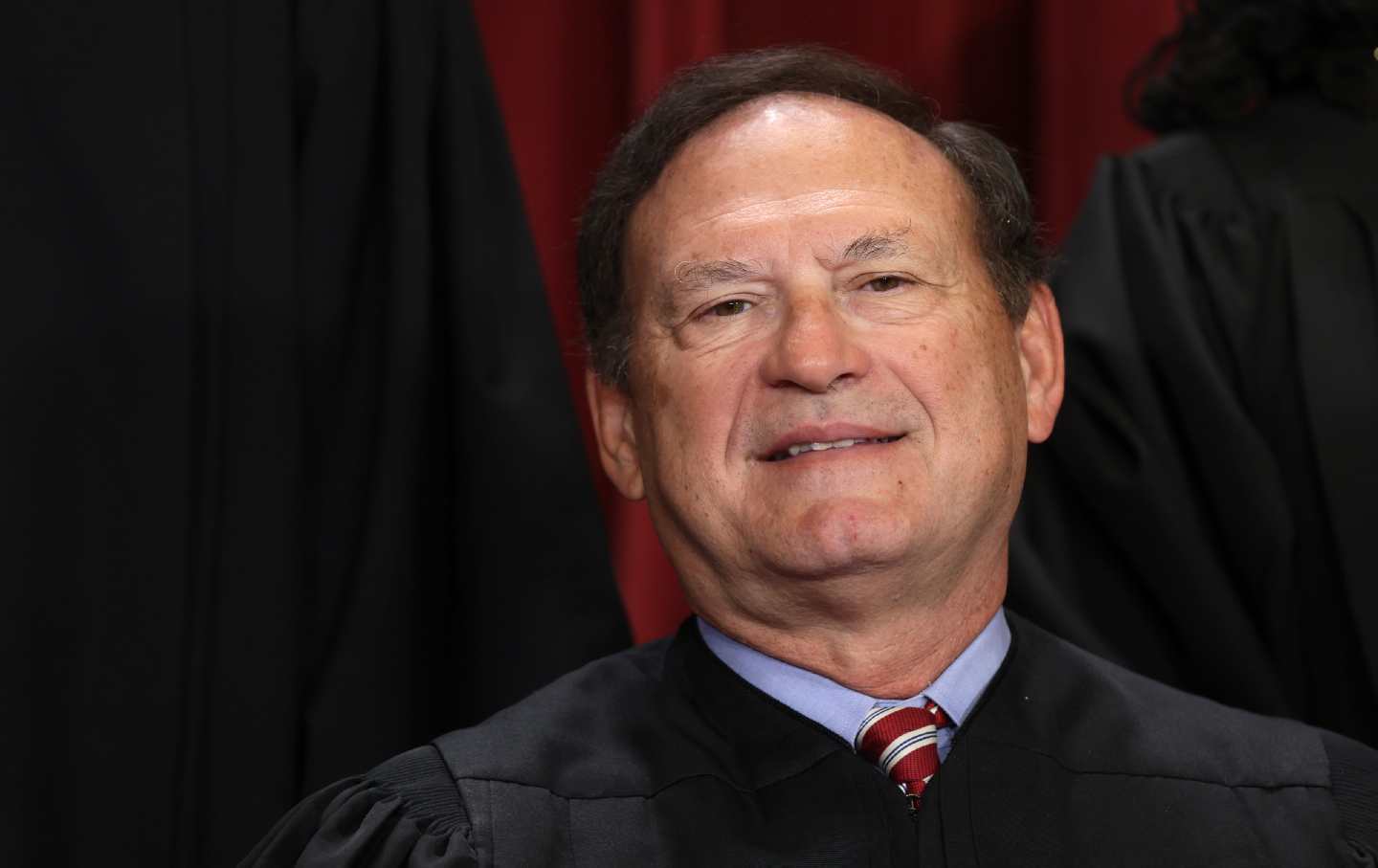
Associate Supreme Court Justice Samuel Alito
(Alex Wong / Getty Images)
Samuel Alito almost certainly does not want to leave the Supreme Court now.
The 76-year-old jurist sits at the apex of his power, the muscular force behind a 6–3 GOP supermajority. He has been a pivotal senior voice in a right-wing court that has all but abandoned John Roberts’s patient incrementalism and pushed the nation sharply to the right on abortion, immigration, race, and voting rights while stripping independent agencies of regulatory power. If Republicans hold the House this fall, it will be thanks to court-sanctioned gerrymanders that have eviscerated Black representation across the South. And if Democrats manage to retake power in Washington this November and beyond, the precedents Alito has crafted, sometimes from whole cloth, will dramatically limit their agenda.
Throughout this constitutional transformation, Roberts and his colleagues have sung the same refrain: The court is not political. The justices are not politicians in robes. They simply apply law.
Yet now, as a term that has demonstrated the court’s centrality to the Republican political project approaches its end, attention has turned to a question that strips any remaining pretense of judicial neutrality away. It’s this: Whether Alito will strategically step aside, perhaps as soon as this week, while Republicans still control the White House and Senate. (Those close to Alito noted that he has hired clerks for the next term—but so did Anthony Kennedy before he passed the baton to Brett Kavanaugh.)
After all, Supreme Court justices do not merely wield extraordinary power for life. They also possess a capacity that no elected official enjoys: They alone decide not only how long they serve but also when a fellow traveler who shares their philosophy has the best chance of inheriting their office.
This is a strange way for a democracy to allocate power. Yet everyone understands the stakes and consequences so clearly that it scarcely seems controversial at all. Supreme Court retirements have become a morbid blend of constitutional hardball and actuarial risk management. Justices balance ambition against mortality and Senate election forecasts. At the end of their lifetime appointments, they know all too well that a mistimed retirement can reshape constitutional law for a generation.
Current Issue

Few willingly relinquish this kind of power. Yet the conservative legal movement has also spent decades strategically passing ultimate judicial authority down to ever-younger and reliably ideological Republicans. Even if the justices view themselves as irreplaceable, the GOP appointees understand that they will be replaced. The important question is by whom.
That we all know this, and that the justices so clearly play this game, should be enough to permanently end the fiction that this is a court of law that stands outside politics.
Whether Alito leaves this week, or white-knuckles it through election night returns from Texas, Maine, and North Carolina, he will almost certainly work to time his departure for maximal ideological impact. He’s sure to do his utmost to ensure that he’s replaced by one of the young Federalist Society firebrands auditioning for the next opening. Such carefully calibrated strategic retirements reveal what the justices understand about the court’s institutional power and how they seek to maintain it.
After all, it has been more than three decades since a justice voluntarily left the court knowing that a president from the opposing party would almost certainly choose the replacement. Every justice appointed since Clarence Thomas in 1991 who has chosen to step down has timed their departure to allow a president of the same party to name his or her successor.
Otherwise, the last example is Thurgood Marshall, whose failing health forced him to relinquish his seat on the court in 1991. (He lived five days into Bill Clinton’s first term.) George H. W. Bush replaced the liberal giant with Thomas, one of the most conservative justices in modern history.
No justice since has been eager to repeat that lesson. Each of the nine seats is far too important. “Tell me who the president could have nominated this spring that you would rather see on the court than me,” Ruth Bader Ginsburg demanded in 2014, when Democrats controlled the Senate and White House.
History supplied a brutal answer. When Ginsburg died six years later, with early voting in the 2020 election under way, Republicans filled her seat with Amy Coney Barrett, cementing the conservative supermajority that has transformed American constitutional law and life. Any younger liberal jurist would have preserved Ginsburg’s vision—and Roe v Wade.
In our acutely polarized legal politics, the indispensable asset is never the justice. It is the seat.
That is a remarkable way to think about a constitutional office. No elected official possesses this kind of power. No other democracy allows Supreme Court seats to be passed from one generation of a political movement to the next.
Popular
“swipe left below to view more authors”Swipe →
And for good reason. This strategic banking of high-court vacancies encourages behavior that can’t possibly be explained away as apolitical. Every retirement becomes an exercise in succession planning. The Constitution, and the nation, shifts dramatically based on something as random as whether Marshall hung onto his seat another 15 months, or whether Ginsburg lived another 16 weeks.
The problem is far bigger than Alito. Given these incentives, a strategically timed retirement makes perfect sense. The real fault here lies with a system that allows justices to think like party and movement leaders while demanding that the public pretend they are neutral umpires.
Roberts continues to argue that outside criticism has politicized the court. He has the story backwards. The court’s own behavior has done that. Life tenure, immense policymaking authority, and the ability to determine the political conditions under which a successor is chosen have combined to make each justice a steward of an ideological inheritance stretching across decades. Trump’s term will end in January 2029. The conservative supermajority could last 30 more years, if not longer.
It’s dangerous enough that the high court has been captured by an unelected supermajority. Five decades of shrewd conservative organizing have produced six justices with extraordinary authority over American life. They have used that power to reshape the law in ways that elected majorities will not readily reverse. But no nine people, of either party, should hold this kind of veto-proof, extra-legislative authority for life, and then be allowed to choose who replaces them.
Congress can and must fix this. Simple reforms that majorities of Americans support, such as 18-year terms, a mandatory retirement age, and two appointments for each president would eliminate much of the gamesmanship that surrounds every Supreme Court vacancy. Court reform isn’t fundamentally about partisanship. It’s also about ending a system that allows justices to perpetuate partisan control through strategic succession.
Chief Justice Roberts wants Americans to believe that the Supreme Court stands apart from politics. But when one of the defining questions at the close of every term is whether a justice will strategically time his retirement to preserve an ideological majority, it’s clear that the court has already overruled that verdict.
Support The Nation’s June Fundraising Campaign
With the midterm elections now firmly upon us, the question is whether Democratic candidates will do more than merely occupy ballot lines as mild alternatives to the red-hot crisis that is Donald Trump.
As Trump spends over $1 billion a day on a globally destabilizing war on Iran and admits that he doesn’t “think about Americans’ financial situation,” millions across the country are struggling with the surging costs of essentials. Democrats must seize this moment and advance bold, small-“d” populist ideas—not settle for cynical caution that once again snatches defeat from the jaws of victory.
The Nation elevates progressive ideas, movements, and elected officials achieving real change across the country into the national conversation. At the same time, our journalists are exposing how crypto and AI-funded super PACs are spending hundreds of millions of dollars to knock out candidates they oppose, reporting on the devastating impact of the Supreme Court’s evisceration of the Voting Rights Act, and sounding the alarm on attempts by red states to quickly redraw electoral maps, disenfranchising Southern Black voters.
We can play this critical role because of support from readers like you. This June, we’re raising $20,000 to power The Nation’s independent journalism in the run-up to November’s immensely consequential elections.
It’s in our power to build a more just society, and your support at this critical moment brings us closer to that bold vision. I hope you’ll donate today.
Onward,
Katrina vanden Heuvel
Editor and Publisher, The Nation
David Daley
David Daley is the author of a national bestseller on partisan gerrymandering, Ratf**ked: Why Your Vote Doesn’t Count and Unrigged: How Americans Are Battling Back to Save Democracy.