
Gen Z is playing an instrumental role in propelling Mamdani, his slate of candidates, and his progressive vision to office.
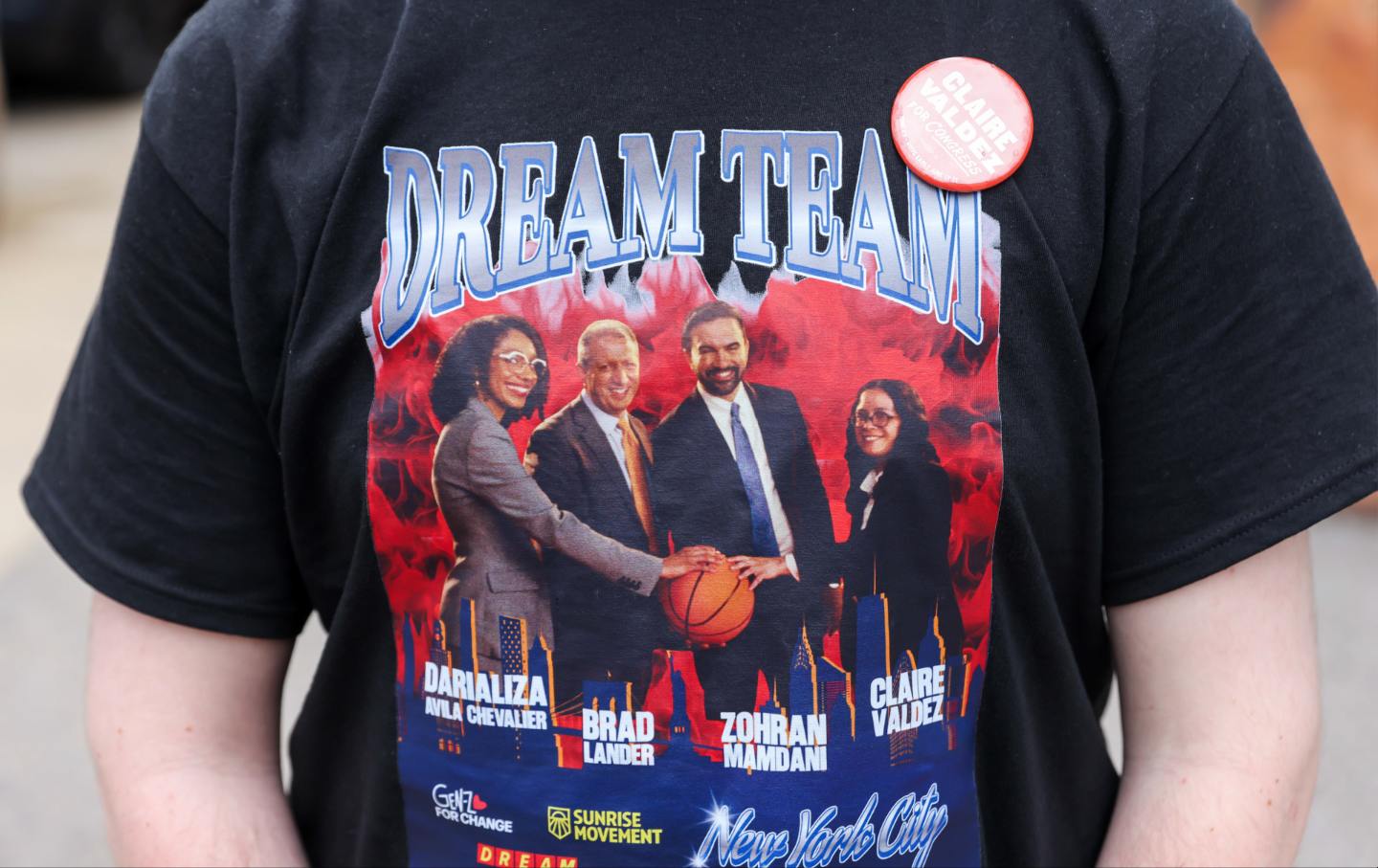
A “Dream Team” shirt featuring images of Democratic House candidate for New York Darializa Avila Chevalier, former New York City comptroller and Democratic House candidate for New York Brad Lander, New York City Mayor Zohran Mamdani, and New York State Representative and US House candidate Claire Valdez, outside a polling location at PS 84 during the primary election in New York City on Tuesday, June 23, 2026.
(Michael Nagle / Bloomberg via Getty Images)
On weekends, the graffitied auto garage-turned-nightclub Silo is packed with boozed-up Brooklynites intent on dancing the night away. But on the Monday before the Democratic congressional primaries, the crowd packed inside the converted hangar was more focused on a slate of progressive candidates winning some tight races.
Awash in neon light, candidates Brad Lander and Claire Valdez each took the stage, urging attendees to tell their communities to vote the next day.
“We have one more day, 6 am to 9 pm; at 9:01, it is too late,” Valdez said. “Until then, we are going to knock on every single door again.”
Hours earlier, Matthew Smith, a student from Fordham University, bounded up the steps to knock on another Upper West Side brownstone in the rain.
“We gotta win this. We gotta power through,” he said.
Current Issue
When the woman inside answered, she politely refuted his spiel. Smith smiled, thanking her, and turned to go back down the steps. When asked if he still gets nervous talking to people about candidates, he admitted, “Yes, every time.”
Smith is one of several students who canvassed for the slate of Democratic socialists who ran for Democratic nominations in congressional districts across New York City. That day, he was canvassing for Darializa Avila Chevalier, who prevailed over incumbent Adriano Espaillat for a seat representing NY-13. The win was shared across the slate of candidates endorsed by Zohran Mamdani, which saw victories for Claire Valdez in NY-7 and Brad Lander in NY-10. For many students who were involved in organizing for Mamdani’s slate, the win signifies the manifestation of their vision for the Democratic Party.
YDSA national co-chair Sara Almosawi, a student at Cornell University who worked on Valdez and Avila Chevalier’s campaigns, joined the organization after graduating from high school. “I felt deeply moved by both of the Bernie Sanders campaigns, and when the DNC forced Bernie to drop out in 2020, I wanted an alternative. I wanted to build something that really represented the politics of working-class people like myself,” said Almosawi.
Several students found their entry into the political left with Zohran Mamdani’s 2025 mayoral election in New York City. “I first volunteered for him because I saw that he represented a campaign, a vision, that resonated with me, which is a working-class-focused vision,” said Fuhad Khan, a City College student working as a field lead for Valdez. Sitting in a corner booth at the dingy Rocka Rolla bar in Williamsburg, Khan’s bright-blue-and-orange Zohran shirt made him hard to miss.
Khan would go on to join the Democratic Socialists of America (DSA), where he became further involved in leftist politics. While Khan “naturally supported any DSA candidates” as a member of the organization, he joined Valdez’s team after receiving a call from her campaign.
Christian Garcia-Castilla, a student at Hunter College, had a similar path into politics. He joined Avila Chevalier’s campaign in February, months after casting his first vote in a New York City election for Mamdani. “I’m really proud of our campaign, how far we’ve gone, and how united we’ve been,” he said.
It comes as no surprise that Mamdani’s bid for mayor had such a galvanizing effect on students like Khan and Garcia-Castilla. His NYCDSA-backed campaign captured a shocking 75 percent of voters ages 18–29, a demographic of which former New York governor Andrew Cuomo garnered only 19 percent.
“The youth vote, I think, was critical, and a lot of analysis has shown that the youth vote is overwhelmingly lent for progressive candidates,” said Leel Dias, a student at Columbia University who worked on Valdez and Avila Chevalier’s campaigns.
Mamdani’s successful campaign was a sign of what was to come in the June primaries. Lorelei Crean, a student who graduated from high school in upper Manhattan in June, canvassed for Avila Chevalier. He said the June sweep “was really a testament to New York City DSA’s increasing political power in New York City, but also the power of the people to fight for progressive causes and candidates that have a new politic.”
“These campaigns, they invite younger people, because the candidates are younger, the messages that they’re conveying are resonating with younger voters because they’re actually focused on delivering for younger people, delivering on things that matter to us, like education, affordability, Palestine,” Fuhad said.
Smith has also seen that because of races like Mamdani’s and Avila Chevalier’s, “a lot more young people are getting involved and they’re finally seeing themselves in an elected official.”
Young people making political waves isn’t new. “Students have always been at the forefront of political fights,” Smith said, referencing Vietnam anti-war protests, South Africa anti-apartheid movements, and recent encampments in support of Palestine.
Students often lead progressive campaigns, he said, adding that the slate’s win required young people leading the way.
“Some of my friends would leave class early just to get to some kind of event, or people who are canvassing in the heat, in the cold…I think from those moments it showed me that obviously some of us, we have a lot to give up,” said Tapuwanashe Hightower, a recent NYU graduate who canvassed for Valdez.
While the DSA has championed the success of Mamdani’s slate, not all progressives are cheering, and criticism of Mamdani’s slate has been concentrated on Avila Chevalier. Within days of the June primaries, Jon Favreau, the former Obama speechwriter who hosts the left-leaning podcast Pod Save America, cautioned against Avila Chevalier, taking issue with her decision not to apologize for attending a pro-Palestinian rally on October 8, 2023, that Mamdani, AOC, and Lander had all condemned at the time. He also condemned her opposition to all deportations in a recent interview. By his account, some of her positions ranged from “moronic to abhorrent.”
Zachary Gross and Sam Verstandig, recent graduates of Yeshiva University and SUNY Empire State College who organized for Espaillat’s campaign against Avila Chevalier, were similarly troubled by Avila Chevalier’s attendance at the rally. Her stance on Israel was a “driving force” for many of the students who volunteered for Espaillat, Verstandig said.
Both students expressed concern over how their interests might be represented by Avila Chevalier in Congress. “Based on the messaging that she’s given, I think she bunches Israel and the Jewish people together,” Gross said. “I hope that her opinions towards Israel don’t make her decide to neglect her constituents who are Jewish.”
The Avila Chevalier and Espaillat campaigns did not respond to requests for comment.
Daniel Marks, a student at King’s College who organized for the Alex Bores campaign in NY-12, which ultimately fell to establishment-backed Micah Lasher, provided a softer critique of Avila Chevalier. “I am very happy to see how she does. I would just like more clarification on her foreign policy stances, especially when it comes to Russia and Ukraine,” Marks said. “I go to school in the UK, and I think NATO is really important, and I think there’s a divide between progressives and socialists where sometimes the further to the left you are, there’s maybe more of an unwillingness to condemn Russia’s invasion in Ukraine.”
“While I do have issues with some of the things Darializa’s said, she is the Democratic nominee, and so it is important we support her,” he added.
Marks does not see the success of Mamdani’s slate as indicative of any enduring shift in the Democratic Party as some of his DSA counterparts do. “We have the tendency to use midterms as political tea leaves,” Marks said. Yet he recognizes that the left flank of the party will be a force to be reckoned with. “I think what it does tell you is the progressive left wing of the party should be taken seriously,” Marks said.
He did, however, raise concern over mounting tension between “moderates and the left wing of the party.”
“We’re getting to this point where it’s really like an internal war between these two sects of the Democratic Party, and that’s becoming a problem when the two groups aren’t willing to support the other,” Marks said.
For several of the students who worked on the Mamdani slate’s primary campaigns, however, that war—pushing the party to align with the DSA—is the Democrats’ only chance to become a more viable party.
“I see the future of the Democratic Party is either a Democratic Socialist Party or an obsolete party that no longer represents the working class, and there will be another party to take its place,” Smith said. “If that is the split of the Democratic Party—if it’s between fighting for working-class people and fighting for the billionaires—the people who are fighting for the billionaires should not be in the party, and let the party split.”
Regardless, students are hoping the success in the primaries extends to the future. “I think that’s the testament to the new wave and the new energy that Democrats really need to harness, especially in these midterms and going into 2028,” Crean said.
Popular
“swipe left below to view more authors”Swipe →
Noah Bernstein, a student at Stony Brook University, said he felt that if the Democratic Party doesn’t put up a progressive for president in 2028, “we either risk losing…or having a worse fascist in 2032.
But before the DSA can think about supporting a presidential candidate in 2028, its candidates will have to prove themselves on the Hill. “The test will be, you know, what happens when they go to Congress—how much are they able to deliver,” Dias said.
On the evening of June 24, students populated election parties across the city and celebrated as their candidates delivered victory speeches. “It was absolutely electric,” Almosawi said. “People that I didn’t even know, I was hugging, I was crying with them, I was screaming with them.”
“The older generation, their time is up. They can only stay in power for so long, and it’s time for young people to take our place,” Smith said. “We have a world to win, and it’s ours to take. We just have to fight to get it, and that’s where the students come in.”
Cate Latimer
Cate Latimer is a 2026 Puffin student writing fellow for The Nation. She is a journalist and documentary filmmaker at Brown University, where she serves as the editor in chief of The Brown Daily Herald.
Paul Hudes
Paul Hudes is a student and writer at Brown University interested in political oddity. He is the senior editor of opinions of The Brown Daily Herald and previously served as a managing editor of the Brown Journal of World Affairs. He writes crossword puzzles.