

Two consulting firms that do not always coincide in their numbers this time arrived at the same place: the industry ended the first semester with a negative sign. The Government has already announced tax cuts for the sector and is betting that the second half of the year will be different. The question is if it is enough.
Industrial production once again showed signs of weakness in June and closed the first half of 2026 with a result that, beyond methodological differences, all private reports agree in describing as negative. It is not an isolated piece of information or a forced reading: two measurements that work with different methodologies reached the same conclusion, although with magnitudes that do not coincide.
According to the Foundation for Latin American Economic Research (FIEL), the Industrial Production Index registered an interannual variation of just -0.1% in June, almost in line with the same month in 2025. But in the seasonally adjusted comparison the fall was 1.7% compared to May, and the accumulated six-month period was -0.7% compared to the same period last year. The consulting firm Orlando J. Ferreres & Asociados (OJF), on the other hand, measured year-on-year growth of 1.4% in June, although it also recorded a seasonally adjusted monthly decline of 0.3% and a negative half-year accumulated of 2.2%, deeper than that of FIEL.
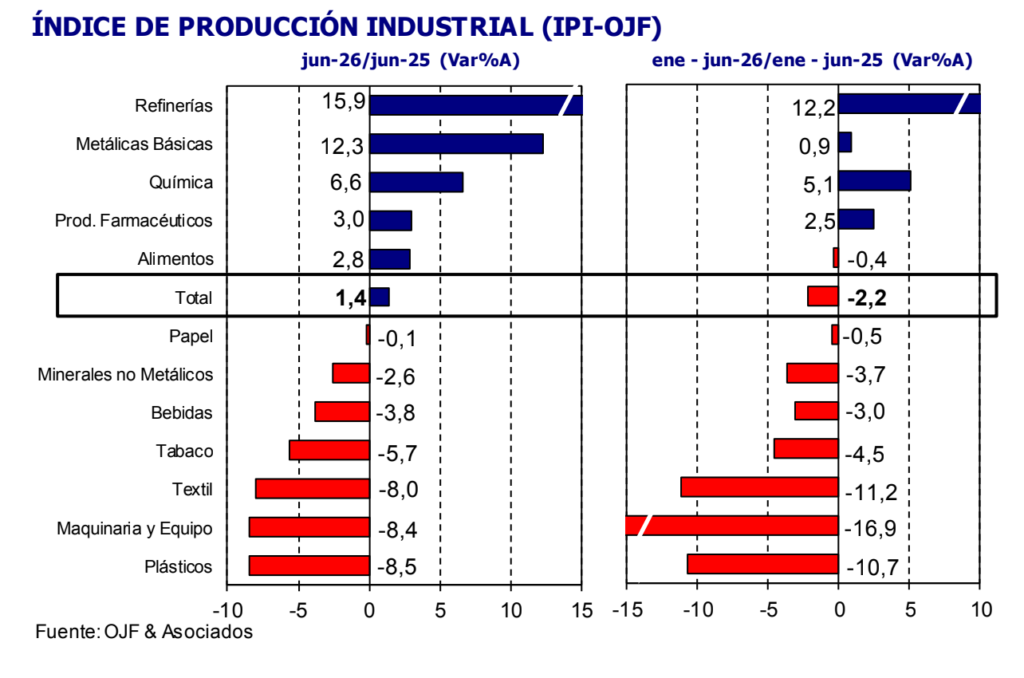
The numbers by sector are the ones that speak the most. For FIEL, the biggest drop in June was once again in the automotive industry, with a drop of 1.9% associated with lower vehicle production, fewer shipments to dealerships and a decline in exports. At the other extreme, food and beverages reached a record level for the month of June, driven by pig slaughter, poultry production and the sustained improvement in dairy activity. OJF, for its part, located refineries as the most dynamic sector, with a year-on-year jump of 15.9%, while plastics (-8.5%), machinery and equipment (-8.4%) and the textile sector (-8.0%) were the hardest hit.
OJF’s own report, titled Recovery is delayedrecognizes that the behavior of the industry continues a pattern that has been repeated since November of last year: a positive month followed by a negative one, without either of the two managing to establish itself as a trend. It is an elegant way of saying that the recovery, if it exists, has not yet found a firm footing.
In the midst of this panorama, the Government has already made a move: through Decree No. 566/2026 it established a gradual reduction of export duties for industrial products, with a schedule that foresees the total elimination only in June 2027. The same OJF projected that the second half of the year could show a more favorable performance than the first semester, although the recovery would continue to be uneven between sectors. Does a tax reduction that is only completed within a year reach to reverse a semester that closes in the red in the two available measurements?
Industrial deterioration does not appear as a loose fact. It is known just weeks after official data confirmed that formal employment in Argentina fell in April and has accumulated a consecutive year of decline, with salaries that have not yet recovered the purchasing power of 2023. The industry that does not rebound and the employment that does not recover seem like two sides of the same phenomenon, although no one in the Government raises it in those terms.
The truth is that, between official optimism and the numbers that still do not support it, the gap is still there. If the second half of the year repeats the pattern of ups and downs that OJF describes, the discussion about whether or not there is a recovery will continue to swirl unresolved.