
After exhausting all judicial avenues in Argentina, Cristina Kirchner’s team formalized a complaint before the UN Human Rights Committee for the conviction in the Roads case. The presentation does not speak of an isolated ruling: it points to the nine magistrates who, in three different courts, endorsed the sentence that sentenced her to six years in prison and perpetual disqualification. Can an international organization twist what the Argentine Justice has already ruled?
The letter was published yesterday, Wednesday, simultaneously with a press conference and with opinion columns in media such as El País and Libération. The text, titled «The democratic cost of the politicization of Justice», bears the signature of Cristina Fernández de Kirchner and announces what her defense had already begun to prepare for months: an Individual Communication before the United Nations Human Rights Committee, presented under the Optional Protocol of the International Covenant on Civil and Political Rights, a treaty that Argentina ratified.
The proposal comes after the Supreme Court left the sentence final in 2025 and rejected the defense’s appeals, and after the highest court also confirmed the confiscation of almost 685 billion pesos against the former president and the other convicts in the case. As it turned out, the presentation does not stop at three generic questions: it lists eight specific violations of the Pact. He invokes article 25 due to the electoral ban that the conviction would have pursued; Article 14 for attributing administrative acts outside its jurisdiction, based on Decree 54/2009; 14.1 for an alleged irregular mechanism for assigning cases and links between judges, prosecutors and the opposition; 14.2 due to a presumption of guilt prior to the ruling, aggravated according to the defense by statements by the President himself; 14.3 for the incorporation of evidence from other files without real possibility of contradiction; 14.5 because the Court of Cassation would not have really examined the grievances; 14.7 because 49 of the 51 public works investigated had already been archived or dismissed before; and 2.3, right to an effective remedy, due to the current composition of a Supreme Court reduced to three members. As urgent precautionary measures, the defense requested three things: suspending the perpetual disqualification, restoring the full integration of the Court and modifying the house arrest regime, with the removal of the electronic anklet and the end of visiting restrictions between the central points.
In her open letter, the former president does not hold back any nuances. He speaks of «structural machismo» in the Judiciary, maintains that deprivation of liberty is only the accessory penalty and that the true sentence is perpetual banning, and calls for the summoning of two international lawyers, the Spanish Javier Borrego and the Brazilian Rafael Valim, so that the case «is examined with the legal rigor it deserves.» There appears the phrase that had the most impact: that all the judges who participated in his trial «will be subjected to the scrutiny of International Human Rights Law.»
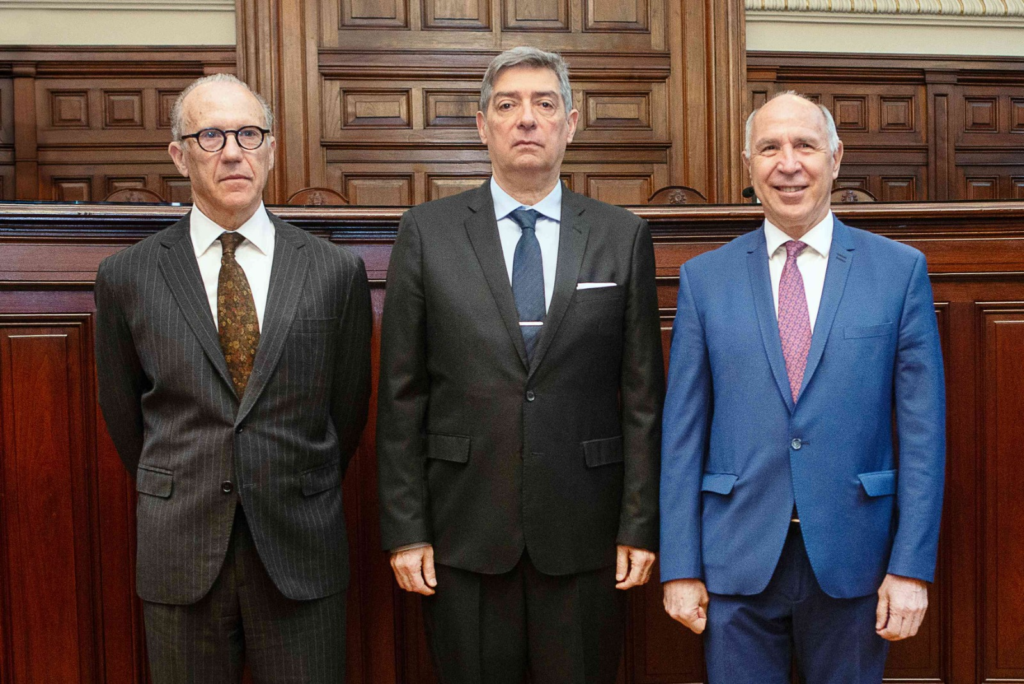
What does that mean in concrete terms? The Road Traffic case went through, strictly speaking, three instances. The oral trial was conducted by the Federal Oral Court No. 2, made up of Andrés Basso, Jorge Gorini and Rodrigo Giménez Uriburu. The subsequent review fell to the Federal Chamber of Criminal Cassation, with Diego Barroetaveña, Mariano Borinsky and Gustavo Hornos. And the closure, with the rejection of the extraordinary appeals, was left in the hands of the Supreme Court: Horacio Rosatti, Ricardo Lorenzetti and Carlos Rosenkrantz. These are the nine names that circulated these days associated with the complaint, although it is worth clarifying: Kirchner’s letter does not mention them one by one, it speaks of «all Argentine judges» in a generic way. The nominal list is a later construction, which arises from cross-referencing who signed each ruling.
The underlying question is what real margin an organization like the UN Human Rights Committee has to twist a ruling that has already passed through the Argentine Justice system three times and that the Supreme Court, the last possible word in the domestic system, has declared final. The Committee does not have the power to annul rulings or enforce compliance; Their opinions are recommendations, not executable sentences. That does not detract from the political value of the gesture, but it does relativize it in strictly legal terms.
On the other side of the counter, the reading is different. For a good part of the judicial arc and the opposition to Kirchner, the maneuver is read as a storytelling strategy rather than a legal one: taking to the international level a battle that has already taken place in all available domestic instances. For Kirchnerism, on the other hand, the appeal to the UN confirms what they have been maintaining since the ruling: that there was lawfare, that the conviction had a political rather than a judicial objective, and that the perpetual disqualification seeks to remove it from the 2027 board.
What is left open, then, is not only if the UN is going to intervene or how. It is whether this move manages to install a discussion on the guarantees of the process on the public agenda, or whether it ends up functioning as another chapter in the communication battle between Kirchner and the judicial system that condemned her.