
By: Vive Caba Editorial Staff
The physiognomy of the vicinity of the National Congress has once again mutated. What should be the epicenter of a key democratic debate—the discussion on the labor reform project—has become, once again, a scene of display of force. Under the orders of the Ministry of Security, the operation deployed for this Thursday not only seeks to organize circulation, but, due to its magnitude, sends a political message that exceeds what is strictly preventive.
A display that conditions public space
Since the first hours, members of the National Gendarmerie, the Federal Police and the City Police have taken positions on Avenida Rivadavia and Callao. The inventory of resources seems typical of a situation of extreme conflict: water hydrant trucks, large mobile units and police cordons that block traffic even blocks before the Plaza de los Dos Congresos.
Beyond the declared intention of “preserving order,” a critical question arises: at what point does prevention become intimidation? The announcement of measures such as the inspection of backpacks and the regulation of flags and demonstration instruments brushes the limits of individual freedoms, transforming the right to protest into an activity under permanent suspicion.
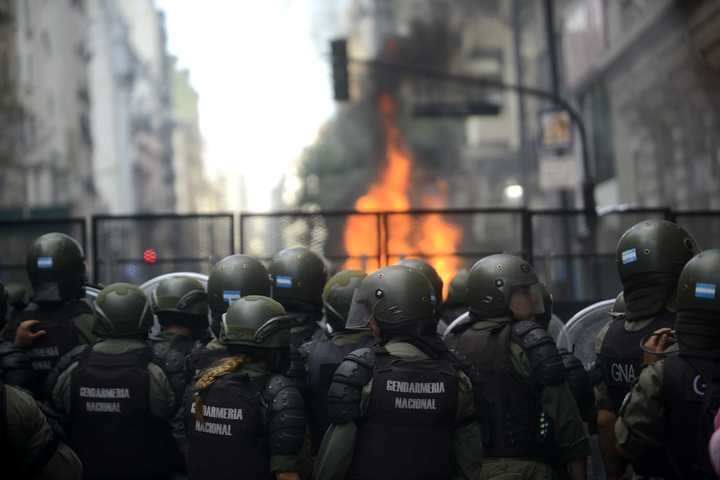
Photos Emmanuel Fernandez
The contrast: social protest under the magnifying glass
While the Government reinforces the shielding, social reality manifests itself on the street. Retiree organizations and unions have already begun to gather to express their rejection of the economic measures and the reform that is being debated behind closed doors. For many of those in attendance, the deployment is not only “excessive,” but a disproportionate response to claims born of economic distress and job loss.
Even the press has received «recommendations» that, far from facilitating coverage, seem to seek the isolation of reporters. By suggesting that press workers avoid positioning themselves between sources of tension and security forces, there is a risk of making possible excesses in the use of force invisible.
A city under siege
For residents of the City, the impact is direct. The immense fencing and the systematic cutting of vital arteries for urban mobility turn the center of Buenos Aires into an area of difficult transit, affecting not only the protesters but all citizens who try to go about their day.
Security is, without a doubt, a responsibility of the State. However, when the strategy focuses on «going out to scare»—as opposition sectors and social organizations denounce—there is a risk of eroding the natural channels of expression of a society in crisis. In a mature democracy, the shielding of institutions should not imply the silencing of the streets.