

Politics / February 5, 2026
Here’s one idea for a coordinated response to Trump’s coordinated attacks.
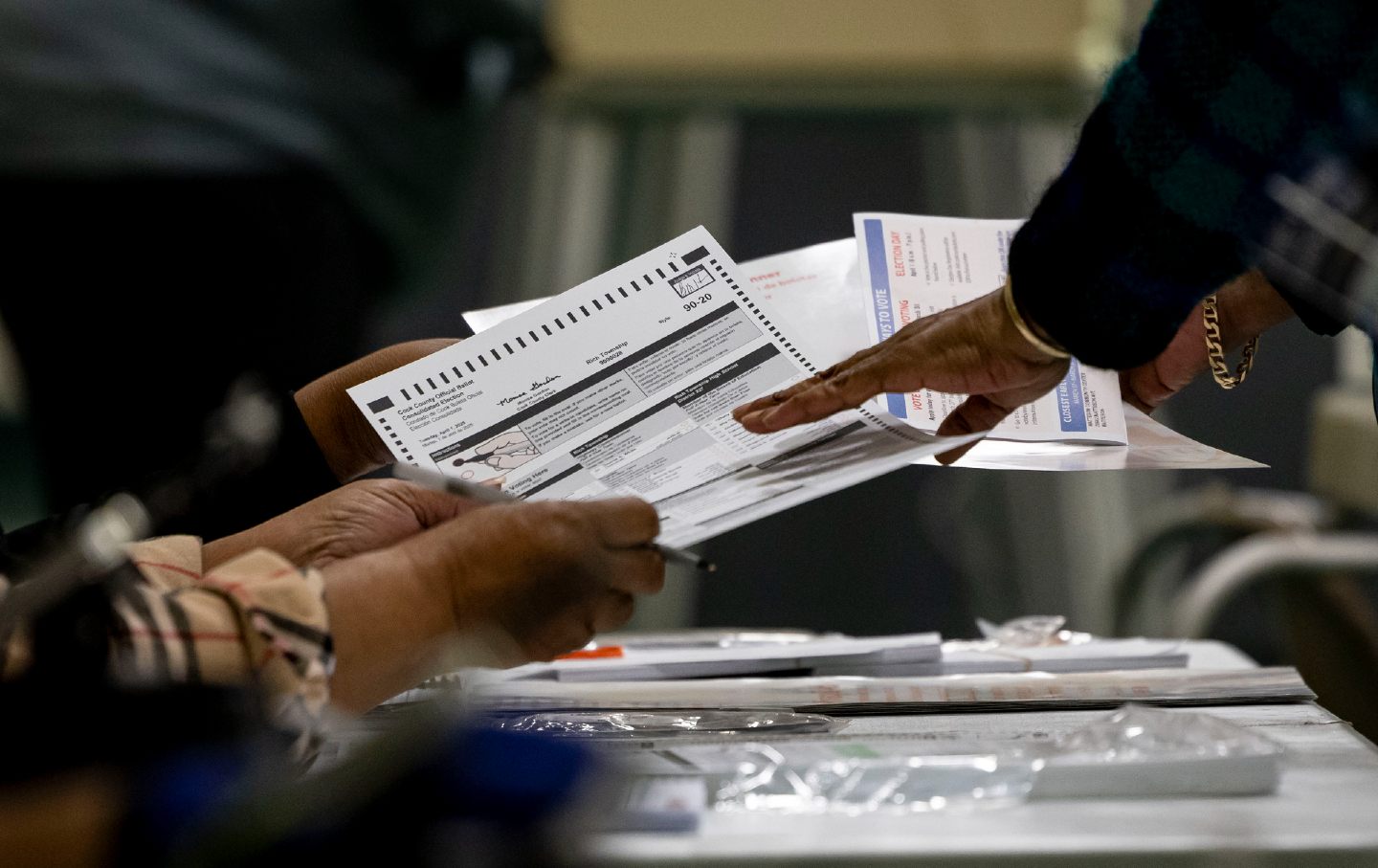
A voter receives a ballot.
(Brian Cassella / Chicago Tribune / Tribune News Service via Getty Images)
Voting rights and pro-democracy advocates are in a precarious position. If they speak loudly and frankly about Donald Trump and the Republican Party’s plans to suppress, manipulate, or outright “steal” the upcoming midterm election, they risk depressing the very people who must be counted on to show up and vote. They risk making people feel like their votes will not matter because “the fix is already in.” They get called a “doomer” by Pollyanna Democrats on social media, and “hysterical” by Republicans. And since the single best solution to the threat of voter suppression is overwhelming turnout, depression and doom, even in the name of truth, ends up helping Trump’s forces.
But: to ignore the threat posed by Trump, to pretend like everything is going to be okay, to assume that upstanding members of the courts will rise to prevent the theft of the election is to stick your head in the sand. Trump and the Republicans have no intention of letting the upcoming midterms (in which Republicans are predicted to lose control of the House) proceed fairly. They’re attacking the election through legislative, law-enforcement, and political means.
The most obvious threat is the legislation Republicans keep introducing. Republicans in the House have already passed the Safeguard American Voter Eligibility Act (SAVE Act). The bill radically reshapes the voter registration process by essentially repealing the Motor Voter Act. Instead of allowing people to register with a driver’s license, the SAVE Act requires them to show additional identification, like a passport or a birth certificate, in order to register. The Economic Times estimates that at least 21 million eligible voters may not be able to provide this extra information. The people most likely to struggle with the new requirements are the usual suspects—people of color, young people, and poor people—but there’s an additional group that could easily be prevented from voting should this bill become a law: married women who have changed their name. Those women likely do not have a birth certificate with their new marital name, and if they also don’t have an updated passport with their married name, they could be denied their right to vote.
And that’s not all the SAVE Act does. The act requires regular “purges” of voting rolls, so people who don’t vote every election cycle—who, say, vote only every four years, during a presidential election—might suddenly find that they’ve been de-registered. The bill also authorizes the prosecution and jailing of election workers who help people who don’t have proof of citizenship to register.
The SAVE Act is unlikely to survive a Senate filibuster. Senate minority leader Chuck Schumer said that the Act is “Jim Crow 2.0,” but relying on Schumer and Senate Democrats to hold their nerve is like relying on a puppy to hold its pee until you get home. Should the Democrats actually stand up long enough to filibuster the SAVE Act, Republicans are already making noises about killing the filibuster to pass it.
The SAVE Act isn’t even the most dangerous thing Republicans in Congress have cooked up. That dubious honor belongs to the Make Elections Great Again Act (MEGA Act), so named because these people are obviously in a cult. The MEGA Act includes all of the same requirements to register to vote as the SAVE Act, but also requires these new forms of identification to be shown by voters when they try to cast their ballots. And: The MEGA act ends universal mail-in balloting and eliminates the grace period that allows ballots that are mailed by Election Day to be counted.
Current Issue

Most important, the MEGA Act calls for the creation of a federal voter-registration database, superseding state voter-registration rolls. This would mean federal control of elections, which is a power traditionally reserved for the states. Now, I’ve long advocated for a federalized approach to elections: Having 50 different states with 50 different rules is no way to run a national election. But I have been repeatedly told, by Republicans, that such ideas are patently unconstitutional. I guess it’s unconstitutional to federalize elections to make them more fair and less confusing, but perfectly constitutional to federalize elections to make them more racist and less democratic.
The MEGA Act hasn’t passed the House yet, and if it does it will likely meet the same Democrat-led filibuster in the Senate as the SAVE Act will. But some Republicans are talking about attaching these new voter restrictions to the omnibus appropriations bill that is needed to fund the government. Will Democrats hold the line if protecting voting rights means shutting down the government? I dunno, Lucy, we’ll see if Charlie Brown is able to kick the football this time.
All of this would be bad enough, but Republicans aren’t just hoping for legislation that will allow them to suppress the vote in 2026. They’re also putting in place the legal ability to steal the votes that get through these gauntlets. Last week, the FBI raided the Fulton County elections operations center, which covers Atlanta, looking for 2020 ballots. The action was a result of Trump’s ongoing lie that he won Georgia in 2020. (As a reminder, Trump is on tape asking Georgia election officials to steal that election for him).
If the FBI can seize old, 2020 ballots in the name of fishing for “election fraud,” it’s not hard to imagine them seizing ballots and voting machines trying to stop “fraud” in 2026. Attorney General Pam Bondi has also appointed, essentially, a “special counsel,” Thomas Albus, and given him the authority to seize ballots. Lawyer Marc Elias summed it up this way: “DOJ’s legal machinery to subvert the 2026 election is already in place.”
And then there’s the existential elephant in the room. Trump recently said: “We should take over the voting, the voting in at least many—15 places. The Republicans ought to nationalize the voting.” The news media can sane-wash what Trump means by that as much as it wants, but we know that Trump has already deployed armed goons across the country to violate people’s rights. Trump’s id, Steve Bannon, said on Tuesday: “We’re going to have ICE surround the polls come November.”
Who knows what kind of ICE presence we’ll see on Election Day? Who knows how much violence they’ll use to keep people from voting? But you’d be a rank fool to think the answers to those questions are “nothing” and “none.”
All of this points to a rigged midterm election that will be outright stolen if the rigging doesn’t produce results pleasing to the tin-pot dictator in charge of our country.
So what do we do about it?
I don’t have a great answer to that question, but I know the answer starts with a nationalized response from the opposition party. Trump’s forces are attacking 50 different election systems by means of a coordinated campaign run out of Mar-a-Lago, while the Democrats are leaving state parties and concerned lawyers to fight a rearguard action of whack-a-mole. That won’t work. Trump doesn’t have to steal every election; he just has to steal enough. We can’t be in a situation where Minnesota knows what to do, but Pennsylvania doesn’t. We can’t be in a situation where California is able to run a normal election because it has a Democratic governor, but Georgia cannot because it has a Republican one.
So, as a start, my first suggestion is for Democrats to tap a shadow “elections czar.” A leader who has the respect of Democratic elected officials in Washington and in the states, and whose only job is to coordinate national Democratic opposition to these voter suppression tactics. Yes, this job theoretically exists already in the form of Democratic National Committee chairman Ken Martin, but (and I’m going out of my way to be kind to Martin) his job is to win elections, not protect them.
I also know that many Democrats like to tell themselves that Marc Elias already serves this function. Elias is vital, but he’s not some kind of electoral fairy godmother who’s looking out for Democrats so they don’t have to worry and can sleep easily at night. Elias is an attorney who works in the trenches trying to hold the legal line against these unlawful Trumpian maneuvers. He can’t “save democracy” by himself.
The Democrats need a leader—someone who can get Schumer and Jeffries and Abigail Spanberger and Kathy Hochul and all the rest of them on a Zoom and tell them exactly what they need to do. They need a person who can call up Elias and say, “I need you in Georgia filing this lawsuit” and then call up Janai Nelson, of the NAACP Legal Defense Fund, and say, “I need you in Milwaukee.” They need someone who can go on social media and say, “The press conference is on Tuesday and all our governors will be there. I’d watch.” We need a coordinated response to these coordinated attacks.
Popular
“swipe left below to view more authors”Swipe →
My imagined elections czar would also be able to serve as the designated spokesperson for the cause. Let’s all just agree that Schumer has not been the best communicator for this moment. Let’s all just stipulate to the fact that Democrats in Washington have not had the kind of singular focus on protecting our elections that one might expect them to have—out of a sense of self-preservation, if nothing else. We need a person who can give the official quote to The New York Times and go on all the shows and serve as a human alarm bell on this issue, without also having to talk about tariffs or affordability or the Epstein files or whatever Trump’s latest distraction happens to be.
I don’t know who this person should be. There are people with big names whom the media would notice but have no pull inside the party—and there are people with a strong inside game who don’t have the vision to pull it all together. But the Democratic leadership needs to get together and name a champion—and then listen to them.
That’s the hierarchical approach.
At the grassroots, we need to be building the street-level infrastructure to monitor or confront ICE or any other goons Trump unleashes on Election Day. We’ve seen how people have come together in Minneapolis, Portland, Chicago, and elsewhere. We’ve seen the energy of the No Kings protests, just waiting to be tapped. These dedicated people need to be converted into election monitors. Trump is building his election-stealing army; we need to build our counterforce of election protectors.
Some of this is already happening. People like Elias and Nelson know what they’re doing, and activists on the ground are trying to convert protesters into protectors. But, we need more, and we need it now.
They are coming for the election. That is obvious. What we are doing to stop them needs to be just as obvious.
And that’s how you fight despair. That’s how you counteract doom. The threats to the upcoming election are real. They cannot be and should not be understated. But you can’t help people defend their rights by ignoring the obvious. You help people, and our democracy, by joining the battle.
Your support makes stories like this possible
From Minneapolis to Venezuela, from Gaza to Washington, DC, this is a time of staggering chaos, cruelty, and violence.
Unlike other publications that parrot the views of authoritarians, billionaires, and corporations, The Nation publishes stories that hold the powerful to account and center the communities too often denied a voice in the national media—stories like the one you’ve just read.
Each day, our journalism cuts through lies and distortions, contextualizes the developments reshaping politics around the globe, and advances progressive ideas that oxygenate our movements and instigate change in the halls of power.
This independent journalism is only possible with the support of our readers. If you want to see more urgent coverage like this, please donate to The Nation today.
Elie Mystal
Elie Mystal is The Nation’s justice correspondent and a columnist. He is also an Alfred Knobler Fellow at the Type Media Center. He is the author of two books: the New York Times bestseller Allow Me to Retort: A Black Guy’s Guide to the Constitution and Bad Law: Ten Popular Laws That Are Ruining America, both published by The New Press. You can subscribe to his Nation newsletter “Elie v. U.S.” here.