

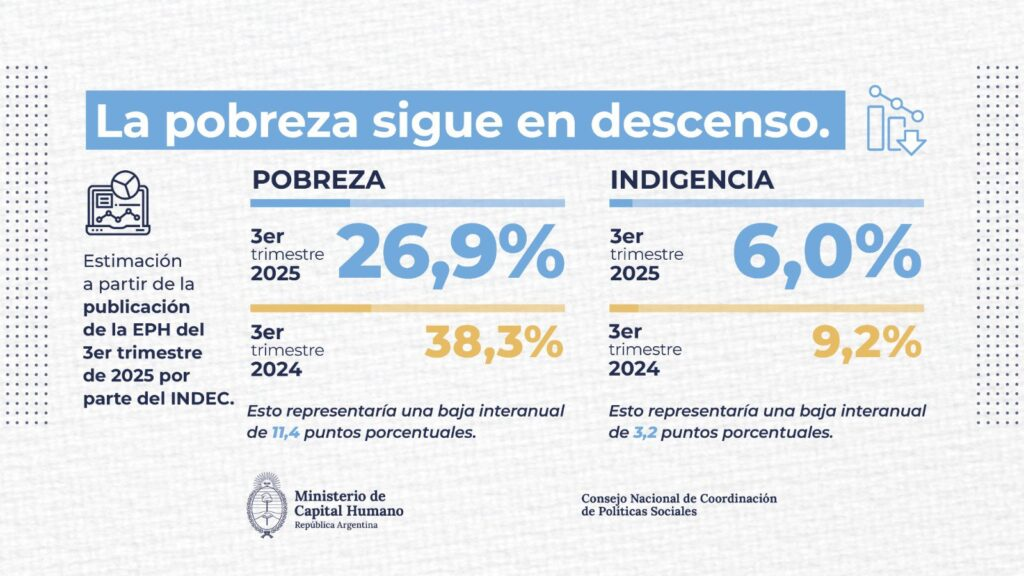
The director of the Social Debt Observatory of the Argentine Catholic University, Agustín Salvia, questioned the recent drop in poverty rates reported by Javier Milei’s government and warned that it responds to methodological limitations rather than a real improvement in living conditions.
The sociologist questioned poverty figures published by INDECpointing out that they are based on consumer baskets outdated, built with parameters from 2004 and 2005.
“There is a certain fiction in the data or a certain levity”said Salvia.
As explained, this methodology generates distortion: The indicators can show a statistical improvement without there being real relief in the families’ pockets. That is, the measurement would not be able to reflect the current reality of consumption.
A methodological problem rather than a political one
For Salvia, the axis of the problem is technical. The way poverty is measured fails to capture changes in consumer habits or the impact of inflation about everyday life.
In that sense, he highlighted the need to update parameters used to construct the indicators. Without this update, the data lose representativeness and become increasingly distant from the real experience of households..
La Plata: when the numbers are not enough
In La Platathe discussion becomes concrete. The rising cost of living, especially in food, rent and transportation, deepens the feeling that statistics do not reflect what is happening on the street.
Merchants and social organizations warn that Demand for food assistance continues to risewhile difficulties persist in sustaining consumption. In that context, the supposed reduction in poverty appears disconnected from daily life.
The debate also has an impact on the management of Governor Axel Kicillof, in a scenario marked by economic adjustment and the need to sustain social containment policies.
The discussion about how poverty is measured not only has technical implications, but also political ones: It calls into question the legitimacy of official data and adds tension to the relationship between the Nation and the Province..
A gap that can deepen
Specialists warn that, if the INDEC methodologies are not reviewed, the distance between the indicators and social perception could continue to widen.
In Greater La Plata, this gap already translates into distrust. When the numbers do not match everyday experience, the credibility of public statistics goes into crisis.and with it, part of the debate