By Flavia Tomaello, https://flaviatomaello.blog/, Instagram @flavia.tomaello
Naples has a particular relationship with time. The city lives intensely in the present while preserving intact the memory of centuries. Between hills that descend towards the Gulf and streets that breathe history, the Grand Hotel Parker’s observes Neapolitan life from a privileged position on Corso Vittorio Emanuele.
This historic hotel is part of the city’s cultural heritage. Since the 19th century it has received travelers seeking an experience of refined hospitality in one of the most suggestive panoramic points of Naples. Its rooms, full of light and elegance, have been the scene of memorable meetings and a refuge for writers and artists. Among its illustrious guests are names such as Robert Louis Stevenson, Virginia Woolf and Oscar Wilde, visitors who helped consolidate the cosmopolitan character of Parker’s.
The tour of the hotel inevitably leads to the heights of the building. On the sixth floor is the Bidder Terrace, a panoramic terrace that offers an open view over the Gulf of Naples, the islands and Vesuvius. From there the city seems to unfold slowly while the sea accompanies the rhythm of the gastronomic experience.
The restaurant proposes a contemporary formula based on the concept of all day dining. This proposal allows you to enjoy its cuisine during different times of the day, from lunch to evening, in an elegant and relaxed atmosphere that attracts both hotel guests and external visitors.
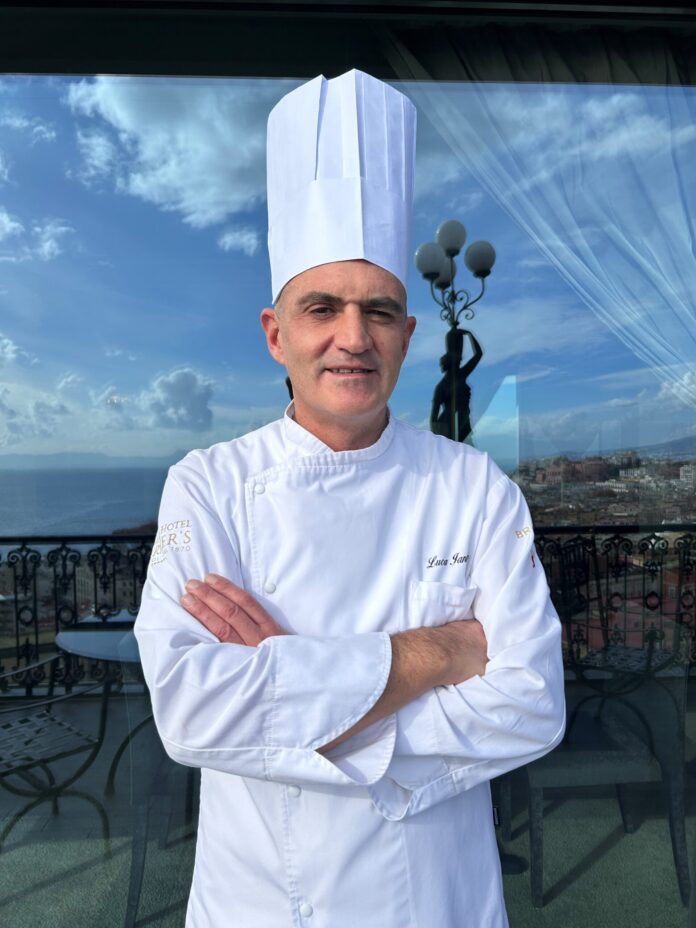
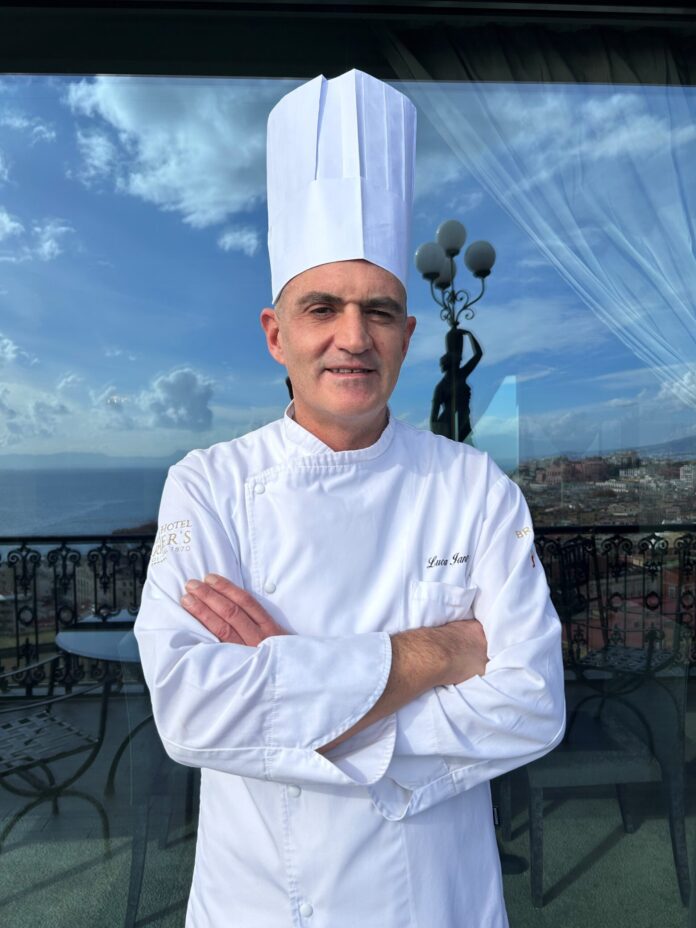
The Bidder Terrace kitchen is directed by chef Luca Iannone, who has built a proposal that draws on Neapolitan tradition and a current culinary sensibility. Its approach focuses on respect for the territory and the search for a clear gastronomic identity that dialogues with the history of the place.
The history of the restaurant is closely linked to the Avallone family, who has owned the hotel for generations. Among the chef’s sources of inspiration are the recipe notebooks of Matilde Avallone, mother of the current owners, remembered for her domestic cooking and the hospitality that characterized her table.
Their dishes represented a family tradition based on the generosity of home cooking and the pleasure of sharing. At Bidder Terrace, part of that legacy lives on through some preparations that the chef reinterprets with a contemporary look.
The restaurant’s menu reflects a broad proposal that combines international flavors with dishes deeply linked to the territory of Campania. Among the options are classics that have been present in hotel restaurants for decades, such as the Caesar salad, the club sandwich or the mozzarella with seasonal tomatoes.
These proposals coexist with recipes that evoke Neapolitan tradition, such as ravioli stuffed with buffalo stracciata and ricotta, Neapolitan lasagna or spaghettone with clams, one of the most emblematic dishes of local cuisine.
The main dishes cover flavors of sea and land. You can find preparations such as sea bass in acqua pazza accompanied by small vegetable pearls, beef tagliata served with Paestum artichokes flavored with rosemary or chicken marinated with Amalfi lemon accompanied by agretti.
The starters section proposes fresh and elegant combinations. The beef carpaccio appears accompanied by an emulsion of raisins, toasted pine nuts and marinated egg, while the white fish tartare is completed with confit tomatoes, taggiasche olives and anchovy colatura.
The menu also includes different eating styles. There is a section dedicated to plant-based cuisine with delicate soups, crunchy vegetables made with multigrains and vegan burgers. The menu also includes proposals designed for children and a selection of artisanal pizzas.
Among the dishes that synthesize the spirit of the restaurant, an interpretation of the classic spaghetti with clams stands out, enriched with a light note of lime and caper powder. In the sweet chapter, the fresh fruit presented with precision and the traditional Neapolitan babà keep the link with local pastries alive.
Parker’s also cultivates an ongoing relationship with art. Its spaces have hosted exhibitions such as Parthenope Syreni by the sculptor Domenico Sepe, a collection inspired by the mythological figure of the mermaid Parthenope, the founding symbol of the city. This dialogue between art and gastronomy contributes to reinforcing the cultural character of the hotel.
In this privileged environment, Luca Iannone’s cuisine proposes a contemporary reading of Neapolitan identity. The chef clearly remembers the influence of his childhood when he talks about his relationship with gastronomy. «I grew up in Naples, where food was the silent language of respect and coexistence. That childhood taught me that cooking means guarding a memory and caring for others, values that today continue to be the soul of each of my dishes.»
His professional evolution led him to build an increasingly defined culinary vision. «My path is a constant search for balance between the rigor of the territory and my personal perspective. From intuitive beginnings I have arrived at a conscious and essential cuisine, an exercise in purity where each ingredient has a precise identity and nothing is left to chance.»
Tradition and contemporary sensibility
Working in a city with such a deep gastronomic tradition means assuming a special relationship with the past. «In Naples, tradition never represents a limit, it is a responsibility. I honor it by choosing absolute raw materials and interpret it through technique. I only question it when I feel that my voice can contribute something authentic to the story.»
Elegance occupies a central place in the way he conceives cooking. «Elegance lies in subtraction. It appears in the harmony between a few clear elements, capable of speaking for themselves. A dish reaches its true elegance when it does not need explanations to be understood.»
In this creative process, technical precision and expressive freedom coexist. «Technique is my grammar, creativity is my free gesture. My job consists of constantly making them dialogue, because without rigor creativity becomes ephemeral and without imagination technique is reduced to a mechanical exercise.»
The Mediterranean continues to be a permanent source of inspiration. Among the ingredients that he considers undervalued, he mentions one in particular. «Sea fennel represents for me a Mediterranean signature. It has a saline, almost ancestral character. I like to rescue it from oblivion to turn it into an element of depth and identity within the dish.»
The relationship with local producers also influences their gastronomic vision. «I learn every day from the knowledge of local fishermen, farmers and artisans who work with rigorous ethics. Their silent resistance has influenced my gastronomic vision much more than any passing trend.»
The international spirit of Parker’s is echoed in its cuisine. “My cuisine is recognized in the history of Parker’s, deeply Neapolitan in its soul and open to the world in its attitude, refined in its welcome and always close to the guest.”
The advancement of technology generates new reflections within the gastronomic field. «Artificial intelligence can become a valuable ally for sustainability and logistics management. However, the emotion that is born from human gesture and creative imperfection will continue to be a territory inaccessible to machines.»
The experience that the chef seeks to offer at Bidder Terrace combines serenity and discovery. «I aspire to offer an experience of calm and wonder. I would like those who visit us to feel enveloped by the comfort of a home, but at the same time stimulated by the emotion of discovery.»
When thinking about Neapolitan cuisine, Iannone believes that there are still nuances to explore. «The most essential sea cuisine, that of simple and everyday gestures, is where the deepest truth of Naples is found. That purity still has a lot to reveal and deserves to be told with contemporary dignity.»
From the Bidder Terrace, the city stretches out to sea in serene beauty. In this setting, Luca Iannone’s cuisine proposes a delicate and current interpretation of Naples, an experience where memory, territory and contemporary sensibility find their expression in each dish.
Discover more from LatamNoticias
Subscribe to get the latest posts sent to your email.