

Activism / January 25, 2026
Minneapolis has become ground zero for the Trump administration’s war on immigrants and the growing resistance to it.
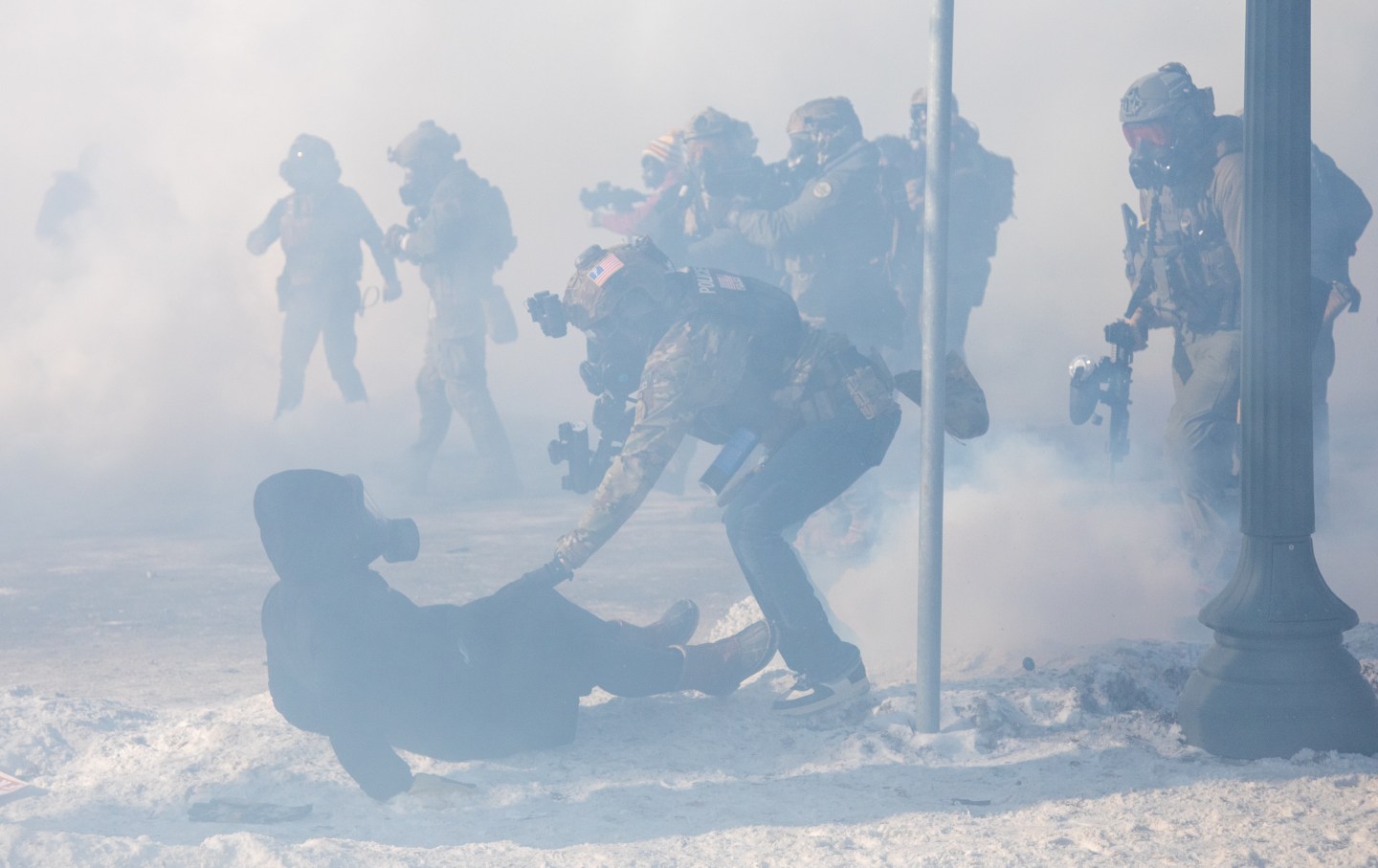
Protesters clash with law enforcement in Minneapolis on January 24, 2026, after federal agents shot and killed a man—the second time one has shot dead Minnesotan this month.
(Arthur Maiorella / Anadolu via Getty Images)
Minneapolis—On Saturday morning, I followed the sound of whistles to the sound of flash-bangs. A man on the corner wiped his eyes while holding a gas mask. “You OK?” I asked. He shook his head. “I should have put my mask on sooner,” he told me. I pulled on my own as I approached the mass of protesters just beginning to gather. The eye shield crystallized like a windshield in the cold. When the sun hit, I could see nothing. I pulled the mask back off. Riot cops were moving in alongside the federal agents already in formation behind yellow crime-scene tape. Metal scraped on cement as protesters began to form a barricade from dumpsters, a mattress, a car. The makeshift fortress was meant to shield the swelling crowd from less-than-lethal weapons. But it also exemplified the persistence of community members in the face of escalating state violence.
On Saturday, three months to the day after Secretary of Homeland Security Kristi Noem’s opening salvo in Minneapolis, federal agents were filmed shooting a legal observer multiple times at point blank range, including after his body went limp. Alex Pretti—a 37-year-old lawful gun owner, per police chief Brian O’Hara—was declared dead at the scene. The assembly of protesters was declared unlawful shortly after.
The shooting, which took place on the immediate heels of a citywide strike, has further solidified Minneapolis as ground zero for the Trump administration’s war on immigrants and the growing resistance to it. The afternoon prior, tens of thousands descended upon downtown Minneapolis, armed with cardboard signs and snow goggles, as part of the nation’s first general strike in eight decades. Since January 7, when ICE officer Jonathan Ross was filmed shooting 37-year-old Renee Good in the face, residents have called for ICE to leave the city. Ross has not been arrested or charged.
Current Issue

On the light rail to US Bank Stadium, where an afternoon march celebrating the strike began, a woman with a yellow stole around her neck told me she was part of a clergy delegation, the largest since Standing Rock, 100 of whom were arrested at the airport earlier that morning. As we funneled into the streets, chants of “ICE out, fuck ICE!” filled the air. On sidewalks, people pulled off their boots to shove handwarmers inside. Somewhere along the way, I was handed a newspaper. Its front-page demand was simple: general strike, nationwide.
“This is crazy,” a nearby man said to his companion. “Never seen anything like this.” Then, he added: “I hope people don’t get hurt.”
In 1934, during the city’s last general strike, police in Minneapolis killed two unarmed picketers in an event that came to be known as Bloody Friday. It led the governor to declare martial law and deploy the National Guard, not to break the strike, but to rein in police. The question now, as it was then, is not whether order will be restored, but whose order, and at what cost.
In a video of Pretti’s death, whistles can be heard, along with a bystander yelling, “What the fuck is wrong with you?” as agents wrestle the ICU nurse to the ground. Then the gunshots begin. It didn’t take long for multiple videos of Pretti’s death to begin circulating. “Definitive angle,” a friend texts after sending me one. “Execution.” Shortly after Pretti was pronounced dead on Saturday, the Department of Homeland Security shared a photo of his gun, which he was seemingly disarmed of before being shot.
When the ICE surge began, Minnesota Governor Tim Walz told residents two things: Remain peaceful and document the atrocities. This weekend, he echoed the call, also made by Mayor Jacob Frey, for ICE to leave. “The President must end this operation. Pull the thousands of violent, untrained officers out of Minnesota. Now,” Walz posted on X. On Saturday, the National Guard was deployed to support local law enforcement at the shooting site and the Bishop Henry Whipple building, where people detained by the feds are held. But what it would take for Walz—a retired sergeant himself—to mobilize the National Guard to confront ICE remains unclear.
Trump, a white-collar criminal and adjudicated rapist, claims that ICE operations are taking “the worst of the worst” off the streets, language Noem mimicked in her October press conference from Whipple. At the time, Trump had federalized the National Guard and attempted to deploy it to cities like Los Angeles and Chicago, an approach that the Supreme Court found likely violated the Posse Comitatus Act.
Trump has threatened to invoke the Insurrection Act to send troops to Minneapolis instead, a doctrine for which the courts tend to give far more deference to the executive, according to Syracuse law professor William Banks. So why didn’t Trump invoke the Insurrection Act on January 6? “He was leading the insurrection, that’s why,” Banks said.
“The Insurrection Act is seen as the biggest, and really the only, exception to the Posse Comitatus Act,” law professor Rachel VanLandingham, a former lieutenant colonel in the Air Force, told me. “The founding fathers had an aversion to a large standing army, because they were afraid it would be used as a tool by a despot.”
The last time the Insurrection Act was invoked was in 1992, during Rodney King riots, at the behest of California’s governor. President Rutherford Hayes also invoked it at the request of state authorities during the Great Railroad Strike of 1877. It remains to be seen what will happen if it’s invoked against a governor’s wishes.
“I take issue with any assertion that it is the people of my neighborhood, the people of this city, who are in any way responsible for the escalation we are seeing in the streets,” council member Aisha Chughtai, who represents the 10th Ward, where Pretti was murdered, said on Saturday. “There is only one group of people here instigating violence and escalating the situation: the federal agents. They are the people whose behavior needs policing right now.”
According to The Minnesota Star Tribune, those who witnessed Pretti’s shooting were taken to Whipple, the ground zero of ground zero. The feds also reportedly tried to get local police to leave the scene. Thus far, the Minnesota Bureau of Criminal Apprehension has been excluded from the investigation, as was the case after Good’s death. On Friday morning, ahead of the general strike, about 100 protesters at Whipple were tear-gassed—a tactic banned from international warfare in 1925. I’d headed that way after hearing rumors of water cannons being prepped to use on the crowd, but arrived late because police had closed the roads to the building.
Popular
“swipe left below to view more authors”Swipe →
“They came and blocked off all the sides, then just started gassing people,” a protester told me afterward. It was her sixth straight day outside the facility. She described agents in dark uniforms and fatigues, moving in the most organized fashion she’d seen. “This is new since I was out here last,” she added, gesturing to the chain-link fence that towered over us.
The day before, Vice President JD Vance came to Minneapolis to call for greater cooperation between ICE and local police and to defend the detention of Liam Conejo Ramos, a 5-year-old boy now being held in Texas. At the strike, the blue bunny hat he was wearing when taken into federal custody could be seen sketched onto protest signs. At another facility in Texas, if a collection of tents can be called that, a man arrested by ICE in Minneapolis recently died—the third death there since the beginning of December. ICE called it a suicide. Earlier this month, authorities also said Geraldo Lunas Campos died by suicide at the same facility, but witnesses reported that he was choked by staff, and an autopsy later ruled his death a homicide caused by asphyxiation.
Thus, even before Pretti’s death, the scope of the resistance was broadening. Those who turned out for the strike harbored a growing list of grievances, some grounded in basic human decency, others in constitutional principle. Protesters are against ICE, against the weaponization of the DOJ, against the entire administration. They understand that Trump is defending American values—the white-supremacist kind—and that ICE operations are a continuation of this nation’s racist history, which the president would like to erase while also reenacting.
The protesters, however, are also defending American values—the less nefarious ones. They’re fighting for the Constitution, for states’ rights, for the children, for the people.
By Saturday night, the space that police had blocked off and guarded earlier in the day had been filled by community members, who gathered for yet another vigil. A man laid a candle on Pretti’s memorial while holding the American flag. At the same time, national pushback continued to grow. In the wake of Pretti’s death, Democratic senators said they would block a funding bill that includes additional investment in the Department of Homeland Security, raising the risk of another government shutdown. ICE is already the single highest-funded federal law enforcement agency, while immigration-enforcement spending writ large dwarfs that of many major militaries. But regardless of whether a broader general strike or government shutdown comes to fruition, will Minnesotans be in the streets?
You betcha.