

Activism / January 8, 2026
An ICE agent shot dead Renee Nicole Good. Residents are ready to fight back.
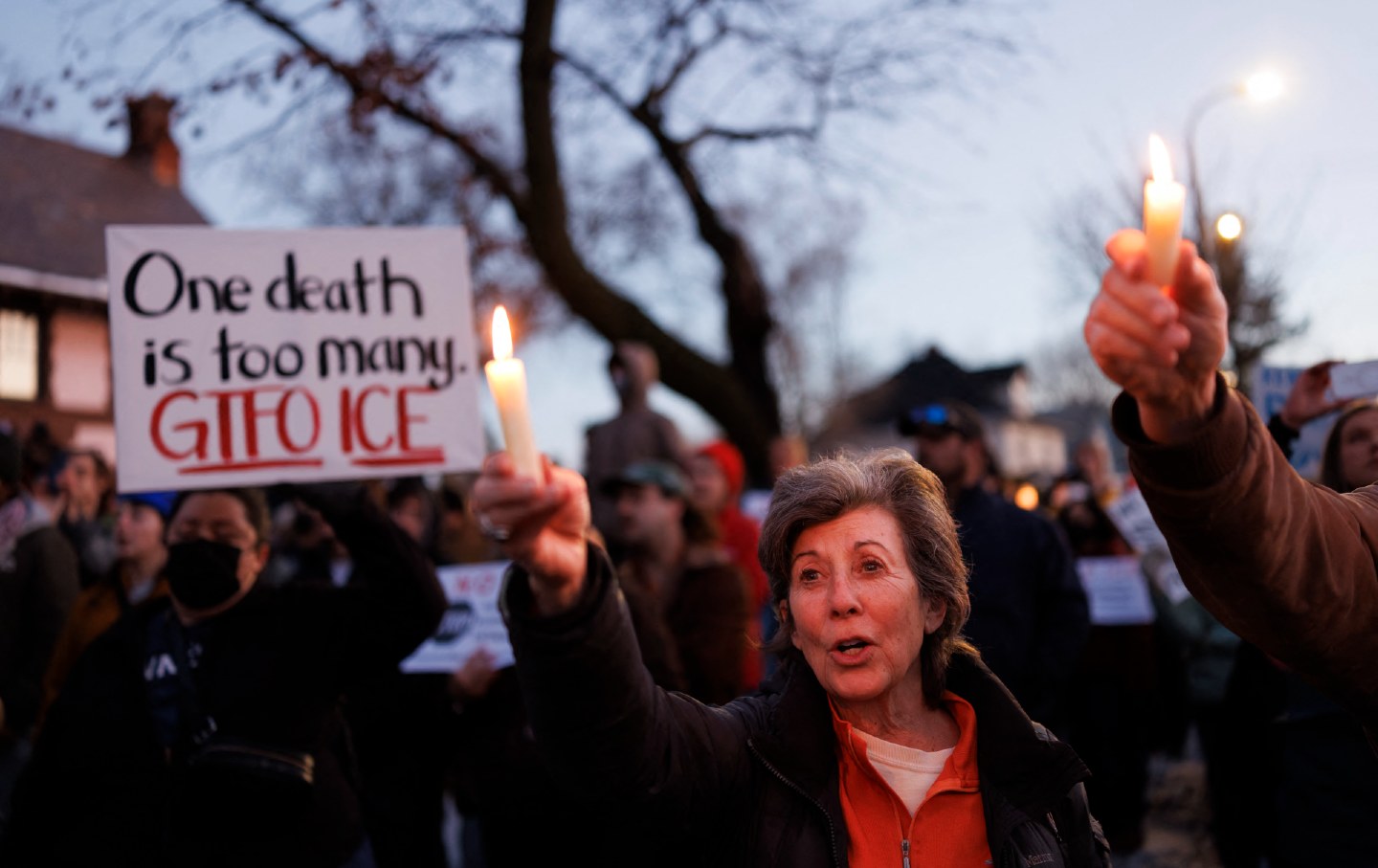
People demonstrate against ICE during a vigil honoring Renée Nicole Good, who was shot dead by an immigration officer earlier in the day in Minneapolis, Minnesota, on January 7, 2026.
(Kerem Yucel / AFP via Getty Images)
Minneapolis—At the base of a barren tree in south Minneapolis, candles flickered in the night. The vigil held for Renee Nicole Good, a 37-year-old mother and poet shot in the face by a federal agent yesterday morning, was over, but congregants remained. Some held flowers. Some warmed themselves by makeshift fire pits. Some cried. Nearby in the snow, two words were scrawled in red: ICE KILLS.
“We haven’t seen a gathering this large in our city since the murder of George Floyd,” Suleiman Adan, the deputy executive director of CAIR Minnesota, said of the vigil, which drew thousands. Indeed, Good’s death follows an unfortunately familiar pattern: Law enforcement uses lethal force, a video circulates, self-defense is claimed, protesters accumulate, demands are made. According to Minneapolis City Council member Robin Wonsley, the calls to action are straightforward: ICE out of Minneapolis, justice for Renee.
“Her murder should not be allowed to happen without any repercussions,” Wonsley told me. “That should not be a national standard.” The agent needs to be arrested, and there needs to be local control of the investigation. According to MPR, state investigators have already been ousted from the case, with the FBI serving as the sole investigative unit.
Current Issue
Any investigation undertaken by the federal government will likely be a sham, Alex Vitale, author of The End of Policing, added. “Folks should be trying to produce their own sense of justice,” he said, citing the We Charge Genocide petition of the 1950s, which aimed to hold police and mobs accountable for the killings of unarmed Black men and women. The US government has long been reluctant to reckon with its violence.
At the same time as the candlelight vigil held in Good’s honor, Kristi Noem, secretary of the Department of Homeland Security (DHS), held a press conference in which she dubbed Good a “domestic terrorist”—a label the administration increasingly applies to anyone who disagrees with them. This morning, protesters gathered outside the Bishop Henry Whipple Building, which houses DHS, just as they did for Noem’s visit in late October. On Monday alone, ICE agents arrested 150 people in Minneapolis.
“The real and consequential question is how far Minnesota officials are willing to go to challenge out-of-control federal law enforcement,” Stuart Schrader, author of Badges Without Borders, said. “Prosecutors should be convening a grand jury to indict the shooter, and state and local law enforcement or National Guard should be mobilized to stop ICE. If I were Walz, I would cross the Rubicon.”
Coleen Fitzgerald, a protester dressed as a clown, considers an investigation the bare minimum. “I suppose burning at the stake isn’t an option,” she said.
While Walz has the National Guard on standby, it is unclear whether the aim would be to quell protests or to resist ICE. At this morning’s protest, a row of masked ICE agents pushed community members backward and threw smoke bombs into the crowd. “Nazis!” people shouted. “ICE out now!”
“Minneapolis residents have time and time again showed that we care deeply for one another,” Wonsley told me. “When we see a grave injustice happen, we will organize to make sure that justice or accountability is rendered.”
Right now, people are scared to simply live their lives, she added. Some parents, Adnan noted, have sewn their children’s passports inside their jackets. Although he is a naturalized citizen, he has begun carrying his everywhere he goes.
“As people of faith, we believe that God chose the people of Minneapolis to continue the work that we started in 2020,” he said. “The work was not done then, and it’s not done now.”
Trump’s crackdown is not guided by research or logic, criminologist Charis Kubrin said. “It’s guided by emotion, stereotype, and moral panic” and lies at the intersection of negative stereotypes based on race and immigration status.
Immigrants are indeed being scapegoated for problems born of runaway corporate greed, Vitale told me. “When we see a problem turned over to people with guns to manage, we should look for the political failing that is being covered up,” he said. The “theater of the strongman” is meant to distract from the actual issues at hand. “A lot of this is about overcoming a sense of emasculation that a lot of the population is feeling in the face of runaway corporate power,” he explained. “It’s producing this kind of toxic masculinity that is looking for refuge in the trappings of military might, whether it’s invading Venezuela or chasing Latin American housekeepers down the street in Minneapolis.”
Protests are important, but “we also need organizing,” he said. “There were 10 years between the Montgomery bus boycott and the passage of real civil rights legislation. We need to think in longer time horizons. But the underlying arguments that police are doing too much, that reform is a distraction, these ideas have really stuck and have a lot of popular support.”
Popular
“swipe left below to view more authors”Swipe →
Even Mayor Jacob Frey, who was booed in 2020 for his refusal to support the defund movement, said ICE should “get the fuck out” of Minneapolis.
In the hours immediately following Good’s death, yellow crime tape and metal barricades surrounded the scene. Protesters gathered on the perimeter and shouted at local police, who were congregating casually near their vehicles.
“What the fuck are you smiling about?” a protester shouted to a cop in riot gear. “Someone was murdered.” Despite a recently strengthened separation ordinance—which prohibits local police from enforcing federal immigration law—the overarching feeling was that police were protecting ICE, not the people.
“It was a white lady who was killed!” a protester yelled at a woman in a bulletproof vest labeled FBI. “It could have been you!”
“If only there was a poem about this,” someone added.
As of this morning, the street remained barricaded, with fires burning at each end. A crowd gathered around the memorial as a woman handed out samosas. Meanwhile, outside Henry Whipple, a man fell to his knees in the snow after agents threw a smoke bomb in his direction. “I can’t breathe!” he said. A medic poured water in his eyes as a swarm of journalists photographed the moment. The scene was reminiscent of 2020, as is the sentiment surrounding it. In Adan’s words: “The world is watching.”