

Por: Galo, Maíl.
I write this not only from personal experience, but from the need to make known a process that is often reduced to what aesthetic. I am a trans man, a worker and a student studying Philosophy and Psychology and I have been on hormone replacement therapy for more than four years. In this time, I have learned that testosterone did not come to «transform» me into someone new, but to repair a mental architecture in accordance with my perception and in coherence with my personal and identity experiences.
From Philosophy we usually debate about identity and the body, but there is a dimension that is undeniable: the neuroplasticidad. Not only the body is shaped, but also the brain. It is not an assumption; Science today tells us about how testosterone strengthens or weakens some areas of the brain, including the white matter and improving the connection between our perception areas (Kranz et al., 2014). For me, this translated into a state of chemical peace. Dissonance ended and coherence began.
Being a hormone with a strong influence on the central nervous system, testosterone directly impacts how emotions are managed and processed. Below I mention some of the key structural and emotional changes:
Changes at the Brain Level (Structural and Functional)
- Increase in White Matter: An increase in white matter connectivity has been observed, particularly in areas related to visuospatial perception. (The white matter is responsible for long distance communication between different regions of the brain) This translates into an increase in the sense of orientation, motor coordination and more focused and less branched information processing.
- Reduction of Gray Matter in language areas: It is the part of the central nervous system where the information processingdecision making and muscle control. Some studies indicate a slight decrease in gray matter density in regions associated with verbal processing (Broca and Wernicke’s areas), which does not mean a loss of capacity, but rather a reconfiguration (Hahn et al., 2016). The brain becomes more efficient: it optimizes processing to make it faster. We move from “diffuse” processing (many words for an emotion) to a more “synthetic” one. This translates into more action and less verbal rumination.
- Greater volume in the Hippocampus and Amygdala: These areas are linked to memory and emotional reactivity. This influences a faster response to alert or threatening stimuli.
Toda esta información me llevó a una pregunta:
¿Se puede decir que los cerebros más estrogénicos tienen un pensamiento más complejo y los androgénicos uno más práctico?
Decir que un cerebro es "más complejo" es arriesgado. Lo que sí podemos afirmar es que el cerebro bajo una configuración estrogénica tiende a la hiperconectividad hemisférica (comunicación entre ambos lados), lo que facilita integrar emociones con lenguaje. Es un cerebro más discursivo. En cambio, las configuraciones androgénicas tienden a la especialización intra-hemisférica (conexiones fuertes dentro de un mismo lado), lo que facilita la conciencia ejecutiva. Ves un problema -> El cerebro busca la herramienta técnica o física -> Acción. Es un cerebro de síntesis.
The trap of determinism
If we say that men are «practical» and women are «analytical» because of biology, we would be agreeing with the sexism that justifies that women do not occupy positions of command because they are «emotional» or that men do not have emotional responsibility because they are «simple.»
The technical answer is: it is not that one is more complex than the other. They are different survival strategies. One prioritizes response speed and spatiality; the other, reading the social environment and communication.
Changes in Emotional Processing
Many trans men report a reconfiguration of our internal world:
- Difficulty crying: It is a common effect. Physiologically, the threshold for crying is raised. We feel the emotion, but a physical inability to shed tears appears.
- Anger management: Testosterone can shorten the “wick time.” Irritability may manifest itself more physically or explosively rather than introspectively.
- Reduction of anxiety and depression: As dysphoria is reduced, anxiety levels drop drastically. The brain begins to function with the “gasoline” it always needed, generating calm and greater mental presence (The Lancet, 2023).
The Great Debate: Are there “female” and “male” brains?
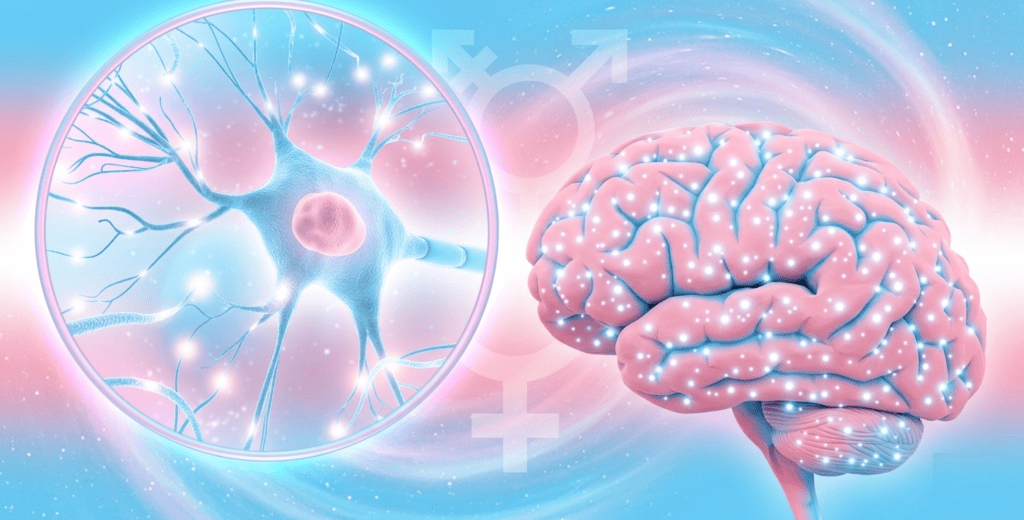
Is it true that brains are different depending on assigned sex? Yes and no. There are statistical differences in certain nuclei, but modern science speaks of a «cerebral mosaic» (Daphna Joel, 2015). Most brains have a mix of traits. Most fascinating, studies show that the brains of trans people, even before getting hormones, often share more structural similarities with their gender identity than with their sex assigned at birth.
Dismantling the myth of «instinct»
As a Philosophy student, it is central for me to question whether these differences justify sexist behavior. As a male who knows both sides of the hormonal setup, my answer is: No.
Biology is not a destiny or an excuse. Behavior (how we treat others, how we occupy space) passes through prefrontal cortex. Therein lies ethics and our ability to decide. Machismo is a social learning, not a cellular impulse. Attributing violence or dominance to ‘male nature’ is a fallacy that seeks to exempt the subject from his ethical responsibility.
At the end of the day, the most profound effect of the transition is the identity congruence: the cessation of an internal war that allows us to achieve a functional stability. This homeostasis returns to us the energy that we previously lost in dysphoria, allowing us to inhabit the world not from reaction, but from a conscious and authentic presence. The transition, then, is not only a change of form, but a conquest of one’s own sovereignty.

Maíl Galo, Trans male (29) student studying philosophy and psychology. IG: @galo_mail
Sources and Bibliographic Citations:
- Joel, D. (2015). Sex beyond the genitals: the mosaic of the human brain
- Kranz, G. S., et al. (2014/2020). White matter microstructure in transgender people before cross-sex hormonal treatment. Diffusion tensor imaging study.
- Hahn, A., et al. (2016). Testosterone administration modulates gray matter in specific language areas. Psychoneuroendocrinology.
- The Lancet Diabetes & Endocrinology (2023). Hormone therapy and mental health outcomes in transgender adults.