
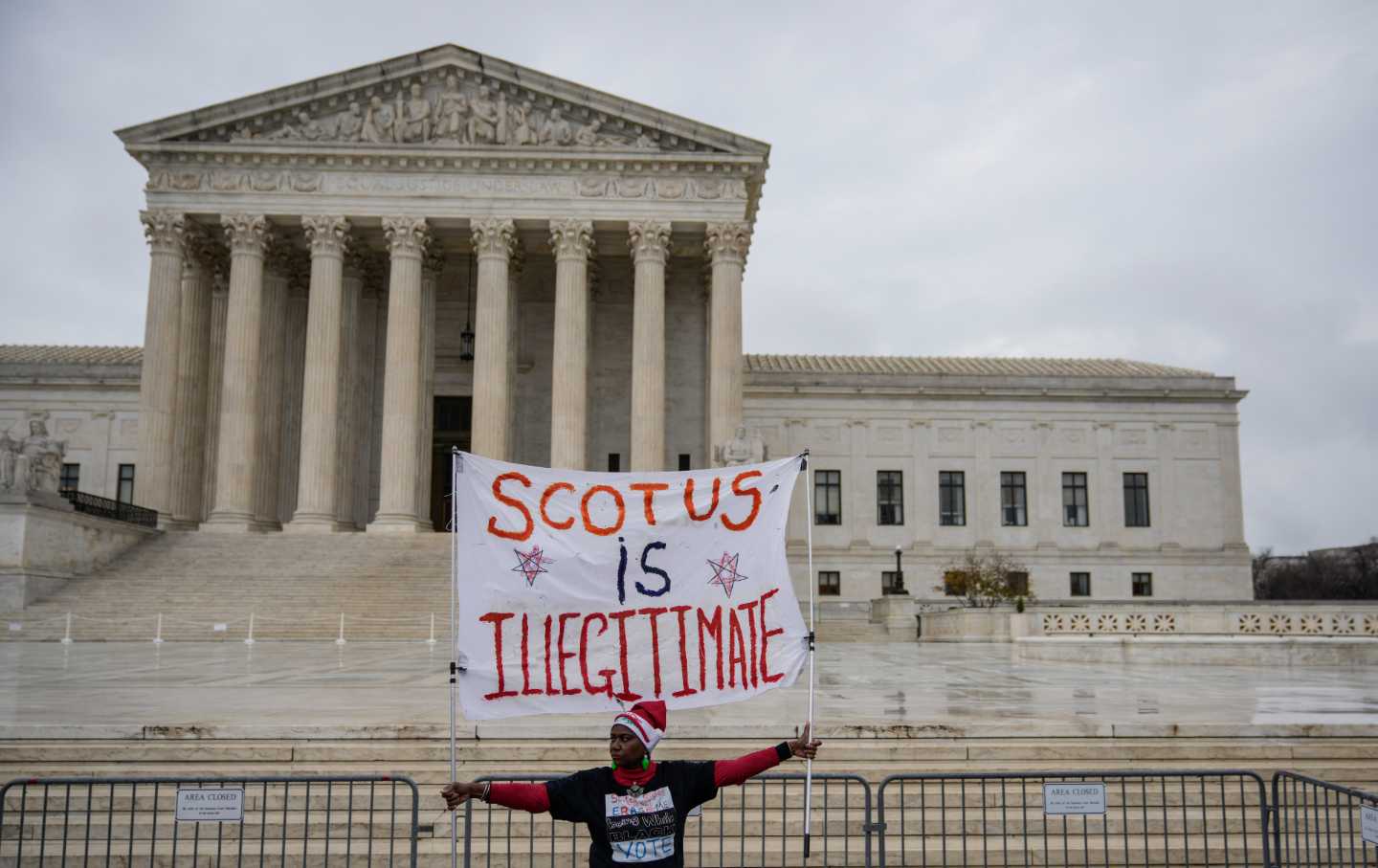
Protesters rally during the “No Kings” national day of protest in Los Angeles, California, on October 18, 2025.
(Frederic J. Brown /AFP via Getty Images)
The No Kings 3 protests this Saturday are going to be big—maybe the biggest day of protest in American history. Leah Greenberg, cofounder and codirector of Indivisible, will explain.
Also: Trump has renewed his yearlong campaign against universities that have been resisting his authoritarian rule—he’s focused his attacks on the most prestigious private university, Harvard, and the most prestigious public university, UCLA, suing each of them in the past week for… “antisemitism.” David Myers, who teaches Jewish history at UCLA, comments.
Subscribe to The Nation to support all of our podcasts: thenation.com/podcastsubscribe.
Jon Wiener: From The Nation magazine, this is Start Making Sense. I’m Jon Wiener. Later in the hour: Trump has renewed his year-long campaign against universities that have been resisting his authoritarian rule – he’s focused his attacks on the most prestigious private university, Harvard, and the most prestigious public university, UCLA, suing each of them in the past week for – “antisemitism.” David Myers, who teaches Jewish history at UCLA, will comment. But First: The No Kings 3 day of protest will be this Saturday–it’s gonna be a big one. Leah Greenberg of Indivisible will explain – in a minute.
[BREAK]
Maybe you heard the news: this Saturday, March 28th, is the day for the next No Kings mobilization called by Indivisible and its allies. It’s going to be a big one. For that, we turn to Leah Greenberg. She’s co-founder and co-executive director of the Indivisible Project, a grassroots movement of thousands of local Indivisible groups working to elect progressive leaders, rebuild our democracy, and defeat the Trump agenda. And now she’s got a new weekly podcast, “What’s the Plan?” It’s about the actions we can take right now that have the most impact. Leah Greenberg, welcome back.
Leah Greenberg: Great to be here.
JW: The last No Kings Day of protest, October 18th, we had 2700 events in all 50 states involving a total of 7 million people. That seemed to have been one of the biggest days of protest in American history. What do you think will happen this Saturday?
LG: Well, I’m superstitious, so I never give I never assign numbers in advance. But what I can tell you is that we are topping out at, we’re topping at over 3000 events all over the country that are already on the map, which means that we are well over the 2700 that we saw last time around. These are, you know, small towns in places that maybe have never even had a progressive protest before, but that are collectively coming together and pushing back. So, we are seeing an enormous amount of enthusiasm and energy for the event. We are seeing an enormous amount of outrage at everything the Trump administration is doing, and we are expecting another big day of mass defiance.
JW: Well, now it’s time for your Minnesota moment. That’s news from my hometown of Saint Paul that you won’t get from Sean Hannity. What are the plans for the No Kings 3 rally this Saturday at the state Capitol downtown Saint Paul?
LG: When we were when we were thinking about what are the stories that a no kings collectively can tell in this moment. One thing that we thought was really important was to center the story of the horror that was visited on Minnesota by Donald Trump, by his secret police, and then the extraordinary, dedicated, creative, nonviolent, disciplined resistance that rose up to meet it, right? Because fundamentally, this is a story of Donald Trump trying to brutalize a blue state because he perceived it to be in political disagreement with him — using an extraordinarily racially discriminatory force that were coming in and creating, basically, a reign of terror, and then being defeated, politically and practically, by an army of, you know, activists and immigrant rights organizers and soccer moms and retirees and workers and faith leaders and just about everybody who collectively came together and pushed back and said, “no, you’re not going to do this to my neighbors.”
And so that is an incredibly important story to tell when you’re operating under a would-be authoritarian, when things feel really dark a lot of the time. It’s important that we tap into these moments that are actually about our collective power when we work together, when we take that, when we sacrifice and risk together. And so the story of the flagship event in Minnesota is really going to be about centering those local voices, the people who organized, the people who protected their neighbors, the people who were in harm’s way and pushed back — with a little bit of support from some national voices and some national representatives who will tell that story in some creative ways. So, for example, we’ve got Bruce Springsteen joining to sing his song about Minneapolis, as well as people who have been on the ground and who were leading the charge the whole time.
JW: I think you have some other out-of-towners coming.
LG: Well, we know that Bernie Sanders is confirmed, as well as Jane Fonda, who has been, many folks know, has been involved in organizing artists across the country to push back and raise their voices. So we’re going to have some folks from all over who are coming together with that Minnesota story.
JW: Also, the lieutenant governor, Peggy Flanagan, will speak. She’s running for the Democratic Party nomination for the open Senate seat there. Hasn’t Indivisible made an endorsement in that race?
LG: Indivisible has endorsed Peggy Flanagan. Our statewide network endorsed; many, a number of local groups too. We had a resounding vote in her favor. All Indivisibles are really excited to come around behind Peggy Flanagan. She is a fighter and an organizer and exactly the kind of person that we are looking forward to getting into the Senate.
JW: We remember the first No Kings Day rally in Saint Paul last June. The night before, the Democratic speaker of the state House of Representatives, Melissa Hortman, was assassinated along with her husband by an anti-abortion activist. And the killer was still on the loose when the No Kings rally was scheduled to start. How did you decide to go ahead with that rally–at a time when some people, including the police, said it was too dangerous?
LG: Well, fundamentally, I want to give credit to the local organizers of that rally, because they were extraordinarily determined that threats would not stop them, that in fact, this was a moment to come together and memorialize Melissa Hortman and to stand against political violence. And what we saw was an extraordinary number of people responded to that call and turned out that day.
JW: Yeah. I remember watching it on my computer. 30,000 people showed up despite the apparent danger. I remember Attorney General Keith Ellison gave a great speech. And that’s the same place that the rally will be held this Saturday.
LG: That’s right, that’s right.
JW: Well, Indivisible took the lead in scheduling the more than 3000 No Kings protests this Saturday. There are thousands of Indivisible groups. But you don’t do this alone. You have partners. I started to count the groups listed on the partner’s page. It’s in alphabetical order. The AAUP, the ACLU, AFSCME, the AFofL, Amnesty International. I got to 24 partner groups and had not finished the letter “A” yet. So, I think it’s fair to say Indivisible has a lot of partners.
LG: The beauty of this is that it is a broad front against fascism. It is people from the left and to the right who are collectively coming together to say, “we are not going to write our own full policy platform, but we are going to collectively agree on pushing back to fight for our democracy, to fight against illegal, unconstitutional, catastrophic wars to protect our neighbors. We can come together to do that.” And, you know, that is really powerful.
And I will also just note events of this scale, the amount of organizing and the amount of work that goes into it are wildly beyond the capacity of any organization to hold. And so, this could not happen if it was not a massive collaborative effort with an enormous number of folks across the ecosystem, I cannot successfully name everybody who throws in. But, you know, American Federation of Teachers, SEIU, MoveOn, Public Citizen, ACLU, Black Voters Matter, Transformative Justice Coalition – we have a ton of folks who are collectively pushing so incredibly hard in order to make this happen. And it’s really, it’s really so far beyond the point where it could be one organization.
JW: Well, some of our skeptical friends always ask, do protests really work? Micah Sifry has been thinking about that. He points out at his Substack, “The Connector” a few interesting cases. When Harvard first came under attack by Trump, it didn’t make its decision to hold firm and sue the administration until after the first big Hands Off rallies. That was April 5th, 2025. And while the courts we think of as existing in their own world of legal reasoning, we do know that judges pay attention to the news and the rulings blocking Trump from deploying the National Guard wherever he wanted to take note of the significant public protest that took place against those deployments at the No Kings events. And finally, Congress voted to force the release of the Epstein files, nearly unanimously, only after 7 million people turned out for No Kings 2 in mid-October. So, I conclude: protest works.
LG: And some of those, we heard really direct support for some of those events, right? Like when we, after Hands Off, we heard from people who were very personally involved in the Harvard organizing effort that there was an almost immediate vibe change.
And so much of the theory of these massive multi-issue collective broad front moves is really, actually, not about trying to win on one specific policy. It is about trying to change the atmosphere in which every other actor in American society is making their decisions. Right? Because fundamentally, when you are looking at a would-be authoritarian who is trying to consolidate power, as Donald Trump has been for the last year and a half, part of the danger are the things he does, but the bigger danger is how every other actor in society responds to him, and whether they preemptively move to comply, to obey, to do his bidding, to fall in line. A lot of the damage that we saw in the first year of the Trump administration wasn’t a direct move by Trump. It was other actors who were – they threw out their DEI policies, if they were corporations, in order to appease them, they started moving to have their algorithms favor Trump. They started to collect – universities started to fold to his demands. All of these actions were basically kind of individual actors trying to make a rational calculation that their interests were best served by complying with the Trump administration. And the fundamental theory of the case with the No Kings rallies is that we’re going to change some of those actors’ calculations by demonstrating that resistance is everywhere, that it is in every community – that your people you know are part of it, and that we are big and powerful and that we are ultimately going to win. And so, you better be making the kinds of decisions that you can live with and defend in a year or two years or in four years, when there is accountability.
JW: So more than 3000 events organized for this Saturday. You’ve been doing a lot of work to make sure that every one of those 3000 events is peaceful and nonviolent. And you’ve been running a lot of trainings for organizers and protest marshals–know your rights training, de-escalation training. Tell us what happens in those trainings.
LG: If you sign up to host an event, you are going to need to designate a safety lead. They are going to attend one of our intensive safety trainings and create a safety plan. We really focus on how do we make sure as many people as possible, collectively, are trained and prepared and understand how to have a safe event, understand what kinds of options they have, make an assessment about how they’ll work with, or not work with, local law enforcement — all of the things that go into pre-planning in order to make these as safe and as supportive as possible.
JW: And you’ve also held trainings for thousands of people in learning how to talk to your friends and family and neighbors about No Kings and why they should join you at your local event. Why it matters that they do it now. The next one of these is scheduled for Wednesday, March 25th, 5 p.m. Pacific, 8 p.m. Eastern. Tell us about what happens, what’s going to happen at that one?
LG: Well, look, fundamentally, you know, we don’t control the big networks. We don’t control the algorithms the way that we are going to get to bigger and bigger protests and bigger mass movements is by people who form connections with each other and who talk through to why it is important to get involved. And so that’s really about the practical skills of building those relationships, of getting people involved, of giving them, you know, their own why and their own reason to turn out. And so fundamentally, what we want to do is give people the tools to have really pretty simple conversations in which you invite additional folks to join you.
JW: I took a look at the map for my home state of Minnesota to see where things were happening there on Saturday, just in northern Minnesota, in Duluth, there’s going to be a rally. This is Duluth is at the head of Lake Superior. The rally will be at City Hall up the north shore, north of there on the road to highway 61, going up to Canada at Two Harbors, there’s a rally at Silver Bay, there’s a rally, at Grand Marais, there’s a No Kings rally. These are some of my favorite places on earth. Up on the Iron Range where Bob Dylan grew up. There’s one in Ely, the gateway to the boundary waters in Bemidji at the Paul Bunyan statue in International Falls. That’s the northernmost place in the continental United States. The No Kings protest in International Falls is at Smokey Bear Park, four blocks from the Canadian border. You could come up with a similar list of smalltown No Kings protests for every state of the Union. It’s really my favorite thing about No Kings Day, the idea that we are everywhere.
LG: That’s absolutely right. And you know, look, a lot of times the national coverage is going to be like the drone photos of the city with the big crowd. And that’s good and important, we want to get those big crowds out. And also, a lot of the catalytic effect of No Kings is that person who signs up and says, “you know, I’m going to have a rally in a small town in Tennessee that hasn’t had one of these before.” And then suddenly it turns out that there are 50 people who are in your small town or in the neighboring town who actually wanted to come out, wanted to be together, wanted to be in community. And suddenly you have got a new community that you didn’t have before. And what we hear from people all the time is that that’s just the beginning, right? Those folks stay in touch. They keep organizing. Suddenly, there is a new hub of people who are out there who are doing the work, and that is some of the power that we see on an ongoing basis. It’s not just about the day of. It is about taking as many people as possible and moving them into an ongoing cycle of action.
JW: And for people who haven’t signed up yet, how do you find that no kings protest near you?
LG: You can go to nokings.org and you can check out our map. There will be – I can pretty much guarantee you there will be one near you.
JW: I took a look at the map for my neighborhood of LA, and I learned there’s a No Kings car caravan for LA. The description says, “why choose just one when you can join a bunch of them, without taking a single step? Road Outrage L.A. is an organized car caravan that will do a big loop around central L.A., visiting half a dozen No Kings demonstrations. With our presence–and our horns–along the way, we’ll make sure to wake up the shoppers on Rodeo Drive; we’ll shake up the tourists on Hollywood Boulevard; we’ll pump up the hipsters in Silverlake; we’ll cheer up our immigrant neighbors in East L.A.. The party starts in a parking lot at 10 a.m. in Culver City,” and it ends at my neighborhood No Kings event, “No Kings Pico-Robertson, at 3:30 in the afternoon.
LG: I love the creative stuff. You know, we are hearing some really fun plans across the country for people who are who are going to be doing new and innovative actions this time around.
JW: And I just remember that the last No Kings Day, basically, it was just fun. Everybody looking good, everybody feeling great about seeing each other. It was a memorable day. I think this one will be too.
LG: I think this will be a powerful moment. I think that, you know, the clouds are dark. We are all facing an escalating and horrifying war, that is driving up our costs. We are continuing to push back against the secret police force around the country that is just recently being dispatched to airports. And also, fundamentally, this is a would-be authoritarian who is flailing and overreaching because he understands that he is losing to us. And Saturday is the moment where we project that collective power.
JW: Leah Greenberg — she’s co-founder and co-executive director of The Indivisible Project. She’s one of our heroes. Leah, thanks for talking with us today.
LG: Pleasure to join.
[BREAK]
Jon Wiener: Trump has renewed his campaign against universities that have been resisting his authoritarian rule. He’s focused his attacks on the most prestigious private university, Harvard, and the most prestigious public university, UCLA. He sued each of them in the past week for “antisemitism,” for what the Justice Department says is the school’s failure to protect Jewish students and faculty from antisemitic attacks. For comment, we turn to David Myers. He’s a distinguished professor at UCLA, where he teaches Jewish history. He’s written for The LA Times op-ed page, The Forward and The Atlantic, and he’s been an activist working for Mideast peace for decades. David Myers, welcome back.
David Meyers: Great to be with you, Jon.
JW: Last time we talked here, it was right after Trump said he was fining UCLA $1 billion to punish the school for antisemitism. This came after a tumultuous spring of campus protests in 2024 over Israel’s war in Gaza. A federal court blocked Trump’s billion dollar fine, and he dropped his appeal of that ruling and abandoned the idea. Instead, his Justice Department in the past week under Attorney General Pam Bondi, has filed a lawsuit against the University of California. It’s a Title VII lawsuit under the Civil Rights Act of 1964, which prohibits employment discrimination based on religion, among other things. The feds accuse the UC administration of “routinely ignoring a severe and pervasive wave of antisemitism.” According to Pam Bondi, UCLA systematically ignored cries for help from its own terrified employees. The legal claim is that Jewish faculty and staff at UCLA face a hostile work environment because of the administration’s failure to protect them from antisemitism.
And in response, a group of 130 Jewish faculty and staff signed a letter challenging those allegations. You were one of the signers. Tell us about the response of those Jewish faculty and staff to Trump’s lawsuit.
DM: Yeah, well, the first thing I want to say is that it was two colleagues of mine law professors, Ariela Gross and Joey Fishkin, who led the effort to assemble Jewish faculty and staff to really refute the claim that there was “severe and pervasive discrimination in the workplace” at UCLA. That was a claim that is utterly foreign to the signatories of this letter. It doesn’t resemble the campus that we know. Indeed, there has been a great deal of political activism and tension on our campus. But to the minds of the signatories, that does not translate into the kind of workplace harassment that was alleged in the DOJ complaint. We represent a significant constituency of Jewish faculty and staff.
JW: And the letter says that you and your colleagues oppose taking on antisemitism with “more draconian limits on academic freedom and free speech, to the detriment of all of us, including Jewish faculty and staff.”
DM: Right. I mean, what seems to define antisemitism in the Department of Justice complaint is expression of support for Palestinian liberation or freedom. So, there’s an equation of pro-Palestine equals antisemitic, at least as far as I read it in the complaint. One woman, for example, quoted in the complaint, referred to the encampment for the pro-Palestine encampment as “utopia”– and that was brought as evidence of antisemitism. So, I mean, the equation seems to be total, one-to-on direct correspondence. And if you accept that, then you are virtually eliminating any possibility of expressing any support at any time for the cause of Palestinian freedom, self-determination, or liberation. There’s no possible phrase or expression you could use that would not be deemed antisemitism by that. That seems to me to be an unbelievable curtailment of the right to free expression.
JW: Most of the current lawsuit, and most of the formal and informal complaints against UCLA are about this Gaza encampment, set up in April 2024. It was the site of the worst event in memory at UCLA, in my opinion at least. At the end of April 2024, a mob of Zionist militants came from off campus and attacked the encampment. Police did nothing, for hours. Remind us about that horrible night.
DM: Yeah. Which really was, I think, the worst night in my 35 years at UCLA. So, an encampment had been set up, I believe, five days earlier. On the preceding Sunday, there was a counter-demonstration directly across from the encampment where I got to see tensions really developing between the two sides. And in fact, a number of colleagues and I were restraining largely the pro-Israel side from screaming at or even hitting the pro-Palestine side. Though indeed, tempers were flaring on both sides. And that in some sense was an adumbration of what would come two days later on Tuesday night, when a group of pro-Israel activists, some of whom were Jewish and some of whom were not, attacked the encampment physically with two by fours and their fists and other instruments for some four hours without intervention from law enforcement, a kind of remarkable, unprecedented, horrifying sight in which this group of protesters with whom you can agree or not agree were subjected to four hours of physical attack. And then what made it all the more poignant and really inexplicable was the next day, the response by the administration was to call in hundreds of police and take down the encampment, as if those who were guilty of the transgressions of the previous night were, in fact, those inside the encampment, who had been attacked for four hours.
That brought an end to the encampment and then the beginning of recrimination about who was actually guilty for having transformed our campus. That was something that Trump decided to take up relatively early in his tenure in what I think of as Operation Academic Fury 1.0, first attack on UCLA, withholding $584 $4 million in August 2025, then tacking on additional a billion. That was greeted with perplexity on the part of so many of us on campus who didn’t recognize the campus described in the complaint. And now we’re facing, as you described at the outset, Academic Fury 2.0. In typical Trumpian fashion, sort of they forgot about the attack on the university for a spell, it seems, or waned a bit. And now they’re back, probably as an act of deflection from other bad things that are going on. But in any event, we’re back with this new Department of Justice complaint, which makes similar claims and fortifies others that seem to be, on the face of it, unsustainable and even preposterous.
JW: And in between the two federal attacks on UCLA, UCLA itself agreed to settle a private lawsuit brought by Jewish students and a professor. UCLA last July agreed to pay $6.5 million in response to a lawsuit of this group that said the university allowed antisemitic discrimination to take place on campus during these pro-Palestinian protests. The most inflammatory part of that complaint was that protesters had created a “Jew-free zone” on campus, with the knowledge and acquiescence of university officials. And under the settlement, the university admitted that it had “fallen short.” It agreed to pay $2.3 million to eight Jewish groups, 320,000 to a campus initiative to fight antisemitism and $50,000 to each of four plaintiffs.
But was the Gaza protest encampment really a “Jew-free zone”? Weren’t there many Jews who were part of the encampment? And didn’t the Gaza encampment actually have a Passover Seder?
DM: Yeah, there was a Passover Seder. And a shabbat service. But to the best of my knowledge, there was not a “Jew-free zone.” I never saw that. And someone who came to know the physical layout of the camp and –well, the aforementioned Professor Joey Fishkin, wrote a long description of what he saw as part of his own legal analysis of the various legal efforts by the administration against UCLA, and he affirmed what I had just said and saw, which was I never saw a Jew free exclusion zone.
I imagine that some of the signs and chants calling for Palestinian liberation might be uncomfortable for people who define themselves as strong supporters of the State of Israel or Zionists. But that does not mean that there was a zone of exclusion intended for those of Jewish faith or identity. There was no such exclusion zone that I saw, nor that that careful observer saw as well.
One other thing I want to just add about that settlement was that it surfaced a claim that now figures centrally in the latest complaint, which is that Zionism is a religious belief that Jews constitute one people. And this seems to me to be a complete confusion and distortion of what Zionism is. I mean, it’s a very coarse understanding of what Zionism is, and it conflates a political ideology, a national movement, and a strain of Zionism, and for that matter, the most, in some sense, offensive and supremacist strain of Zionism today, an ideology that, I suspect, very few of the people who call themselves Zionists as a religious matter would subscribe to. That claim was first heard in the arguments of the students that UCLA settled. And now it has surfaced again as a central pillar of the claim in the Department of Justice complaint of February 2026. Those, in some sense, are two of the pillars of this complaint: anti-Zionism is antisemitic, and Zionism is a religious belief that therefore qualifies under Title VII.
JW: The new UCLA lawsuit is about the university creating a hostile work environment for Jewish faculty and staff. The Harvard lawsuit, which we need to talk about for just for a minute, which was filed last week, was about Jewish students who the Trump administration said had not been protected by the school from severe harassment. And because of that, Trump says the government does not have to pay Harvard any existing grants, and Harvard can be forced to pay back federal grants it has already received, billions of dollars. This new lawsuit came after a federal judge rejected Trump’s effort last year to cut $2 billion in grants to Harvard. What do you think about the executive branch cutting billions of research grants from Harvard because of the school’s response to Gaza war protests on campus?
DM: I think at some level, it can be reduced to the small-mindedness of Donald Trump, who thought he was going to achieve a settlement with Harvard, and Harvard proved to be a more formidable opponent than he imagined, just as he in some sense thought he was going to achieve a deal with Iran, didn’t, and decided to go to war. I mean, there’s a common thread here. This is a Trumpian negotiating stance: If you don’t get what you want, on the terms you want, you invoke the nuclear option. So again, after months and months and months and months of negotiations with Harvard, when Harvard’s president, Alan Garber, proved to be somewhat less yielding than I think the administration thought, they decide to file another lawsuit, making the same kinds of claims, the same kinds of specious claims about slogans and chants creating discomfort.
And you know what? That’s what happens on college campuses. You’re going to encounter slogans and chants that make you uncomfortable, and if you don’t, you’re probably not in the right place. And you know, you might want to take a pause and be ready to, you know, expand your mind and encounter ideas with which you’re with which you’re uncomfortable. Like that’s what’s going to happen on a college campus. That’s what advocates of viewpoint diversity are always saying we should be doing. And in fact, that’s what occurred.
To be frank, there were chants that I heard that sometimes made me uncomfortable, or signs that I saw, but I don’t assume that everything that makes me uncomfortable is therefore an odious and toxic antisemitic slur that merits federal intervention. I think that’s 17 steps too far from sort of encountering ideas that push you out of your comfort zone. And it is really remarkable that, you know, precisely those advocates of viewpoint diversity are the ones who want to achieve viewpoint conformity around Israel-Palestine, around questions of Zionism, and even around questions of what Jewish identity is.
JW: The big picture here is Trump is claiming to protect Jews on campus, but his targets are institutions that have provided a crucial base of opposition to his authoritarianism. Let’s talk about Trump’s use of antisemitism to target his opponents.
DM: It’s a classic weaponization of a legitimate source of concern for political purposes. I must confess, I gravely doubt the sincerity of Donald Trump in caring about the well-being of Jews, or in combating antisemitism. I mean, he has made his bed with far-right figures who have become increasingly disinhibited in expressing their own antisemitic views, and he’s narrowly nary once renounced them. So, I must confess, I find laughable the proposition that Donald Trump is leading the crusade against antisemitism. He’s leading a crusade with some crusaders whose religious ideology he doesn’t fully understand. On behalf of a kind of illiberal authoritarianism. And the fight against antisemitism, as he defines it, is a key pillar in that, it’s really about a certain kind of appreciation for an ethnocentric vision of Israel that he resonates with, that resonates with his own vision of a white nationalist America. That’s what Jewish means for him. What’s so interesting in this current moment is that some of his followers subscribe to that view, and some have completely departed from that stance altogether, and have said, “no, that version of ethnocentrism that Israel represents, we now denounce and regard as, you know, as toxic and dangerous to the United States.” They connect it to that old antisemitic trope of a Jewish global conspiracy. And there is kind of an implosion within MAGA world that’s quite fascinating to observe and terrifying, in part because it’s giving voice to a new, virulent form of antisemitism that’s meeting up with antisemitism that I think, as I argued in a recent LA Times, op ed is being stimulated by Israel’s own action.
JW: Before we get to that, we need to look at one more element of all this, which is Trump is not alone in invoking antisemitism. There are some very prominent Jewish groups that are not just supporting him but providing him with arguments and evidence and private lawsuits.
DM: Yeah, there are some groups, Jewish groups at UCLA, that have become willing participants in the efforts to take down our university. There’s a curious feature here of Jewish history that I want to call attention to, and that is, for centuries, Jews survived by affecting an alliance with the sovereign, what is known as the Royal or Vertical Alliance. And in the circumstances in which Jews lived in feudal times, for example, that vertical alliance was really necessary in order to ward off attacks from the general populace, Christian Europe, which was strongly anti-Jewish in the current moment. It seems to me that the Vertical Alliance is a dalliance with the devil. The state is not acting in the best interests of Jews. The state is not acting in the best interests of the well-being of all Jews and Palestinians in Israel-Palestine and think anew of horizontal alliances with other groups that are subject to discrimination, intimidation, attempts at deportation that it seems to me where right is, where the right-minded Jews want to be, in that space.
JW: You have just published an important article in The LA Times op ed page about the sources of antisemitism. There’s a huge difference that we need to note between students on campus chanting “Free Palestine” and murderous attacks on Jews, like the effort recently at the Temple Israel in West Bloomfield, Michigan. And that raises the question, which you have been studying, what are the sources of antisemitism in America today? This is not just a matter for opinion. You’ve been doing research on this, and what have you found?
DM: Yeah, I’d say there are two things that are important to note: in recent times, sort of owing to the political pressures of the day, there’s been this claim that antisemitism can be described as a horseshoe. At the ends of that horseshoe are two largely equivalent bodies of antisemites, those on the left and those on the right, so: relatively equal.
What my coauthor, Joshua Goetz, a PhD student in political science at UCLA and I show, is that, in fact, the bulk of research that has been done, certainly prior to October 7th, suggests that antisemitism was considerably more pronounced on the right and far right than on the left and far left. So that dispels, we think, this notion of a virtual equation between left and right.
After October 7, there are competing vectors, and we don’t really have enough data to make an unequivocal claim about which camp is more pronounced in antisemitism. But we do think that it’s probably time to set aside the horseshoe theory of antisemitism. That’s point number one.
Point number two is really addressing an elephant in the room that we have avoided for too long, and that is that Israeli military action, violent Israeli action is a catalyst to antisemitism, to antisemitic action. We think maybe also opinion and expression.
But there’s a body of research which we have surveyed that suggests it is a catalyst or prod to antisemitic action. And one might look at what happened in West Bloomfield and say, that’s exactly an instance of what we’re talking about. The person who undertook this terrible act had recently lost his brother and his brother’s two children in an Israeli attack in Lebanon. The brother was a Hezbollah commander. So that in some sense captures or encapsulates the sequence that we’re trying to understand better.
And we think that, you know, in addition to understanding these two rather set categories, left antisemitism and right antisemitism, we really need to focus on a third factor, and that is Israeli action. And I should add to that, not just Israeli action. That’s a factor in its own right. But I would also add even more recently, say since the Second Iran War, perceptions of Israeli action and Israeli behavior in impelling the United States to enter war. So there’s both Israel’s own actions, and then there’s the perceptions largely of far right conspiracy theorists about or conspiracy theorists in general about Israel and Jews pushing the United States into war. So, Israel is a factor in this equation, and we have to come to terms with it and understand it a lot better.
JW: David Myers – you can read his article, “Antisemitism appears from the left and the right, but not equally” – at LATimes.com. David, thank you for all your work, and thanks for talking with us today.
DM: Always a pleasure to be with you, Jon.
Subscribe to The Nation to Support all of our podcasts
Support independent journalism that does not fall in line
Even before February 28, the reasons for Donald Trump’s imploding approval rating were abundantly clear: untrammeled corruption and personal enrichment to the tune of billions of dollars during an affordability crisis, a foreign policy guided only by his own derelict sense of morality, and the deployment of a murderous campaign of occupation, detention, and deportation on American streets.
Now an undeclared, unauthorized, unpopular, and unconstitutional war of aggression against Iran has spread like wildfire through the region and into Europe. A new “forever war”—with an ever-increasing likelihood of American troops on the ground—may very well be upon us.
As we’ve seen over and over, this administration uses lies, misdirection, and attempts to flood the zone to justify its abuses of power at home and abroad. Just as Trump, Marco Rubio, and Pete Hegseth offer erratic and contradictory rationales for the attacks on Iran, the administration is also spreading the lie that the upcoming midterm elections are under threat from noncitizens on voter rolls. When these lies go unchecked, they become the basis for further authoritarian encroachment and war.
In these dark times, independent journalism is uniquely able to uncover the falsehoods that threaten our republic—and civilians around the world—and shine a bright light on the truth.
The Nation’s experienced team of writers, editors, and fact-checkers understands the scale of what we’re up against and the urgency with which we have to act. That’s why we’re publishing critical reporting and analysis of the war on Iran, ICE violence at home, new forms of voter suppression emerging in the courts, and much more.
But this journalism is possible only with your support.
This March, The Nation needs to raise $50,000 to ensure that we have the resources for reporting and analysis that sets the record straight and empowers people of conscience to organize. Will you donate today?
Jon Wiener
Jon Wiener is a contributing editor of The Nation and co-author (with Mike Davis) of Set the Night on Fire: L.A. in the Sixties.
More from The Nation
How Is Mamdani Doing? How Is Mamdani Doing?
Former Nation editor Don Guttenplan on how Mamdani is balancing pragmatism and principles as he deals with policing,
Donald Trump and a tough budget.
Trump’s Attacks on Voting, and on Iran Trump’s Attacks on Voting, and on Iran
David Cole talks about fighting a coming executive order restricting voting in the midterms, and John Nichols explains a congressional War Powers resolution on Iran.

How LA Defeated Trump! Plus, Bob Dylan’s Xmas How LA Defeated Trump! Plus, Bob Dylan’s Xmas
On Start Making Sense: Bill Gallegos on the withdrawal of the National Guard and marines from LA last summer, and Sean Wilentz on Dylan’s choice of songs for his Christmas album.