
Por Galo Maíl
In a world that tends to simplify reality into binary categories, biology emerges as the discipline that constantly reminds us of the inherent complexity of life. Far from the strict duality of «male» and «female» or «male sex» and «female sex», contemporary science is inclined to reinterpret the concept of biological sex not as a fixed identity, but as a spectrum of reproductive possibilities.
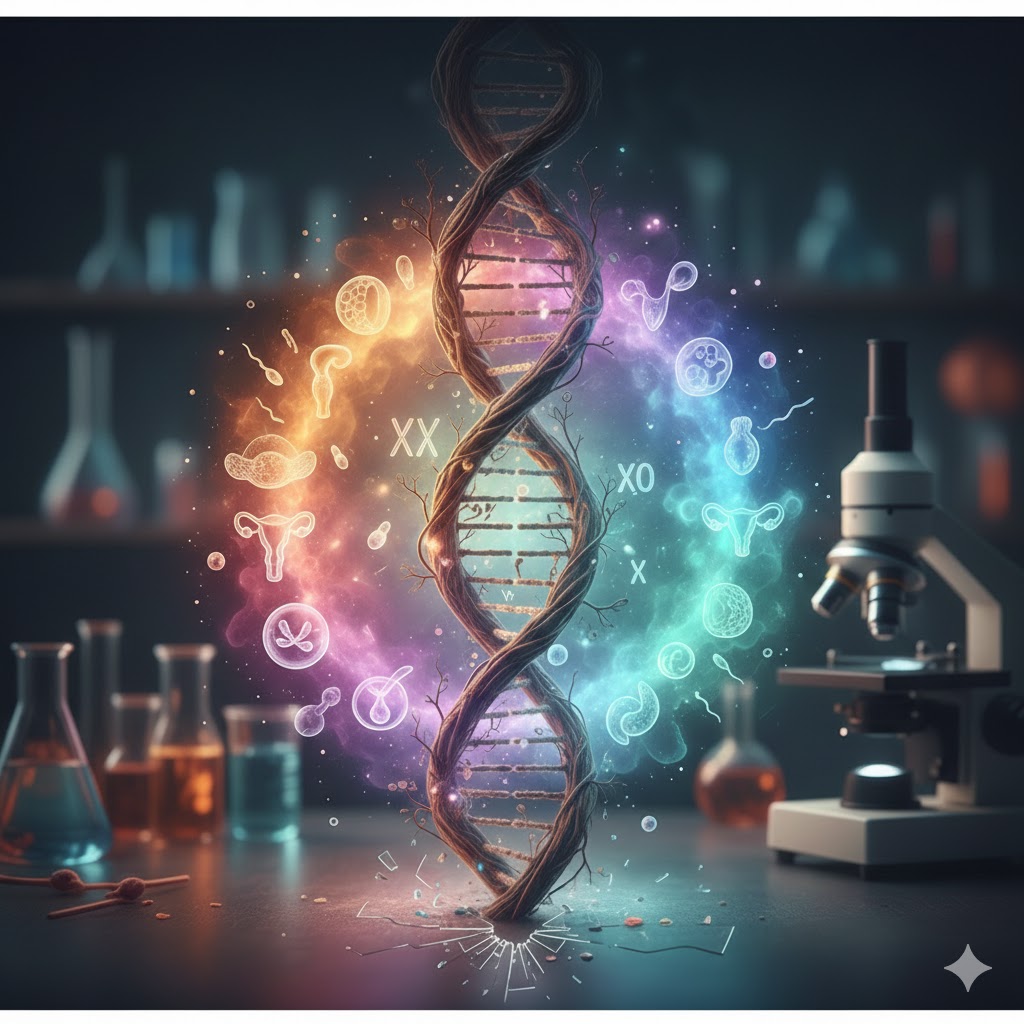
What Really Is Biological “Sex”?
Traditionally, it has been taught that an individual’s biological sex is clearly and immutably defined at birth, based on observation of the genitals. However, this approach drastically simplifies a much more intricate reality that encompasses multiple levels of differentiation.
According to experts in genetics and endocrinology, to talk about biological «sex» we must consider the interaction of at least five key factors:
- Sex Chromosomes: (XX, XY, XXY, X0, etc.)
- Gonads: (ovaries or testicles)
- Sex Hormones: (Levels of estrogens, androgens, etc.)
- Internal Genitals: (Uterus, prostate, etc.)
- External genitalia: (Penis, vulva, etc.)
When all these levels align in a typical way, we speak of sexual differentiation concordant. But biology shows that this perfect alignment is just one of the multiple configurations possible.
The Diversity of Reproductive Possibilities
The current paradigm of biology suggests that the true evolutionary goal is not to create perfect «male» or «female» individuals, but to create individuals with different capacities to contribute to reproduction.
This is where the concept of reproductive possibilities gains centrality. The existence of people intersex (previously called hermaphrodites) is the clearest example that the binary is insufficient. Variations in sexual differentiation (VDS) are more common than is believed, affecting approximately 1.7% of the populationa proportion similar to that of redheads.
- The Central Argument: What distinguishes two people with different biological «sexes» is not an absolute essence, but the differences in gamete types that can produce (eggs or sperm) and the organs necessary to carry out or participate in a pregnancy. In this sense, nature creates a variety of biological «packages» optimized for different roles in the perpetuation of the species.
Social Impact: Breaking Stereotypes
This new biological understanding has profound social implications. By recognizing that sex is a spectrum and that intersexuality is a natural variation of the human species, the biological argument that supports the existence of only two genders and the rigid social roles associated with them is dismantled.
Biology, far from imposing limits, offers us a lesson in diversity and flexibility. By accepting that there is not a single «sex» but rather a range of possibilitiesscience invites us to stop pathologizing or making difference invisible. This opens the door to a more inclusive society where gender identity and sexual orientation can be better understood as phenomena that interact with, but are not rigidly determined by, the complex and varied reality of the biological body.
The next time we talk about sex, let’s remember that biology tells us that life is infinitely richer than just two boxes.