

The New York Court of Appeals revoked the sentence that forced the country to pay more than USD 16,000 million for the expropriation of YPF. This is a historic ruling in one of the most relevant trials against Argentina.
In a historic ruling, the New York Court of Appeals annulled the ruling that condemned Argentina to pay millionaire compensation for the expropriation of YPF in 2012.
The decision reverses what was ruled in the first instance by Judge Loretta Preska and represents a key victory for the country in a litigation that spanned more than a decade.
According to the court, the shareholders’ demands are not admissible under Argentine law, which nullifies the payment obligation that exceeded USD 16,000 million.
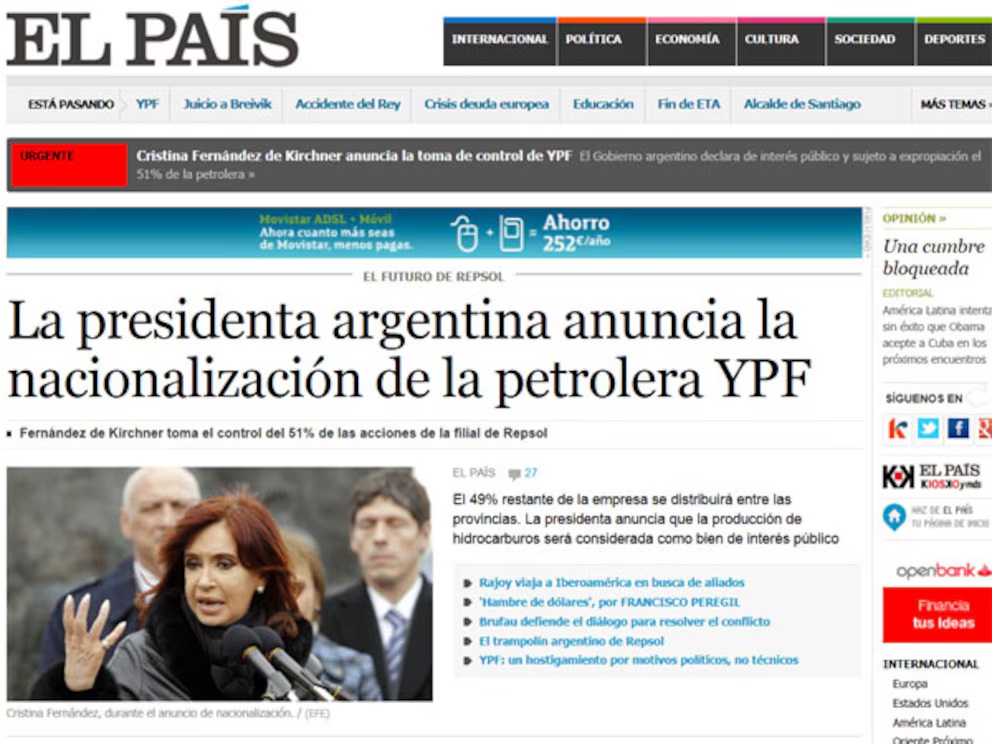
The expropriation of the oil company was promoted during the government of Cristina Fernández de Kirchner, in a political decision aimed at recovering state control of the country’s energy resources.
Currently, YPF has consolidated itself as a strategic company for the national economy and is one of the main drivers of dollar income, especially from the development of Vaca Muerta.
A failure with global impact
The YPF case is considered one of the largest trials against a sovereign State in international courts.
In addition, the ruling directly impacted the Burford Capital fund, the main promoter of the lawsuit, whose shares plummeted after learning of the court decision.
Political repercussions
After learning of the ruling, different political figures celebrated the decision.
Cristina Fernández de Kirchner maintained that the nationalization of YPF “was done in accordance with the law” and defended the measure as a strategic decision for the country’s energy sovereignty.
Along the same lines, the Buenos Aires governor Axel Kicillof affirmed that “justice was done” and questioned President Javier Milei, stating that “he should apologize for having supported the vulture funds.”
Furthermore, he stressed that the trial “was absolutely absurd” from a legal point of view and highlighted the role of YPF and Vaca Muerta as a lever for national development.
For his part, President Javier Milei said «we had to come to fix the mistakes of the useless Kicillof, during the second government of the corrupt Cristina Kirchner.»
What can happen now
Although the ruling represents a resounding victory, the plaintiffs could still attempt new appeals to higher courts in the United States, something that is unusual.
For now, the resolution marks a before and after in the litigation and clears up one of the main international judicial fronts that Argentina faced.