

Politics / January 1, 2026
John Lindsay expanded welfare, civil rights, and public spending—yet left New Yorkers politically disarmed. Zohran Mamdani should learn the lessons of his mayoralty.
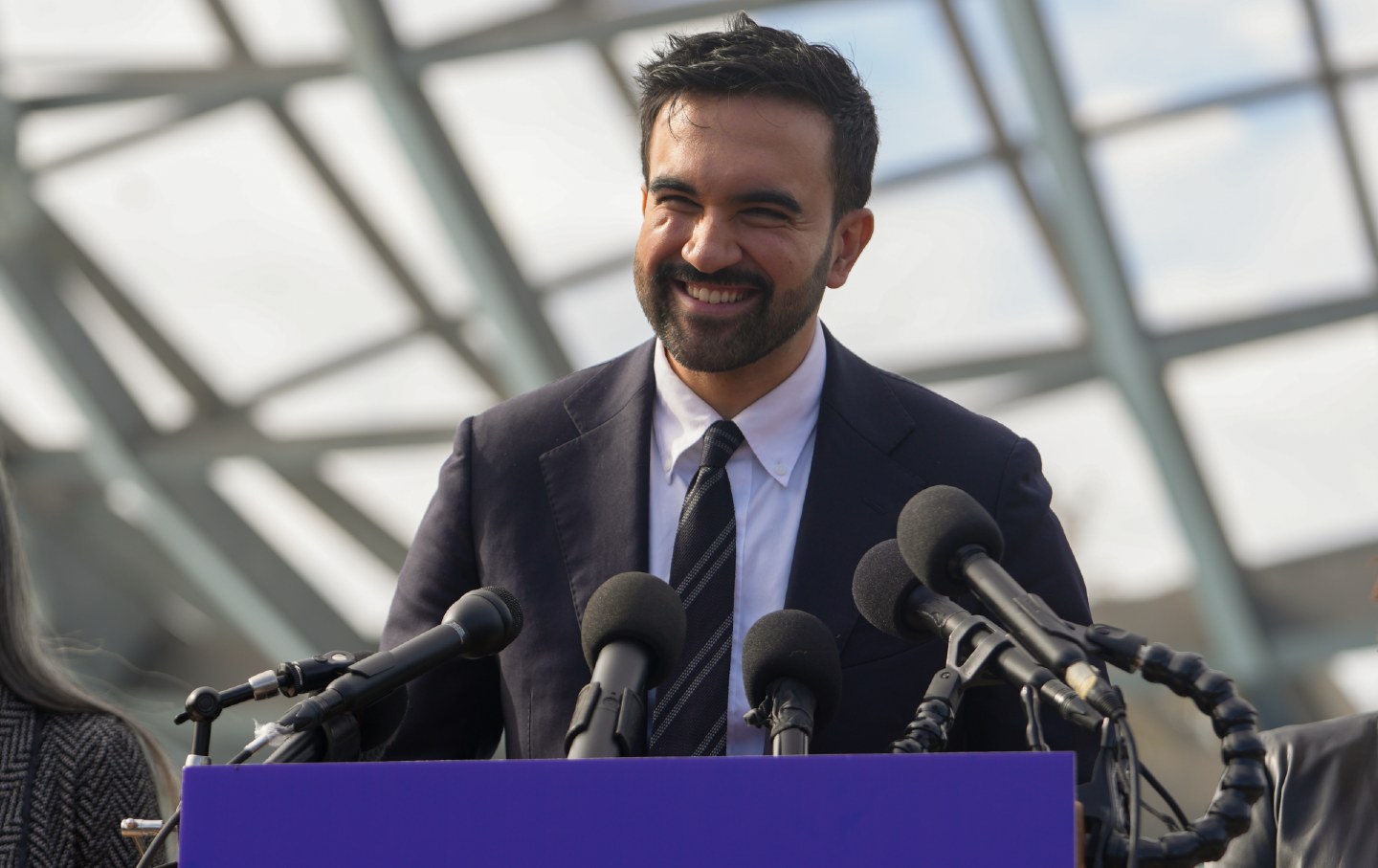
New York City Mayor-elect Zohran Mamdani reacts during a press conference at the Unisphere in the Queens borough of New York City, on November 5, 2025. Most of Mamdani’s big policy goals will be in need of funding from New York’s state government, plus universal childcare and free buses.
(Stephani Spindel / VIEWpress via Getty Images)
There are many ways a progressive politician can fail. They can fail to be elected. They can fail to deliver on their platform once in office. And they can also fail to build up the left’s power in a way that outlasts their administration.
This third possibility has often been overlooked by commentary around Zohran Mamdani’s election as New York City mayor. However, this scenario fits the tenure of John Vliet Lindsay perfectly: a New York mayor who, from 1966 to 1973, passed progressive legislation that leftists would dream of winning today, but whose administration nonetheless oversaw an erosion of working-class power.
Because of this failure, Lindsay’s good intentions and accomplishments were largely for naught. By the late 1970s, his legacy was all but undone and the ex-mayor himself became, in The New York Times’ words, an “exile in his own city.”
To avoid this melancholy fate, Mamdani must do more than deliver good policies on behalf of the city’s most marginalized. He must also build durable power among New York’s working class through his political organizations, coalitions, and approach toward the city’s political economy. If Mamdani can learn from Lindsay, he can establish a progressive legacy that can survive and be built upon. If he doesn’t, then he will become what a reporter once said of Lindsay: someone who “gave good intentions a bad name.”
A Liberal Triumph
Current Issue
Lindsay, like Fiorello La Guardia, won the 1965 mayoral election on the Republican Party ticket. This was hardly his only difference with Mamdani. Lindsay hailed from an impeccably blue-blood WASP family. He gained prominence on the national rather than state level. And he was distinctly uninterested in spreading socialism.
Yet a glance at his 1965 mayoral campaign poster, emblazoned with demands like “free city college tuition,” “strong rent control,” and “better public housing,” hints at the similarities between Lindsay and Mamdani. Like Mamdani, Lindsay was buoyed to power in the face of a divided opposition, with the support of college-educated professionals and groups that had long been alienated by the city’s established power structure, particularly Black and Puerto Rican New Yorkers.
Like Mamdani, Lindsay saw city government as a tool for social justice. His platform called for neighborhood-oriented policymaking, increased welfare spending, and robust antidiscrimination measures. Indeed, in many ways his program embodied elements from both the Students for a Democratic Society’s radical Port Huron Statement and Lyndon B. Johnson’s liberal Great Society effort. As one municipal white paper read, his administration sought the “fullest participation in the determination of governmental policy by the citizens who are affected by that policy, while at the same time achieving the economies of large operation and the consistent coordinated use of city-wide resources.”
And, in many ways, Lindsay delivered. Under his watch, the city’s municipal union numbers swelled. Its welfare spending grew fivefold, its healthcare spending quadrupled, and its education budget doubled. Lindsay embedded antidiscrimination policies across his administration, inaugurated grand “be-ins” designed to revive civic spirit, and launched experiments in decentralized policymaking in the fields of education, planning, and anti-poverty.
Yet these progressive successes are not how Lindsay is remembered. Instead, he is looked back on largely as a failure. This is partly due to forces beyond his control: The many woes that visited the 1970s, from stagflation to the urban fiscal crises, would have been a challenge for any local administration. But Lindsay’s decisions as mayor left New York without the political muscle it needed to secure and advance his accomplishments in the face of these crises.
A City Hall Without a Base
Lindsay and his idealistic staff sought to make City Hall both accessible and efficient. What he accomplished in practice was to fragment the progressive coalition and alienate the city’s working class from his liberal administration and liberalism more broadly.
To appreciate how this happened, we should compare Lindsay’s middle-class brand of civic engagement with that of traditional “machine” leaders. These leaders grew up in the neighborhoods they represented, belonged to the same local civic associations that voters joined, and set up their political clubhouses in the districts where voters lived. Voters came to these clubhouses seeking material aid: a job on the waterfront, a business license, help navigating the city’s bureaucracy. And machine leaders, with their own material livelihoods dependent on getting reelected by local votes, were more than happy to oblige.
But Lindsay’s professional-class base had neither the need nor the inclination for such neighborhood politics. They had no need for public patronage for their own livelihoods given their professional salaries, and their idealism militated against dispensing “patronage” for the sake of votes. For them, politics was a matter of ideals and issues, not material give-and-take. Working-class voters visiting a Reform clubhouse were more likely to find young professionals discussing weighty matters of foreign policy rather than parochial issues like street paving. And by operating on a volunteer basis, these reformers excluded residents without the time and resources to fully participate.
The result was a fundamental division between the reformers and the city’s broader electorate. As one reformer complained, “The reform movement…is made up chiefly of college graduates and the wealthy, who are concerned with the conditions of the workers. Unfortunately, it is the workers themselves, those with the economic problems, who vote against us.”
Similar issues came up when Lindsay was in office. The mayor, to his credit, built up a materially grounded patronage network in several ways. His experiments in decentralizing anti-poverty efforts to local advocacy groups undercut the base of local machines while rewarding groups aligned with the mayor. These efforts rebounded to Lindsay’s electoral advantage in some ways: His 1969 reelection, for example, was spearheaded by both upper-income New York reformers and lower-income racial minorities who benefited from his anti-poverty programs.
However, by being routed through the mayor’s office and nonprofits rather than local clubhouses, Lindsay’s policies alienated the city’s political parties from his administration. His effort to build a network of local city halls that would act as multi-service centers, for example, was seen by neighborhood representatives as competition with their own authority—and was dutifully shot down by the City Council. By the 1970s, many of Lindsay’s policies were anchored more to his office and personality than to his party and were thus easily discarded upon executive turnover. And on a broader level, Lindsay accelerated the growth of the “nonprofit blob,” non-membership organizations that deliver services for, but not by, the broader public they ostensibly serve.
All this would serve to reduce the political capacity of New York’s working people in a way that would leave them vulnerable to the revanchism soon to come.
The Coalition That Came Apart
Lindsay’s mayoralty also increased tensions among segments of the city’s working class. This was not a foregone conclusion. Lindsay was initially elected by broad coalition—Silk Stocking Manhattan Republicans, the city’s business elite, middle- and lower-middle-class white Catholic homeowners in the outer boroughs, liberal Manhattan reformers, middle-class Jews in the outer boroughs, and many Blacks and Puerto Ricans. What united these groups was a shared sense that the city’s quality of life was declining, and that the established parties were unwilling or unable to arrest the decline.
As mayor, however, Lindsay shifted most of his rhetorical and reform energy toward supporting particular segments of this coalition, particularly low-income Blacks and Puerto Ricans.
This was right and necessary in many ways, of course, and Lindsay’s policies (and the broader growth of public-sector unions) helped bring enormous progress to the city’s racial minorities.
But framing the city’s problems purely in terms of race and poverty obscured the broader swath of issues facing the city’s working class. Living costs in New York, for example, were the fastest growing in the country during most of his mayoralty. Inflation was rising. And while public sector unions were expanding, private sector unions were beginning to atrophy.
But Lindsay gave little attention to these developments compared to the problems of racialized poverty. Partly this was because Lindsay and his professional-class backers had little respect for the white ethnics who comprised the majority of the city’s unionized working class or their “parochial” concerns for lower taxes or better street paving. Such a lack of concern was exemplified by the 1969 snowstorms, when the mayor left Queens streets unplowed a week after Manhattan’s streets were carefully swept. As one critic said, “The guys around Lindsay didn’t know what a neighborhood was. If you didn’t live on Central Park West, you were some kind of lesser being [to them].”
It was also true that Lindsay staffers, many of whom had drunk deeply from neoclassical economic theory, had little concern with the kind of anti-inflation politics, industrial policies, or public price controls that might have addressed the broader material concerns of the city’s working class. Lindsay thus did little to address the creeping sources of economic instability that would explode in the 1970s. As one cabbie stated of Lindsay, “He’s alienated just about every man in every union in this city.”
The politics of race inflected this entire development: Any attention Lindsay gave to rectify racial discrimination and inequality could be seen by white workers as an attack. A more adept mayor, however, could have found ways of handling this dilemma without excessively hemorrhaging white working-class support, whose population made up most of the city’s private unionized sector. But Lindsay militated against this approach. As he once said of the white working class, “I understand how they feel, and I don’t resent it. But this had to be the year of the poor in New York.”
Politically, this strategy backfired on the mayor and ultimately his most vulnerable supporters. True, Lindsay’s coalition of “limousine liberals” and racial minorities propelled him toward reelection in 1969. But this coalition has not been, and never will be, sufficient to propel progressives to office consistently. Instead, as one historian wrote, “The longest-lasting consequence of the Lindsay years on the city’s political landscape has been the rise of the white ethnic sensibility” embodied by the later success of Ed Koch, Rudy Giuliani, and, to a certain extent, Donald Trump himself.
In this way, Lindsay’s administration marked a missed opportunity for creating a popular front of anti-poverty groups, civil rights organizations, and unions that might have better resisted the assault against progressivism in the 1970s.
Betting on Capital, Losing Labor
If Lindsay’s patronage and coalition policies were harmful for progressivism in New York, his economic policies were disastrous.

These policies were, for the most part, designed to attract wealthy corporations and their employers to the city. Lindsay hoped that taxing these groups would help furnish the revenue needed to finance the city’s social programs. As Lindsay’s financial adviser asserted in 1968, “Concentrations of need in the central cities” needed to be “matched” by “city concentrations of wealth and taxpaying capacity.”
But Lindsay’s pro-corporate strategy, in retrospect, undermined both the political and fiscal basis for progressivism in New York. Lindsay’s economic approach took many forms. He formed an Economic Development Council made up largely of banks and corporate firms as a vehicle for his economic strategy. He made progress on initiatives that had long been promoted by groups like the Regional Plan Association of New York and the Downtown–Lower Manhattan Association, such as a new Midtown convention center and the World Trade Center complex. And he launched newer initiatives on behalf of the city’s white-collar workforce, such as tax exemptions for high-income apartments, which one critic complained was “another step in Lindsay’s attempt to subsidize the rich.”
Lindsay paired this strategy with a relatively blasé attitude toward the city’s continuing deindustrialization—and more broadly, de-unionization. In a 1967 New York Times article headlined “Mayor Discounts Loss of Industry,” the mayor dismissed a new report indicating manufacturing flight, pointing to the city’s “boom in corporate growth” as a sign of its healthy economy. An unpublished draft report of the city’s 1969 master plan remarking on manufacturing flight argued that the “displacement of manufacturing activity is the complement to the expansion of office construction which results in higher investments…than the manufacturing activities they replaced.”
Popular
“swipe left below to view more authors”Swipe →
The new corporate economy (and subsidies on its behalf) not only failed to save the city from fiscal crisis but exacerbated it. The flight of manufacturing jobs both raised the city’s welfare costs. As journalist Robert Fitch argued, the “financial collapse” of New York was a consequence of its “national-center strategy,” which “pushes out industry, requires an enormous infrastructure and generates very heavy debt.”
Beyond these fiscal costs was the broader political costs of Lindsay’s strategy. Enabling deindustrialization, for example, weakened the city’s private-sector unions. His focus on welfare measures as the ultimate standard of progressivism left the city ill-equipped to propose alternative economic strategies needed for addressing its fiscal crisis. And what tax revenue these corporate bodies brought in for the city’s welfare state was arguably outweighed by the political disempowerment they brought to the city’s poor. As Richard Cloward and Frances Fox Piven wrote in a 1969 article for The Nation, “the economic lot [of the poor] will be improved somewhat, to be sure, but their long-term economic prospects depend on their potential political power, and that will be diminished.”
This, together with the fragmented working class and weak community roots of Lindsay’s liberalism, left the city unable to fight the wave of neoliberal austerity measures that faced the city.
The result was that, where earlier fiscal crises had been met by waves of municipal-level revolts against mainstream economic policies, New York witnessed no such revolts in the 1970s. As one scholar wrote, the city’s fiscal crisis—what one radical called “an opportunity, unequaled since the Vietnam War, to organize a broad-based movement for economic change”—had come and gone. And while its social-welfare state was dismantled and degraded, its corporate welfare state survived and thrived, helping create the unequal metropolis Mamdani is called upon to govern.
Learning From Lindsay
Thankfully, there are many signs Mamdani will not repeat Lindsay’s mistakes. Mamdani’s allies are already committed to building a durable infrastructure capable of developing the political capacity of his base. But that apparatus will only matter if it meets—and crucially, delivers—the material needs of that base, much as the old machines once did: through tenant legal defense, public jobs, and neighborhood-based service guarantees.
Mamdani also understands that “public excellence” cannot be confined to welfare policy alone; it must extend across the full range of city governance, from education to street cleaning. Getting the fundamentals right will be essential to sustaining broad working-class trust.
The new mayor’s early appointments further distinguish him from Lindsay’s approach. He has brought figures with ties to the solidarity economy into his advisory orbit, including Lina Khan, Gianpaolo Baiocchi, and Deyanira Del Río. The task ahead is to ensure that economic policy strengthens—rather than undercuts—the political capacity of the working class. Unlike Lindsay, Mamdani must treat economic strategy not just as a revenue tool but also as a foundation for durable democratic power.
The lesson of the Lindsay years is not that progressive governance is futile but that it is fragile. Policies enacted without durable organization, broad working-class coalitions, and a political economy that strengthens working-class power will not survive. If Mamdani succeeds where Lindsay failed, it will not be because his ideas are purer or his intentions firmer but because he has learned that governing from the left requires more than the moral clarity of a single progressive administration: It requires building an infrastructure that prepares the ground for the next one.