

Why “The Nation” Is Nominating Minneapolis for the Nobel Peace Prize
On this Fourth of July, Minneapolis reminds us of what America can be.
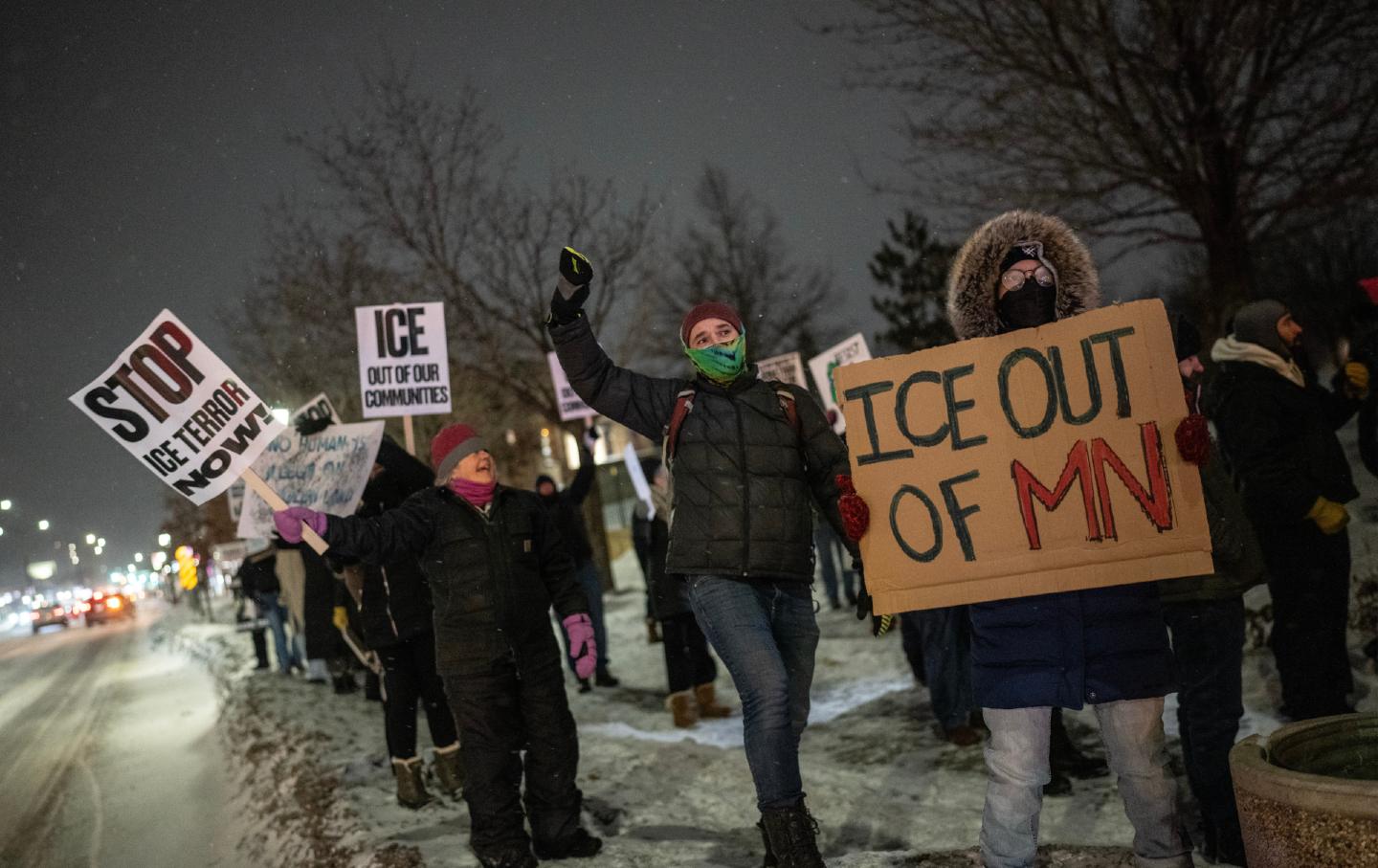
America approaches its 250th birthday with the national ideals of democracy, equality, and opportunity on alarmingly shaky ground.
Still, thousands remain committed to and engaged in making those ideals a reality. As evidence, just take the people of Minneapolis, nominated by The Nation for the Nobel Peace Prize earlier this year. Though its winter of violence and terror has thankfully ended, on this Independence Day the city remains an inspiring example of what love of country looks like when the country in question is careening off the rails.
In the wake of a cynically sensationalized welfare fraud scandal that fomented right-wing fury at Minnesota’s immigrant communities, Donald Trump’s Department of Homeland Security launched Operation Metro Surge in December of last year. Minneapolis was flooded with thousands of federal agents—many newly hired, poorly trained, and hastily vetted. Often in plainclothes, driving unmarked vehicles, and obscuring their faces with masks, they raided homes, workplaces, and even schools. Some 3,800 Minnesota residents were arrested by immigration officials; most had no criminal record.
Faced with an onslaught of unprecedented scale, locals banded together and took a “stand for this land and the stranger in our midst,” as Bruce Springsteen put it in his rousing protest song, “The Streets of Minneapolis.” Locals donated and delivered food to those too fearful to venture from their homes, drove strangers to work to help them elude federal agents, and organized neighborhood watches to monitor and document the actions of Immigration and Customs Enforcement and Customs and Border Patrol agents.
Every one of them shouldered considerable risk. In January, ICE and CBP officers fatally shot Renée Good andAlex Pretti, killings that horrified the nation in their wholly unnecessary brutality. But officers also became violent in innumerable other encounters, dragging people out of cars, deploying tear gas, and, in one case, shooting a man through a residential front door as he attempted to flee into his home. Nearly a third of Minneapolis residents had at least one encounter with federal agents—and almost a quarter of those who did reported suffering physical assault.
Elected officials also rallied to the city’s defense. Lieutenant Governor Peggy Flanagan joined protesters in the streets and delivered food to immigrant families. And, after suing to halt the federal surge, Attorney General Keith Ellison was among the Minnesota officials targeted by retaliatory Justice Department investigations.
Current Issue

But no resistance proved as powerful as the mass mobilization of everyday people. It’s hard to conjure a more vivid recent illustration of the First Amendment’s right to assembly than the enormous crowds—organizers estimated attendance at 50,000 for one rally—who braved both lethal violence and subzero temperatures and took to the streets. Or a more potent reminder that ours is a government by and for the people than the public school students who appealed to their elected lawmakers by protesting on the steps of the Minnesota state capitol.
America’s civic ethos also echoed in the name of the organized volunteers who videotaped federal agents to deter misconduct: Today, 30,000 Minnesotans have received training to serve as such “constitutional observers.” Many of those same local activists are now mobilizing to defend November’s midterm elections against an almost certain onslaught of meddling and misinformation.
By protecting their community in the face of state violence, racial profiling, and violations of due process, the people of Minneapolis embodied values America often touts but too frequently fails to realize. But that’s not the only reason Operation Metro Surge is worth revisiting this Fourth of July. Though the Trump administration scaled back its invasion in February, the government’s retaliation against Minnesota continues: Earlier this month, 15 activists in the state were indicted for conspiring to impede DHS agents during the surge, part of a broader Trump administration effort to criminalize left-wing protest. The agents who shot Good and Pretti, meanwhile, have so far avoided prosecution.
In its creep towards autocracy, the United States is not alone. Nearly a quarter of all countries are less democratic than they were even a few years ago, which means that Minneapolis isn’t an example only to America but to communities around the globe.
That’s why The Nation nominated the people of Minneapolis for the world’s most prestigious prize. A city may seem like a surprising candidate, and a magazine an unlikely sponsor. Indeed, Minneapolis would be the first municipality awarded the Nobel Peace Prize—though plenty of organizations and collective entities have won in the past, ranging from UNICEF to the European Union. Not to mention that The Nation has had the honor of counting more than one Peace Prize winner among its contributors and staff, including Martin Luther King Jr. and anti-war activist Emily Balch.
A petition supporting Minneapolis’ nomination has already garnered over 40,000 signatures. The Pact of Free Cities, an international network of progressive mayors, has also championed the effort, writing that the city’s win would celebrate “a form of peacebuilding that is local in scale, democratic in method, and universal in meaning—and would affirm that when cities stand together for their people, they can face down even the most formidable threats to their freedom.”
As the nation turns 250 under the rule of a rogue federal government, this kind of local peacebuilding and defense of freedom is urgently needed. Minneapolis proved that, at our moment of crisis and conflict, dissent is among the truest forms of patriotism. After all, as Dr. King reminded the world in his final speech, “the greatness of America is the right to protest for right.”
Katrina vanden Heuvel
Katrina vanden Heuvel is editor and publisher of The Nation, America’s leading source of progressive politics and culture. An expert on international affairs and US politics, she is an award-winning columnist and frequent contributor to The Guardian. Vanden Heuvel is the author of several books, including The Change I Believe In: Fighting for Progress in The Age of Obama, and co-author (with Stephen F. Cohen) of Voices of Glasnost: Interviews with Gorbachev’s Reformers.