
Martin W. Dolan, New York candidate for Congress, lost his primary by a landslide. But first, he drove me insane.
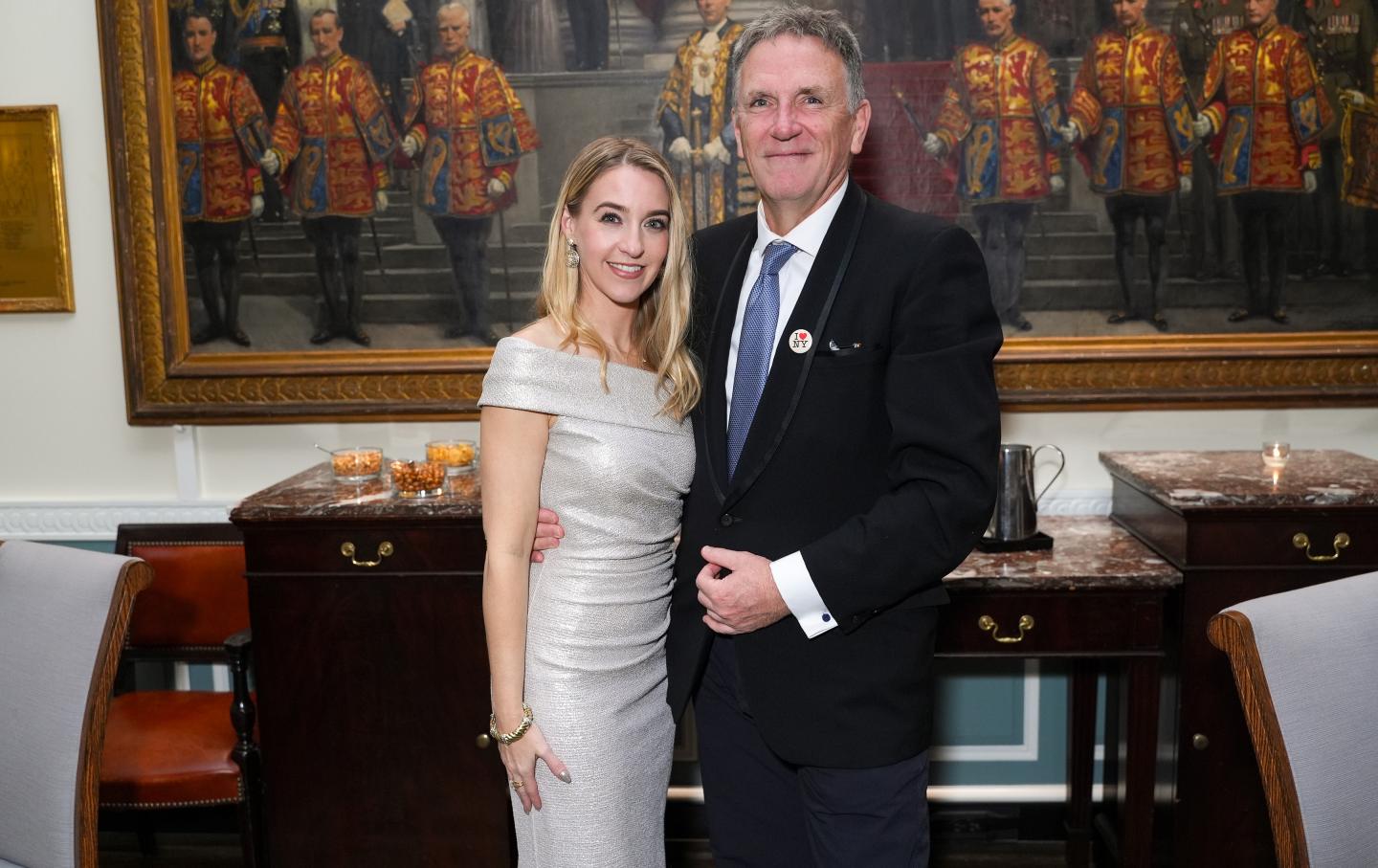
Molly Spears and Marty Dolan attend Yorkville Ball at The Union Club on November 9, 2024, in New York City.
(Sean Zanni / Patrick McMullan via Getty Images)
Two summers ago, my name was all over New York City, though not for the reasons I’d hoped. In June of 2024 a series of billboards—attack ads—appeared above Times Square. “Hey AOC!” they read, in Impact font. An unflattering photo of US Representative Alexandria Ocasio-Cortez wrapped across the boards’ corners. Superimposed over her profile was a blood-red circle evocative, depending on your age, of either the Soviet Union or a rifle’s laser sight. A laundry list of AOC’s political sins lined the right edge: “Rising Crime.” “Illegal Immigrant Chaos.” “Defunding Police.” Then, at the bottom: “Vote Democrat Martin Dolan now!”
In case it’s not obvious, I should clarify that the man who lent his name for these billboards is not me (Martin M. Dolan, b. 2001, Albany, New York). He’s also not my father (Martin E. Dolan, b. 1963, Albany, NY) or grandfather (Martin T. Dolan, b. 1925, Mayo, Ireland). This other Martin, Martin W. Dolan, the self-styled nemesis of AOC, was born in 1957 in Jersey City, New Jersey. He had a long career as an insurance executive on Wall Street before retiring to the suburbs of Westchester County. He reentered the public sphere in 2024, having reinvented himself as a pragmatic, fiscally oriented political hopeful. The office in his line of sight was New York’s 14th Congressional District, straddling the eastern Bronx and northern Queens, which Ocasio-Cortez has held since 2019.
While Martin W. Dolan’s name was being projected across Midtown, I was upstate, in my final semester of a master’s degree in English literature, and trying to figure out what the hell I was going to do next. I half-heartedly applied to jobs and full-heartedly tried to line up freelance writing gigs. I cold-e-mailed the left-literary magazines I admired to try, at the very least, to build some sort of rapport. The responses I got were politely uninterested. I blamed my lack of a network, that I didn’t know anybody, that no one recognized me. I had no idea that at the same moment I was trying to get my name out there, it was also being blown up across New York’s busiest thoroughfares, taking potshots at the closest thing the millennial left has to a patron saint.
Though my trouble landing writing gigs probably had more to do with my lack of experience than any confusion over the attack ads and associated New York Post articles, such cases of byline confusion do have a precedent. In the now-defunct Fine Print, Andrew Fedorov interviewed newspaper journalists who entered the industry just a tad later than their identically named would-be rivals. Julian E. Barnes, a national security correspondent, has had to clarify on multiple occasions that he is not Julian Barnes, the Booker Prize–winning novelist, who was born 20 years earlier. Alexandra Petri and Alexandra E. Petri tried to clarify that their names are even pronounced differently (‘pet-TREE’ vs. ‘PEA-try’), though that’s not the sort of thing that comes across easily in newsprint. The writer Naomi Klein, who doesn’t even share a last name with the once feminist, now conspiracy theorist Naomi Wolfe, wrote an entire book about this common mix-up and the unreality of the digital public sphere. (My favorite author doppelgänger is the pioneering Black comic-book writer initially known as Jim Owsley, who, 15 years into his career, decided to start publishing under the same name as the already established and successful novelist Christopher Priest. The reasons for this change, and the artist formerly known as Owsley apparently angling for his readership’s confusion, remain delightfully unclear.)
When you Google my—I mean our—name, the search results are a hodgepodge of middle-aged professionals. None of the Martin Dolans look particularly comfortable smiling for pictures. And maybe it’s just the lifetime’s worth of geotagged browser cookies on my laptop, but it seems like most of us haven’t ventured far past the American East Coast, either. There are a few Facebook profiles in Dublin and one Australian poet, but at least online, we’re mostly MDs in Massachusetts and JDs in New Jersey. A few of my articles make that first page of results, as does my roster photo from college cross-country. But right at the top of the Google query, crowding out the rest of us with SEO, is Martin W. Dolan, candidate for Congress. He’s smiling dumbly on a pier with the city’s skyline blurred behind him. The photo is accompanied by an AI-generated summary of his already not particularly coherent politics.
Over the past two years, Martin W. had developed a reputation not as a moderate but as an outright anti-progressive Democrat. In an interview with the Bronx Times, he describes himself a “new progressivist,” hyper-critical of the way unabashedly leftist politicians like AOC and Zohran Mamdani govern as if “we’re gonna have a revolution.” He criticizes the way AOC and the party’s progressive wing cater to “niche needs” like trans and immigrant rights, as opposed to more “concrete” policies like tax reform. Though when he describes said tax policies, they sound strikingly redistributive. He proposes a “Fresh Start” account opened for all young people, reimbursing them up to $25,000 in their past years’ tax reductions when they turn 26. There are similar proposals for the parents of young children and working-class tenants, offering them cash to get them out of subsidized housing and into the open market or else as equity to lower future mortgage payments if they want to buy. He says that once in office, he’ll be “Johnny Appleseed, planting seeds.” The platform doesn’t make much sense, but then again, it doesn’t have to: Dolan is emblematic of a vocal wing of Democrats’ inter-party grievance politics—dismissive of those to their left, while simultaneously preaching versions of the same platform of affordability for all Americans.
Current Issue
But ultimately, to read too deeply into Martin W.’s proposed policies would be to give him too much credit. In 2024, he wasn’t really a serious candidate. For one, he didn’t even live in the 14th district. Different publications alternately report him still living in Westchester or the Upper West Side, with a promise to move to the Bronx “if he wins.” The apparent thinking of his campaign strategy was that by merely appearing on the primary ballot as anyone other than AOC, he would attract some sizable portion of moderate voters.
He might have overestimated his chances, but the logic that simply getting his name out there was worth something was, to an extent, sound. In June 2024—as I, with no job offer in sight, resigned myself to a summer of service work —AOC won almost 82 percent of the NY-14 Democratic primary compared to Martin W.’s 18. It was a decisive end to a not particularly decisive campaign. And yet Martin. W. was apparently unfazed by his trouncing at the polls. In 2025, killing time on my work-issued laptop, I read about his running for office again, this time for New York City’s public advocate (now on the Unity Party ticket, a vaguely defined center-left movement he founded himself). Again, Dolan lost handily, and again, he seemed undeterred. Earlier this year, he announced that he’d once more be challenging AOC for the 14th district House seat in June’s Democratic primary.
In that sense, Martin W. Dolan is an almost Trumpian figure. His repeated electoral defeats only make the case for why he’s needed even stronger. Yet compared even to other reactionary, unserious contenders on the edges of New York politics, he lacks real star power. He’s just another kooky political figure in a city already packed with them. He lacks the old New York yarn-spinning charisma of Curtis Sliwa or the digital-native shit-eating grin of Jack Schlossberg or the knack for shameless grifting à la Rudy Giuliani. All Martin W. really has is deep pockets (though, presumably, not as deep as the Kennedys’ or AIPAC’s) and a hard enough head to lose election after election and still declare himself a candidate for the next cycle. Being so immune to rejection, he might’ve better off pursuing a career in freelance journalism.
Given Martin W.’s insistence on remaining in political life despite his losing record, what was I, the second-most-search-engine-optimized man with our name, to do? Both politically and professionally, I wanted to distance myself from his Wall Street–y centrism. But I didn’t want to give up my name, either. I could publish as ‘Marty,” I thought, the name my friends and family call me, but half the press clips about Martin W. refer to him by that nickname, too. The middle initial is timeless, but I’m worried a single measly “M.” wouldn’t distinguish enough. I’m saving “M. M. Dolan” for my mid-career pivot to romantasy. Does my fully spelled middle name— “Martin Michael Dolan” –scan as a precocious enfant terrible à la Bret Easton Ellis or Paul Thomas Anderson? And if I did pick an entirely invented pen name, should it be realistic, nondescript? Or something punny and playful, like Gary Indiana or Richard Hell? I know for sure that I couldn’t pull off a mononym. But other than that, the available options are daunting. This would be so much easier if it were 1930 and I had a SAG card and a union rep breathing down our necks about every union-card holder having a unique name.
This dynamic—having to compete not only for credit or trust but also mere recognition—has become one of the core indignities of trying to market oneself as a writer or artist or politician or any sort of public figure today. In an Internet stuffed to the brim with slop, simply having people know you exist has, ironically, become an uphill battle. And so many in at least one respect—trying, against the odds, to rise above the racket of the rest of the media, to be heard and hopefully even taken seriously—Martin W. and I aren’t so different after all.
New York progressives made a statement in last week’s primary. Across three key races—the seventh, 10th, and 13th districts—establishment favorites were bested by a new generation of young, populist progressives. Like AOC and Mamdani before them, two of these new Democratic nominees (Claire Valdez in NY-7 and Darializa Avila Chevalier in NY-13) belong to the Democratic Socialists of America. This marks, in many commentators’ eyes, the latest milestone in the city’s ongoing political shift away from corporate interests and toward the socialist left. New York’s politics are far from predetermined, but these key victories mark a moment. The evolving electorate—younger, diverse, and sick of the establishment’s roster of lobbyists, financiers, and tech executives—see progressives and socialists as the future.
Popular
“swipe left below to view more authors”Swipe →
In all the commotion surrounding these key primary victories, AOC’s dominance in NY-14 went practically unreported. Her win was, basically, assumed. Of all New York State primaries that went contested, AOC won with by far the highest margin, earning nearly 87 percent of the total vote, her most decisive victory since entering politics in 2018. Martin W. didn’t even manage second place. With 6 percent of the primary vote, he was third, an also-ran to an also-ran.
And so I’ve decided no, I’m not changing how I publish my name. Not even a middle initial for SEO’s sake. Not for him. Martin W. and I can duke it out for dominance of our minuscule sliver of the public sphere. There’s something charming, even quaint, about it. Because we’re each, in our own way, fighting irrelevance. Him with his fealty to the last century’s wonkish politics and me with my commitment to the written word. We’re dinosaurs in the attention economy. Driven by hope that anything beyond the buzz—say, the qualities of the man, of his ideas, of the work—actually matters. And so, every two summers, when Martin W. reemerges to self-fund another doomed primary challenge, that will be my cue to make sure my writing is just a little bit better. May the best Martin Dolan win.
Martin Dolan
Martin Dolan is a writer from upstate New York. His essays have appeared in The Baffler, the Los Angeles Review of Books, Full Stop, and elsewhere.