
Faced with his first political crisis and the economic recession, the president anticipated judicial action against the protesters and ordered the arrest of the leader of the main Bolivian union.
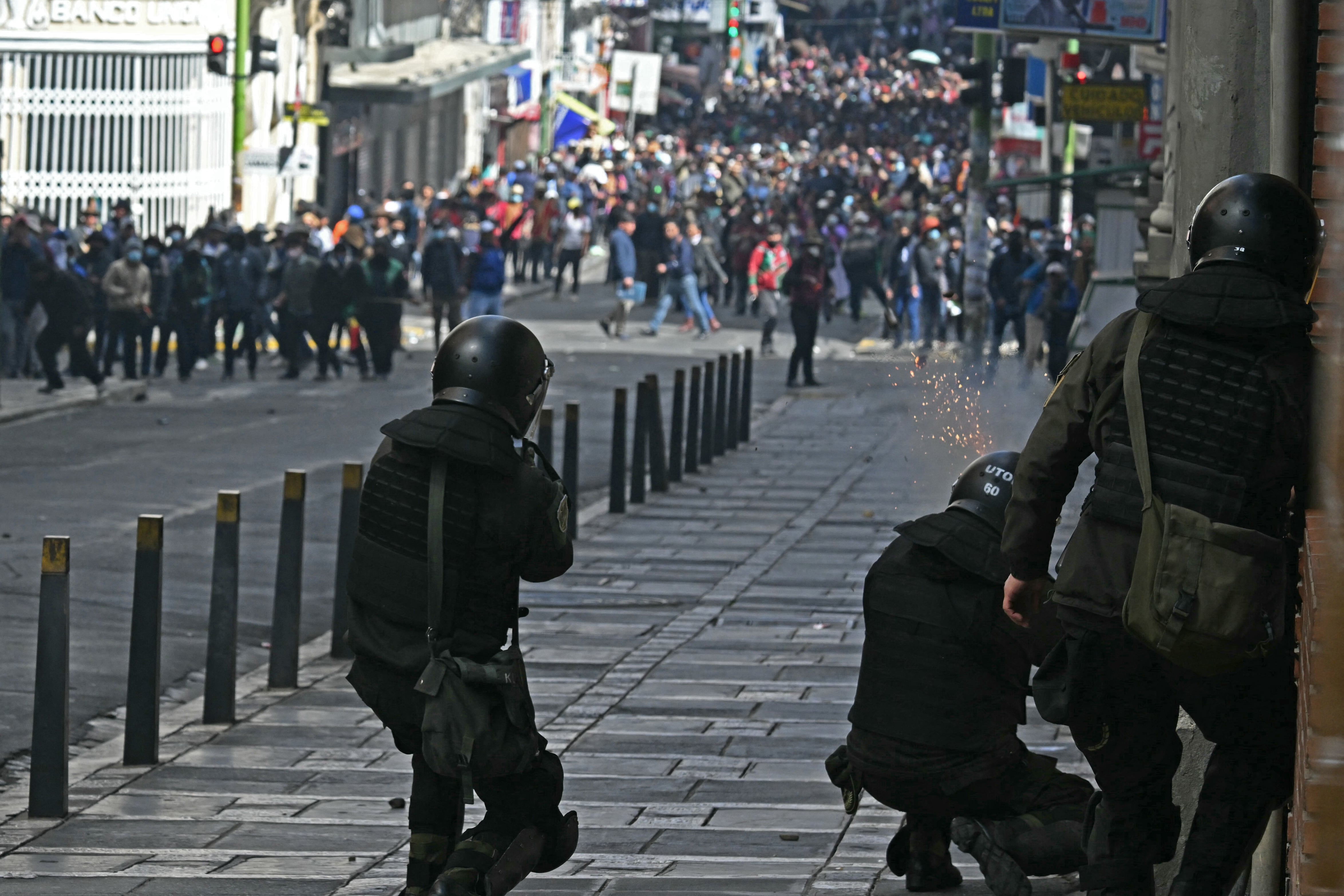
Bolivian security forces reported this Tuesday that More than a hundred people were arrested as part of the protests and strikes what They arrived in La Paz on Monday and with which thousands of people express their rejection of the government of president, Rodrigo Pazand the lack of policies that help alleviate the economic crisis. Police deployed more than 2,500 troops in La Paz and El Alto following the latest riots. The government anticipated legal actions against protesters and leaders linked to the destructionin a series of actions that seem more intended to scare protesters than to seek dialogue between the parties.
Emilio Rhodesanalyst and former vice minister of Autonomies of Bolivia, pointed out in dialogue with Page/12: «The bet may be to increase the level of pressure from the repressive organizations, but historically, as repression has increased, the mobilizations have rather worsened, generating a terrible political crisis.» The main problem, according to Rodas, is that “There is no one to talk to” because “the leaders of the Bolivian Workers’ Central (COB) are being persecuted to put them in prison.”the leaders of the peasant movement are being imprisoned and it is not recognized that These actors are the ones who have to make a solution viable and demobilize the protest.”.
For your part Gabriel Villalba Pérezanalyst and lawyer at the Universidad Mayor de San Andrés in La Paz, told this newspaper that Bolivia is experiencing a “government hitman”«The government has offered Bs. 3,000 (about 600 thousand Argentine pesos) as a reward to the police officers who participate in the repression of the mobilized sectors. Before the conflicts, the right-wing groups proposed an ‘anti-blockade law’ to provide a legal umbrella for any act of government repression. The government has chosen the path of repression instead of seeking viable solutions to conflicts. It has demonized and stigmatized all the mobilized sectors,” explained Villalba Pérez.
“There is no meeting point”
The national commander of the Police, Mirko Sokolindicated that they are “more than 127 people, including apprehended and arrested” in Monday’s protests, some of whom will serve preventive detention and others are waiting to testify before precautionary judges. Sokol mentioned that in the last days of conflict 11 police officers were injured, two of them seriously.
The police official did not refer to the four deaths caused during the blockades and protestsa figure that was recognized on Monday by the government. Sokol reported, however, that they are looking for Mario Argollo, executive secretary of the Bolivian Workers’ Central (COB), and other leaders, who are under an arrest warrant issued by the Prosecutor’s Office for alleged commission of crimes of public instigation to commit crimes and terrorism.
“If the government’s intention to demobilize is to generate fear in the population, it is not giving results,” he explained. Occurs. The analyst warned that with respect to the government’s willingness to dialogue, some distinctions must be made: «There is a part of the government that tries, at least, to soften the language, as José Luis Lupo (Minister of the Presidency) does. But Most of the government is convinced that there is no meeting point and that the bet has to be repression.“.
During Monday’s protests, damage was reported to public and private buildings. The police used tear gas to prevent the advance towards Murillo Square, where the Executive and Legislative headquarters are located. In addition to the protests in La Paz, peasant unions have maintained road blockades for 15 days in the department of La Paz, where some food, fuel and medicinal oxygen began to become scarce.
A chain of complaints
Bolivia is going through its most serious economic crisis since the 1980s. It exhausted its dollar reserves to support a policy of fuel subsidies and its year-on-year inflation was 14 percent in April. Shortly after taking power in November, Paz, who ended 20 years of leftist governments, eliminated those subsidies, raising gasoline and diesel prices.
«Thousands and thousands of people have been affected. Public transportation here is provided by people, by unions, by cooperatives, by associations, and they have seen how their work units were left unusable with fuel,» he said. Occurswho added that “also The implementation of a law that has to do with a change in status from small property to medium property generated a lot of discontent.promoted by the great land monopolies.”
The other major conflict that the government opened was with the teachingboth urban and rural, which fundamentally demands salary improvements and a greater budget for education. Finally Rhodes mentions the conflict with the cooperative mining sectorwhich managed to reach an agreement: «These cooperatives demanded preferential treatment in terms of social security contributions, fuel delivery and non-supervision of mining operations. These have been granted by the government and people have understood that this is an issue of perks, that the sector is being ‘clientelized’ to generate agreements.»
Faced with the unrest inside, some voices of support for the president came from abroad. The US Deputy Secretary of State, Christopher Landau, assured this Tuesday that the protests against Rodrigo Paz show that there is “a coup d’état underway” in Bolivia. Along the same lines, eight right-wing Latin American governments, including Argentina, Chile and Ecuador, issued a joint statement rejecting “any action that threatens the democratic order.”
“A uprising of the people”
This Tuesday, in dialogue with Futurock radio, the former president Evo Morales referred to the two Hercules planes sent to Bolivia by Argentina to transport food to cities affected by road closures and assured that, in reality, they were carrying “tear gas and pellets”. “They are using them to transfer soldiers and police to La Paz,” accused the former president, who expressed his rejection of “Argentina, through its president, helping to repress the Bolivian people.”
In another interview with Radio 750Morales described the protests in his country as “an uprising of the people” against the president’s reform plan and urged “to defend the Constitution, natural resources and basic services.” On May 9, Paz announced the creation of a commission to carry out a “partial reform” of the Constitution that has been in force in the country since 2009 in order to facilitate the arrival of private investments in the Bolivian economy, which is currently in crisis.
«The sectors that are mobilized are concentrating their position on the resignation of Rodrigo Paz. And this leaves the conflict at a dead end, because that is not negotiable for the government. And the popular sectors have not proposed an alternative negotiation agenda either, that is, reaching short-term agreements,» Rodas expressed to this medium and added: «The government would have to make indiscriminate use of repressive force, but at this moment it does not have the conditions of political legitimacy to do so. An attempt was already made over the weekend to make a powerful use of force to clear the country’s routes and lift the siege of La Paz, but the mobilizations worsened.”
To Villalba Perezthe current scenario resembles the last days of former president Gonzalo Sánchez de Lozada in 2003. “A collective subject in the streets mobilized with a single slogan: Paz’s resignation. And a government that finds no other course other than repression. The greater the increase in the action of the repressive apparatus, the greater the reaction of the sectors mobilized in violent forms, non-violent forms, critical forms, academic forms, media forms. The rejection and repudiation of the Paz government is now in unison,” said the analyst.
Source: Page 12
Read original article: https://www.pagina12.com.ar/2026/05/20/bolivia-el-gobierno-de-rodrigo-paz-apela-al-miedo-para-frenar-las-protestas/