

Under Trump, eight Prairieland defendants were sentenced to a combined four and a half centuries in prison.
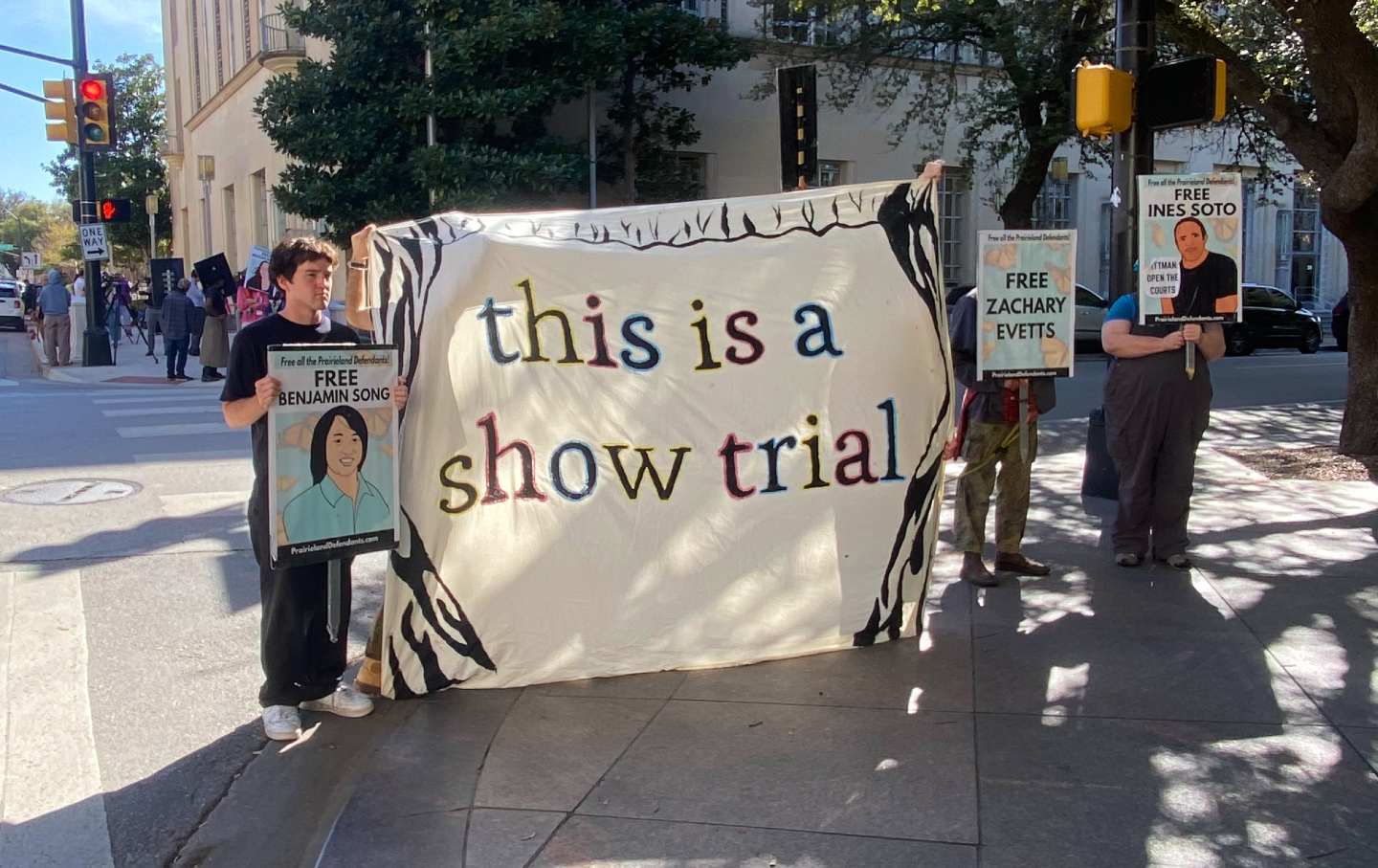
Demonstrators showing support for people accused of conspiring to commit terrorism at the Prairieland immigration detention center last summer gathered outside of the Eldon B. Mahon United States Courthouse in Fort Worth on March 13, 2026.
(Kevin Krause / The Dallas Morning News via Getty Images)
When Savanna Batten heard her sentence read aloud in the federal courthouse of Fort Worth, Texas, she wasn’t all that surprised. For most people, half a century in prison for attending a protest might feel like an unexpected gut punch. But Savanna, one of the 22 Prairieland defendants, understood that hers had been no ordinary trial.
“We knew this was going to happen,” said Amber Lowrey, Savanna’s older sister. “This is a political case, and Texas is sending a message: If you show up to a protest at an ICE facility, expect to go to jail for decades.”
Last Tuesday, eight Prairieland defendants, all of whom have been incarcerated since July, received sentences ranging from 30 to 100 years in prison. Most of the defendants had done nothing more than show up to a noise demonstration outside the Prairieland Detention Center, an ICE facility in rural north Texas, on July 4 of last year.
One defendant, Daniel Sanchez-Estrada, was not present at the protest but was sentenced to 30 years for moving a box of anarchist zines.
“A bunch of people went to a noise demonstration that they saw on a Signal group chat, and now they are facing 50 years in prison,” said Xavier T. de Janon, director of mass defense for the National Lawyers Guild. “That should scare and outrage anyone going to any kind of protest in this country.”
The sentences, which read like Donald Trump’s Truth Social posts, are bizarre and wildly disproportionate. They come months after the conclusion of a three-week federal jury trial in March, which found all nine defendants guilty of “providing material support for terrorism” in a case understood as the Trump administration’s first significant victory over left-wing activism.
Current Issue

The 11 people who showed up to Prairieland on Independence Day, after seeing a flyer in a citywide Signal chat, intended to “lift the spirits of the detainees with a fun fireworks display and go home,” according to one defendant. Some protesters brought a cooler full of fireworks. Others came armed, anticipating counterprotesters. (In Texas, it’s very legal to bring firearms to a protest.) Some protesters shot off red, pink, and green fireworks and then cleaned up the debris. Others disabled a security camera, slashed a van’s tires, and spray-painted anti-ICE messages on a cop car. After about half an hour, the protest dispersed.
When local police officer Lieutenant Thomas Gross arrived on the scene, called by a Prairieland warden, most protesters had headed home. Yet the officer still pulled his gun, aiming at the back of a fleeing straggler, prompting another protester named Benjamin Song to fire eight rounds of suppressive fire. Lieutenant Gross was grazed in the shoulder and, after a brief stint at the hospital, fully recovered.
The federal government argued during trial that Song had fired directly at Gross. Song’s lawyer, however, claimed that the bullet—which shows evidence of impact with a hard surface—was a ricochet and that Song’s actions likely saved the lives of the other protesters. Song’s support team goes even further and, pointing to recently released camera footage, claims that the ricochet was from Gross’s own shot and that Song shot into the ground 60 feet away from Gross.
“I never want to see anyone get hurt,” said Song in a statement released after their sentencing. “I never want to see good people, standing up for what they believe in, gunned down in the street. What we all saw happen to Renee Good and Alex Pretti is my worst nightmare.”
In March, Song was convicted of attempted murder and, on Tuesday, sentenced to 100 years in prison.
The trial was littered with irregularities, from a dubiously dismissed jury pool to a prohibition on self-defense arguments to the barrage of irrelevant evidence presented by the prosecutors. “Every single facet of this proceeding was corrupt,” said Lydia Koza, wife of defendant Autumn Hill.
To inflict the maximum sentences possible, US District Judge Reed O’Conner added a “terrorism enhancement”—the most severe federal sentencing guideline available—to each count of conviction. In another rare move, Judge O’Conner mandated that each sentence be served consecutively instead of concurrently, extending each prison term by decades.
During sentencing, Judge O’Conner called each defendant “violent” and an “extremist,” despite the fact that “there’s no indication that any of these people have ever been violent in their lives,” according to Lowrey. O’Conner underscored the need for long prison time as a means of deterrence to others who share similar political beliefs.
“It has been a politicized prosecution from the get-go,” said de Janon. “These sentences are obscene, they are shocking, but at the same time, I don’t feel surprised.”
The sentences of the Prairieland defendants are longer than any of those received by Capital rioters on January 6.
“When you look at this case next to the Capitol rioters,” said de Janon, “it’s clear that these are political prosecutions with political outcomes.”
Popular
“swipe left below to view more authors”Swipe →
According to de Janon, north Texas now boasts a political apparatus envisioned and created by Project 2025, a conservative political initiative proposed by the Heritage Foundation. Citing Trump-appointed judges, Trump-appointed Department of Justice officials, and Trump-appointed FBI investigators, de Janon highlights the steps taken to ensure that judicial rulings like this one could advance the government’s authoritarian agenda.
“People have been talking about Project 2025 and how we need to be careful. Now it’s 2026 and it’s a reality. It’s happened,” said de Janon. “The federal government has taken over the legal system in this country [and transformed it] into another weapon against the freedom of the people.”
In September, President Trump signed an executive order that designated “antifa”—short for “antifascist”—as a domestic terrorist organization, despite the fact that “antifa” is not an organized group and no legal definition of domestic terrorism exists under US law. Three days later, he issued a National Security Presidential Memorandum calling for a “new law enforcement strategy” to investigate participants in “these criminal and terroristic conspiracies.”
Yet the FBI closed an investigation into “antifa” in Fort Worth in 2018, after concluding that the groups in question posed no threat to national security, according to FOIA records obtained by In These Times.
In many ways, the Prairieland noise demo was similar to the protests that recently rocked Delaney Hall in New Jersey this month. Both protests were meant to show support to ICE detainees, and both were met with police violence, but only one has garnered the support of local Democrats.
The Prairieland protest took place before the ICE invasions of Chicago, Minneapolis, and Los Angeles, which were met with widespread repudiation and resistance.
“The fight against ICE has been happening ever since ICE existed,” said de Janon. “But there’s this amnesia. People weren’t giving the Prairieland defendants the support they needed until [anti-ICE protest] became more mainstream.”
The majority of the defendants are being held in administrative segregation, which is “one tiny whisker short of solitary confinement,” according to Koza. Her wife, defendant Autumn Hill, spends 23 hours in a 10-by-10-foot cell and receives one hour of “rec” time, where she is taken to a slightly larger room with a small skylight.
Hill reports frequent and humiliating strip searches by male guards and inadequate food, including peanut butter despite her having a severe peanut allergy.
“It’s been horrible to sit through my wife being separated from me,” said Koza. “At this point, we’ve spent longer separated by bars and bricks than we have married and free.”
Hill and fellow defendant Meagan Morris, both of whom are trans women, have been deadnamed on indictments and jail records—despite their court-ordered legal name changes—and they are currently being held in a men’s jail.
Johnson County Jail, where the defendants are currently held, has a long history of abusive treatment. A plaintiff in a 2021 lawsuit, filed against Lieutenant Gross, cited the jail’s practice of confining naked inmates in refrigerated suicide cells in order to force the disclosure of information.
Sheriff Adam King, who oversees Johnson County Jail, is being prosecuted for sexual harassment, official oppression, and retaliation of a witness. Two other cases against King alleging sexual harassment are in pretrial.
Given these conditions, the incarcerated defendants need a lot of support. Their families and friends meet weekly to determine the best ways to ensure they receive mail, legal funds, and adequate food (one defendant has Celiac disease).
“When your loved ones are incarcerated, the family does the time with them, too,” said Koza. “It is really just awful. The process is the punishment. They make this intentionally difficult for everyone involved.”
According to Lowrey, the first thing Savanna wants to do when she gets out, after seeing her cats, is to find a prairie and roll around in the grass.
The support committee is calling on the public to write letters of emotional support to the defendants, donate to their commissary and legal funds, and make lots of noise about the case.
“The indifference to the Prairieland defendants was the biggest strength that the government had,” said de Janon. “So the biggest antidote is attention and support.”
Sara Van Horn
Sara Van Horn is a writer based in Texas. Her reporting has appeared in Al Jazeera, The Guardian, and In These Times.