

“What occurred in that courtroom was not simply a failure of protocol or preparedness. It was….a devastating reflection of the cruelty embedded in our carceral system.”
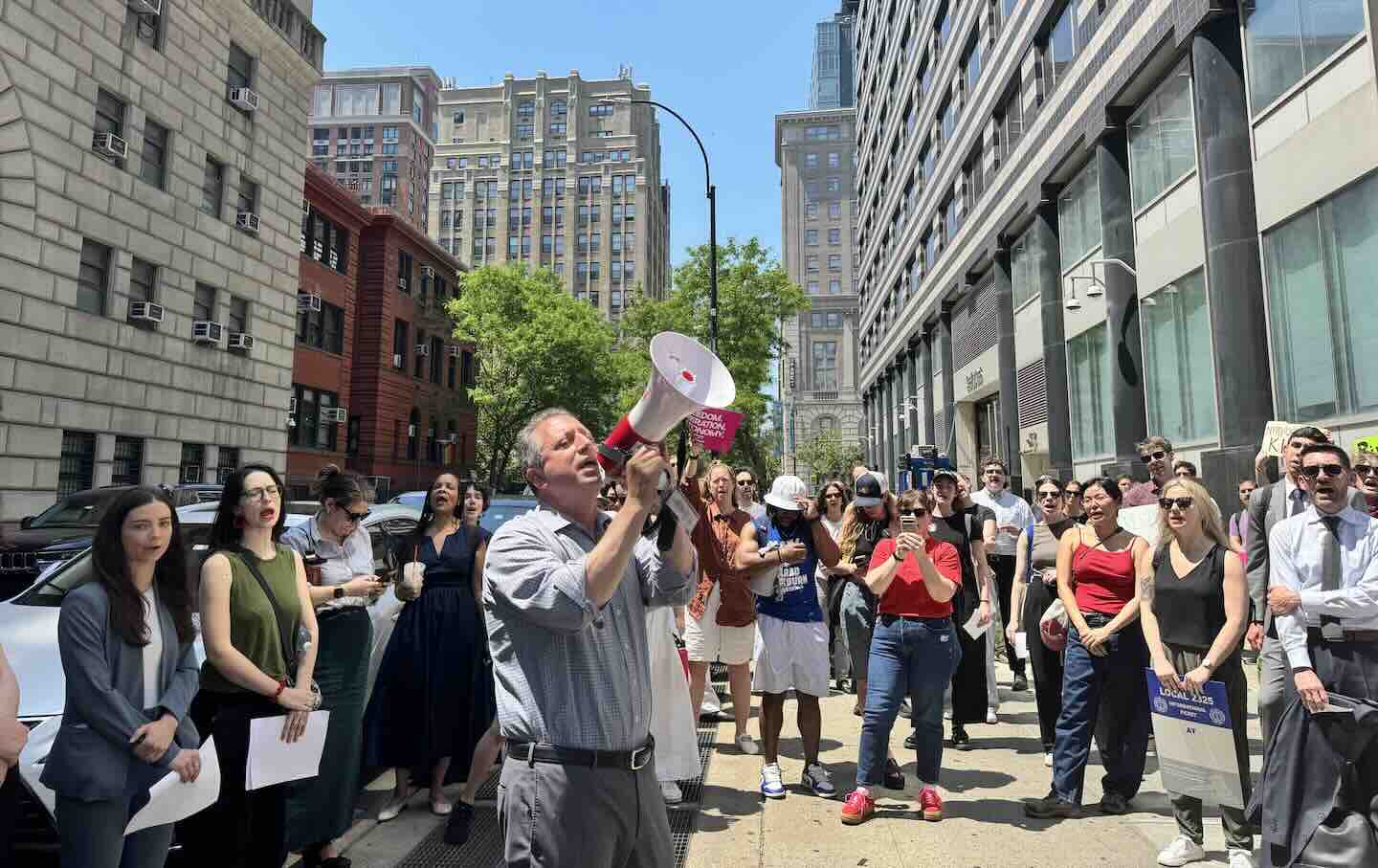
Brad Lander, former New York City comptroller and current NY-10 congressional candidate, speaks to hundreds of picketing public defenders and advocates on May 18 outside the Kings County Criminal Court, where Samantha Randazzo had been forced to give birth days before. Lander called for improved treatment of pregnant people in custody, describing Randazzo’s experience as “extraordinarily egregious” and “something that should shock the conscience of all New Yorkers.”
(Sophie Mann-Shafir)
On a recent scalding Monday afternoon, hundreds of attorneys and advocates gathered outside the Kings County Criminal Court to protest the most recent violation of humanity to unfold in the Brooklyn courtroom. The previous Friday, May 15, minutes before midnight, someone waiting to be arraigned had given birth while handcuffed during open court. The woman, Samantha Randazzo, was afforded neither privacy, nor dignity, nor competent medical treatment—which was not surprising to the public defenders assembled. In a system that has all but normalized lives’ ending in custody, a person being forced to give birth there wasn’t so far afield.
“This is not the first time that something like this has happened,” Olga Karounos, a staff attorney at the Legal Aid Society, told me at the demonstration, which was organized by the Association of Legal Advocates and Attorneys (UAW Local 2325). Three people have died from insufficiently treated medical issues in the 120 Schermerhorn courthouse since early 2025, all arrested for minor charges, and “no changes have happened from that,” Karounos said. “So I think people just really felt like [Randazzo’s giving birth] was the last straw.”
Among the many professionals present during court proceedings, there are no doctors, the public defenders I spoke to noted. They have been trying to change that since last September, when the community of legal advocates issued a 10-step plan calling on the mayor and City Council to implement policy “to Address Growing Crisis of Deaths in NYPD Custody,” including staffing courtrooms with independent EMS personnel. Those workers would supplement existing correctional health staff who sometimes, at the behest of police officers, screen people waiting to be arraigned. The plan also calls for better mental health and substance use services, regular inspections of NYPD policy and central bookings buildings, and the end of custodial arrests for low-level crimes. So far, that 10-point plan is still just a list of unmet demands.
Following the courtroom birth, the news media was quick to craft storybookish narratives about what had taken place, but the public defenders explained in a statement, “What occurred in that courtroom was not simply a failure of protocol or preparedness. It was a profound moral failure and a devastating reflection of the cruelty embedded in our carceral system.”
“People in medical or psychiatric distress are chained to benches or are squashed together in filthy, unsafe holding cells while waiting for their most simple due process rights,” noted another statement.
Low-level arrests have skyrocketed in recent years, according to a John Jay College of Criminal Justice report. Between 2021 and 2024, misdemeanor charges rose 70 percent. One attorney told me they had a client arrested for evading his $3 subway fare, which in his statement he explained was so that he could afford baby formula for his daughter.
Current Issue

These arrests are generating a backlog in an already overburdened carceral system, according to Jane Fox, ALAA’s Legal Aid Society chapter chair. The crisis of accountability lies at every tier: NYPD officers could issue more desk appearance tickets (written notices of an upcoming court date) instead of holding people in custody; district attorneys could use discretion and decline to prosecute.
Instead, people are being held in greater numbers and in filthy and deteriorating conditions, often for offenses as minor as shoplifting or evading subway fares. It’s a criminalization of poverty. Their medical needs are ignored, and sometimes they’re made to wait longer than the 24-hour legal limit to be arraigned. This can lead to deadly consequences.
Deaths of people in NYPD custody have seen a drastic uptick in the past three years, with 43 people dying in 2023 and 2024 across the boroughs. When the attorneys’ 10-point plan was unveiled, nine people had died in NYPD custody in 2025. Their causes of death ranged from medical episodes including overdose to injury, to suicide, and their arrests were for as minor a crime as shoplifting food.
Since last fall, the city’s watchdog Department of Investigation has been conducting an inquiry related to deaths in NYPD custody. Until that investigation was set in motion, the NYPD was monitoring its own practices. The DOI’s Diane Struzzi declined to comment for this article, citing an ongoing investigation.
With standards already bucked and enforcement failing across the board, public defenders are advocating a sweeping change in approach.
In February, Legal Aid filed an emergency petition accusing the NYPD and Brooklyn DA of violating the 24-hour arraignment standard—which is the court’s interpretation of the watershed Roundtree ruling from 1991. Following a snowstorm that temporarily shuttered criminal arraignment courts, more than 100 people in Brooklyn alone had been held for over 24 hours—more than in Manhattan and the Bronx combined. Public defenders sought court intervention, calling for the release of anyone who’d been in custody longer than 24 hours unless police could explain the delays. Officials snapped into action, adding stopgap arraignment shifts to help resolve the bottleneck. Months later, with new deaths and now a birth in police custody, that solution has proven “less impactful than a Band-Aid on a bullet wound,” Karounos said.
Mayoral spokesperson Sam Raskin did not address the 10-step plan specifically but told The Nation, “What Samantha Randazzo went through was horrifying and completely unacceptable. No one should give birth in a courtroom, and New Yorkers deserve a criminal justice and healthcare system that responds humanely and ensures timely medical care for anyone experiencing a medical emergency. The Mamdani administration is reviewing the circumstances that led to this situation and discussing potential next steps, including reviewing the policies and protocols practiced by the NYPD, NYC Health + Hospitals, the courts, prosecutors, public defenders, and other relevant entities as we examine how to address the systemic failures brought to light by this incident.”
In the meantime, legislation long pending in the statehouse could restrict enforcement officials’ ability to handcuff pregnant people in custody during various stages of pregnancy, labor, and delivery. Randazzo’s experience reignited attention toward the bills.
Randazzo had been arrested on low-level trespassing and drug possession charges and was hospitalized for more than 16 hours before her arraignment. It’s unclear why she was discharged so close to giving birth, but if she had been released earlier, she could have given birth in a hospital. Instead, once she went into labor, about 10 minutes went by before a piece of medical equipment was rolled into the courtroom, and about 10 more before an ambulance arrived.
An NYPD spokesperson told The Nation that Randazzo “was wearing baggy clothes” and “did not inform officers she was pregnant” when she was arrested (one day before she gave birth). The spokesperson also claimed that Randazzo’s handcuffs were removed when she went into labor—an assertion disputed by attorneys who were actually in the courtroom.
Popular
“swipe left below to view more authors”Swipe →
Reporting produced in the immediate aftermath also misconstrued the facts and mood of the courtroom. The New York Times claimed that “the courtroom had transformed into a labor and delivery unit” and quoted Randazzo’s lawyer saying “we saw it” about the birth of the “bouncing baby boy.” One account referred to the court officer’s having “delivered the baby.” But according to Hell Gate’s interview with public defender Jen Kovacs, as well as two Legal Aid staff members I spoke to, Randazzo’s lawyer hadn’t been in the room.
Elena Beeley, an arraignment paralegal who typically works the night shift and was seated feet from the birth, told me that she wanted to correct the false information circulating without further violating Randazzo’s privacy. “The officer did not deliver the baby,” Beeley said. “She delivered into her pants.”
Only on Sunday, two days after she gave birth in court, was Randazzo’s case dismissed.
Attorneys described what transpired in the courtroom as within the realm of normal.
“My last arraignment shift, a man was having a seizure on the bench,” Maggie Bergmann, a trial attorney at New York County Defender Services in Manhattan, told me. “Even I know that in a situation where someone’s having a seizure, they’re supposed to be on their side and their head’s supposed to be supported.” In that instance, the man was “eventually” laid on his side, once minutes had passed. Still he remained in cuffs.
Public defender Amy Austern described a depraved cycle of sickness and custody, her clients being shunted between hospital and court, remaining in handcuffs at the hospital and still wearing their hospital bracelets in court.
Attorneys witness such indignities all the time: clients sick and seizing, vomiting, urinating and excreting on themselves, all without a shred of concern from officials. Karounos said courtroom officials sometimes think defendants are faking their seizures. She believes EMS presence could help with that: “They could be the one to make the call and say, ‘No, this is a real seizure.’”
Although Randazzo’s experience of giving birth in handcuffs exposed the rampant neglect that those in custody endure routinely at the hands of officials, attorneys are skeptical that without structural changes much will improve.
Family court attorney Sania Chandrani’s clients regularly leave court only to have their children taken, so to watch a birth in a courtroom struck an especially horrifying chord. “It’s likely that she’s going to have to deal with family court after this, like her kid could be taken away,” Chandrani said of Randazzo. “People come to court to find justice, or they’re dragged into court to find justice, and that’s not at all what they receive.”
Legal Aid’s criminal defense practice chief attorney, Tina Luongo, who co-authored the 10-point plan along with attorneys from the city’s other public defense offices, said implementing meaningful system change would start with a joint meeting between members of the NYPD, the Mayor’s Office of Criminal Justice, the court system, and possibly the FDNY. “We keep saying, convene all the stakeholders together, so that we can work on these issues in tandem,” Luongo told me. “That meeting has yet to happen, or if it happened, defense counsel hasn’t been invited.”
For close to 40 years, former ALAA president Michael Letwin worked as a public defender in the city. He remembers deplorable conditions, sickness, and filth, but no death. “I don’t know what it was like before 1985, but I’m sure it was horrible as long as anybody can remember, and I think it’s just probably gotten worse over the decades.” He called on Mayor Mamdani to order EMS presence in the courtroom. “The buck does stop with Zohran on all of this,” Letwin said.
Lizz Winstead, founder of Abortion Access Front, told me as we waited for the picket to convene that “the reproductive justice aspect of what has happened to this woman is something that everybody who cares about full-spectrum autonomy should be alarmed about.”
In the aftermath of the courtroom birth atrocity, attorneys, regular witnesses to the court’s broken justice feedback loop, were indignant but not desensitized. There were murmurs about renewed interest in the 10-point plan from City Hall.
“Interest is one thing; action is another,” Luongo told me. “I have not seen any action.”
Your support makes stories like this possible
From illegal war on Iran to an inhumane fuel blockade of Cuba, from AI weapons to crypto corruption, this is a time of staggering chaos, cruelty, and violence.
Unlike other publications that parrot the views of authoritarians, billionaires, and corporations, The Nation publishes stories that hold the powerful to account and center the communities too often denied a voice in the national media—stories like the one you’ve just read.
Each day, our journalism cuts through lies and distortions, contextualizes the developments reshaping politics around the globe, and advances progressive ideas that oxygenate our movements and instigate change in the halls of power.
This independent journalism is only possible with the support of our readers. If you want to see more urgent coverage like this, please donate to The Nation today.
Sophie Mann-Shafir
Sophie Mann-Shafir is a writer and journalist currently living in Brooklyn.