

By Maia Livachoffactress and writer recently graduated from the Metropolitan School of Dramatic Art, has been circulating for some time on Instagram under the username maiescribe. Within the framework of Worker’s Day, he shares a text that shifts the focus from the most traditional representations of work and puts an often romanticized experience at the center: teaching.
His writing, titled “The teacher is broken”exposes with rawness and sensitivity the daily life of those who teach.
The teacher is broken
I get the message, hanging on 60,
abruptly interrupting my reading.
It’s my friend and colleague, I have to read it.
“Friend, I left the afternoon course, I don’t give any more.”
Another one, I think.
The teacher is broken.
I’m looking for a useful way to console her,
feeling like an idiot.
The teacher is broken.
We are super powerful eating
a frozen hard-boiled egg with carrot
on top of some public transport.
Then I confirm it: the teacher is broken.
I get a seat on the bondi.
I laugh out loud.
I laugh at all of us.
Of how invisible we are to humanity.
Of how beautifully stubborn we are
thinking that this profession is the means
to build something new, something better,
something that emerges urgently.
But the teacher is broken.
The day ends in my chair, with a glass of wine,
but the boy with the red cap
it gets into my head.
The father hits him,
That’s why he hits his teammates.
The girl from the La Boca neighborhood arrives just
to cut the middle of my stomach,
It squeezes me.
I believe her, I think of her.
(I’m not going to believe him?)
I go to bed without sleeping.
I go to bed without eating.
My loneliness puts me to bed.
Wakes me up the next day:
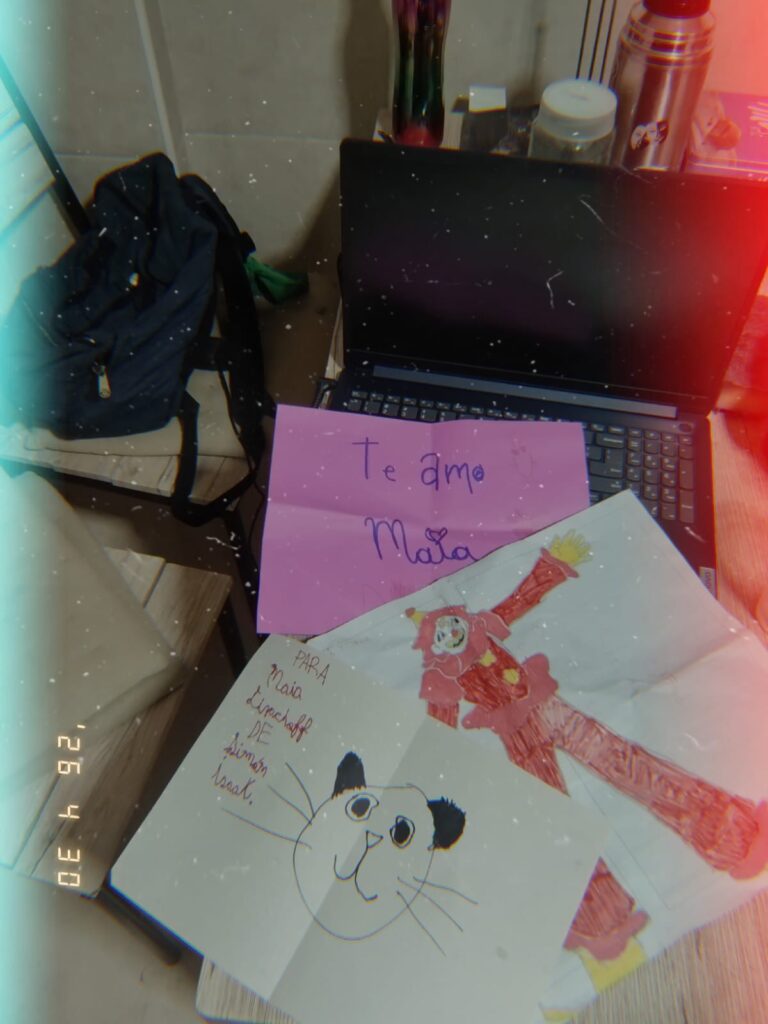
Simon’s drawing,
Martin’s smile
and Jazmín’s hug.
Criminalize the hugs and smiles you want,
Aim for morale and shoot fire.
We are not going to take a step back.
The teacher is broken, but she is here.
A different look at work
The poem proposes a reading of May 1 that displaces the classic idea of the industrial or office “worker” and puts at the center a job that is often romanticized and little recognized: teaching.
The first thing that appears is job exhaustion as the central axis. The repetition of the phrase “the teacher is broken” works as a chorus that insists and constructs meaning. It’s not about being tired or stressed: “broken” suggests a deeper physical and emotional fracture.
The text constructs this precariousness from concrete, everyday images: bus trips, improvised meals, extended days. Recognizable scenes of teaching work that, within the framework of Worker’s Day, also function as a material complaint.
At the same time, the invisibility of care work appears strongly. Teaching does not end in the classroom: the students’ stories—violence, inequality—are still present, they occupy the mind, they cross the body. It is emotional work that is rarely recognized.
A gender dimension is also visible. The collective voice—“we are super powerful,” “I laugh at all of us”—refers to historically feminized jobs: teaching, caring, supporting. The idea of “superpowerful” appears crossed by an irony: the demand for power with everything, even in adverse conditions.
However, the poem does not stop at just the denunciation. Towards the end a form of resistance emerges: persistence. “The teacher is broken, but she is here” condenses that tension between wear and tear and commitment, sustained by small everyday gestures such as a drawing, a smile or a hug.
At this intersection, the text leaves an uncomfortable question floating on this May 1: how to sustain a work that is thought of as an engine of transformation when those who carry it out are, also, deeply affected by wear and tear?
@