

The ruling party is advancing with a scheme that would replace regional discounts on gas rates with targeted subsidies based on income. The debate starts today in Deputies and has already generated disagreements. The question is not whether they will change the rules: it is who will pay the political cost when the cold weather arrives.
The Cold Zone regime has been one of those policies that no one defends in the abstract but that everyone takes care of when the winters hit for decades. The discount on gas rates for users in low-temperature regions worked as a silent buffer, without much media noise, until the Government of Javier Milei decided that the time had come to discuss it seriously.
Today the Chamber of Deputies begins to debate the official proposal to create the so-called Targeted Energy Subsidies (SEF). The new scheme would replace benefits based on geographic location with an income criterion: according to what was reported, only households with incomes of less than three total basic baskets, families registered in the ReNaBaP (National Registry of Popular Neighborhoods), Malvinas ex-combatants and people with disabilities would retain the subsidy.
The Secretary of Energy of the Nation, María del Carmen Tettamanti, came out to defend the change with an argument that well summarizes the logic of the adjustment: resources are scarce and «that people who can pay for energy, pay for it.» The logic has a certain internal coherence, but it avoids a central question: how much more does a family in the south of Buenos Aires consume gas compared to one in the metropolitan area, and to what extent does that justify differential treatment beyond income level?
The response was provided by former representative Alejandro Rodríguez, from the Federal Consensus Institute, with information that greatly changes the framing of the debate. As he explained, the annual gas consumption per home in cold areas is 94% higher than in temperate regions. It is not a whim of geography: it is the climate imposing a basic need that does not choose income levels. Rodríguez also questioned the argument that the expansion of the regime would have generated an abusive use of the benefit. In the new incorporated areas, including Bahía Blanca and the southwest of Buenos Aires, consumption grew by just 7% between 2021 and 2024, a percentage that the leader described as reasonable given the climatic conditions of those territories.
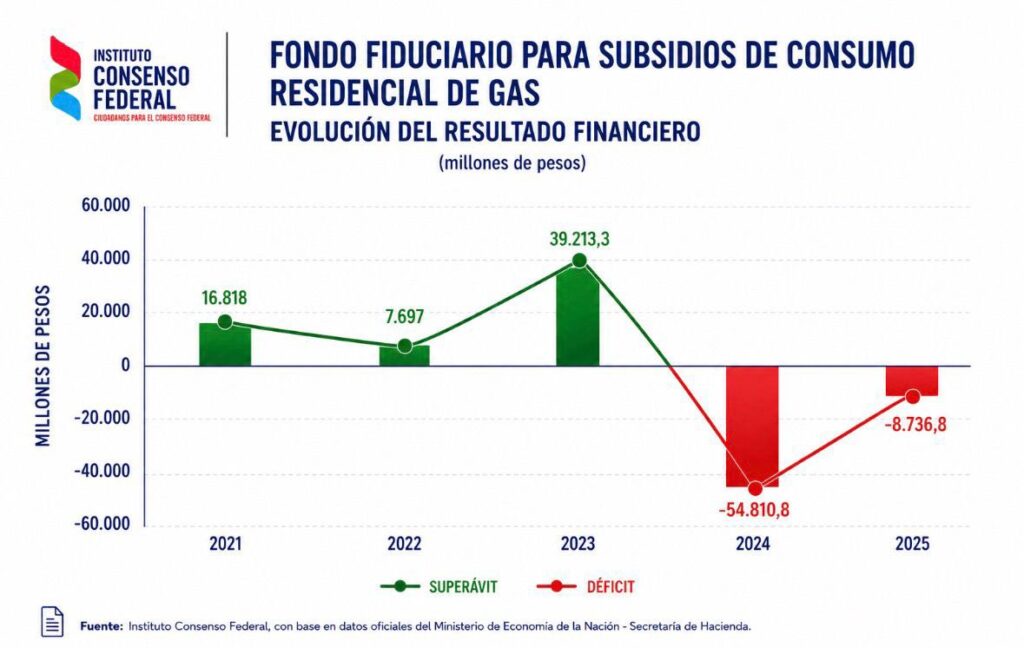
There is another side of the debate that bothers the ruling party. Rodríguez pointed out that the Trust Fund for Residential Gas Consumption Subsidies went from showing a surplus between 2021 and 2023 to registering a deficit since 2024. And it did so during Milei’s administration, despite the increase in the charge that finances the fund in the gas bills themselves. If the official argument for eliminating the Cold Zone is the financial deterioration of the system, it is worth asking how much of this deterioration is due to the tariff policy of the current administration.
For the province of Buenos Aires, the issue has a specific scale. Bahía Blanca and several municipalities in the southwest of Buenos Aires are part of the regime and concentrate a significant number of users who could be left out of the benefit if the project advances. In a context of falling purchasing power and transfers to municipalities at their worst level since the pandemic, the tariff discussion is not abstract: it translates into invoices, neighborhood complaints and, eventually, pressure on the mayors.
Will the debate in Deputies open space to negotiate some compensation for the middle sectors of cold areas that would be left without coverage? Kirchnerism, radicalism and several provincial spaces have already shown resistance. The dispute is over subsidies, but the bottom line is older: who pays the cost of an energy model that the Government wants to thoroughly reform before winter arrives.