

The Argentina is going through a crisis that exceeds economic variables. Beyond inflation, the loss of purchasing power or the daily difficulties of millions of people, there is a cultural and political crisis which is manifested in the growing inability to hold complex debates.
¿Cuánto de las discusiones que tenemos hoy responde realmente a los problemas del presente y cuánto es la repetición de categorías creadas hace más de dos siglos?
The public conversation seems to have been reduced to binary logic. In the media and social networks pincreasingly simplified explanations of deeply complex phenomena dominate. For some, the country’s structural problems are an exclusive consequence of Peronism; For others, responsibilities fall mainly on non-Peronist governments or on the most concentrated sectors of the economy. It is not about determining which of these interpretations contains more truth or more error, but rather about pointing out a common limitation.:
Reality is reduced to slogans and politics loses depth. While different forces dispute stories, millions of people face specific problems that rarely occupy the center of the discussion.
Understanding this dynamic requires looking at the origin of the political categories that we still use to interpret the world.
The Origin as a game: the birth of the «left» and the «right»«
The notions of left and right arose during the French Revolution of 1789. Far from being theoretical concepts previously developed, they were born from a physical arrangement within the National Assembly. The distribution of the bodies on the benches of the National Assembly ended up drawing the eternal crack of humanity, dividing according to the closeness or physical distance they chose to have with the power in power:
To the right: They entrenched themselves conservative sectorscomfortable in protecting their inherited advantages. Conservatism is born from the blind fear of losing control. For them, «maintaining order» was always the perfect excuse to freeze time, protect traditional structures and disguise as tradition what was actually the pure selfishness of protecting their own economic privileges in the face of the advance of the people.
To the left: The urgency was felt the dispossessed. On this side were those who understood that a society cannot prosper if it confuses peace with the silence of the neglected. It was the birth of the force that drives the deep transformationssowing the idea that sovereignty belongs to the people and that politics should serve to expand rights, challenging the comfort of those who believe they are owners of the world.
Over time, these positions evolved into great ideological traditions. The right was associated, in general terms, with the defense of the market and economic freedoms; the left, in the search for greater social equality through different forms of state intervention.
However, Historical experience has shown that both currents, taken to their most extreme expressions, can generate problematic consequences.. Markets without regulations enough have produced scenarios of profound inequalitywhile certain collectivist projects led to authoritarian regimes that restricted fundamental freedoms.
The risk of dogmatism
¿Qué ocurre cuando una idea política se vuelve más importante que la vida concreta de quienes debería representar?One of the greatest challenges of contemporary politics is to prevent ideologies from becoming closed doctrines. Societies are complex, heterogeneous and dynamic. No economic or political model alone can respond to all human needs. When a theory aims to explain the totality of reality, it runs the risk of ignoring what does not fit within its categories.
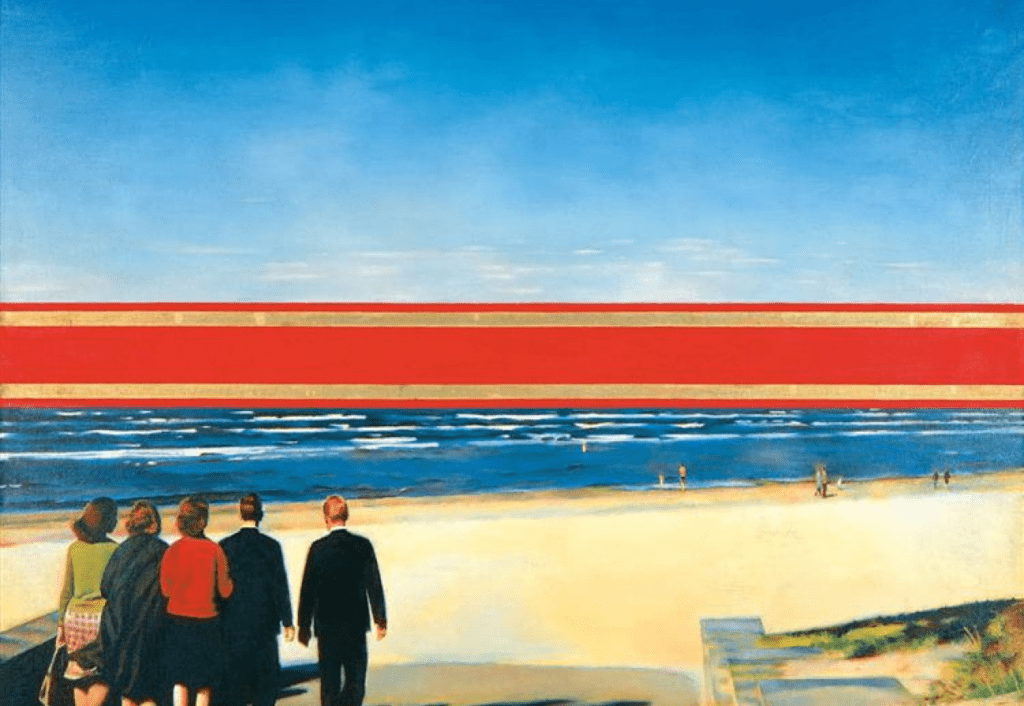
Horizonte – Erik Bulatov (1971)
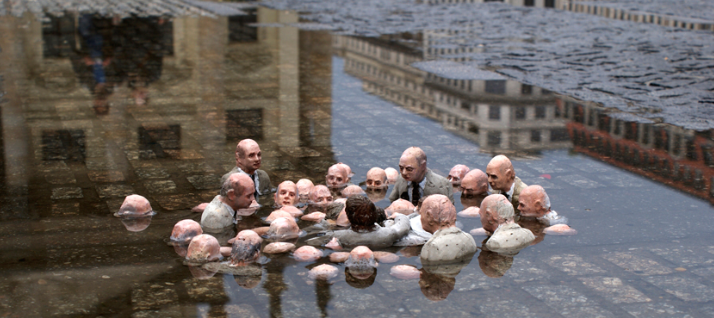
30 mayo, 2023
The problem appears when ideas stop communicating with reality. and they start working like dogmas. In these cases, it is no longer important what specific people experience, but fidelity to a previous theory. Whoever thinks differently is seen as an obstacle and not as part of a plural society. Politics then stops looking for solutions and begins to defend closed identities, often disconnected from the real needs of the population.
The Argentine public discussion seems trapped in that logic. Frequently debated to reaffirm political identities rather than to solve specific problems. The common citizen—who works, studies or seeks to make ends meet—is often left behind in the face of increasingly polarized disputes.
«The problem begins when we stop using ideas to understand reality and start using reality to justify our ideas.»
The «medium» as synthesis
¿Es posible construir una sociedad justa sin caer en los extremos de un mercado sin límites o de un Estado que pretenda resolverlo todo?
Avoid these ideological absolutisms has been the great dilemma of modern democracies. On the international stage, nations have swung pendulumously between one extreme and the other, often paying very high social costs. However, Argentine political history has a particularity: the emergence of a tradition that explicitly tried to break that pendulum and build its own synthesis, an alternative to the dogmas of the «left» and the «right.» Kirchnerismwith all its contradictions and transformations over time, was born as an attempt to escape from that false choice between a market without limits and a State that absorbs all social life.
From my perspective, the so-called Third Position It was not only a political doctrine, but a form of understand that reality is too complex to be trapped in rigid categories. Proposing an alternative is recognizing that the social fabric cannot be solved with one-dimensional recipes. Recognizing the value of private initiative, production and the market does not mean giving up the idea that The State has an inalienable ethical function: to intervene where extreme inequality generates unbearable dehumanization.
I consider that many of the political experiences linked to that tradition sought to translate that perspective into concrete policies aimed at expanding rights, strengthening employment, expanding educational opportunities and generating mechanisms for social inclusion. It consists of understanding that the law must be the same for everyonebut that the starting opportunities are not; therefore, The State must balance the scales.
Naturally, the results of these processes are debatable and are part of the democratic debate. I do not intend to present a definitive truth. However, I find in that tradition an idea that I consider fundamental: economic growth, by itself, is meaningless if it does not effectively improve people’s lives. An economy can exhibit excellent macroeconomic indicators and still fail in its most important task, which is to allow a society to live with greater dignity. I don’t believe in absolute solutions; I believe in the permanent search for a dynamic balance that allows us to live with more freedom, but also with more dignity and social justice.
Put people back at the center
¿Para qué sirve el crecimiento económico si no mejora la vida de quienes sostienen todos los días el funcionamiento de una sociedad?
Politics loses legitimacy when it becomes a permanent dispute of competing identities. Inequality, poverty and exclusion are not only economic problems; They affect the social fabric, deteriorate community ties and limit the possibilities of individual development.
The most important challenge of our time is not to decide between left or right, but recover a policy capable of looking at people before labels. A policy that understands that theories are tools to improve collective life and not ends in themselves.
Societies advance when they manage to combine freedom, social justice and pluralism. Any project that forgets any of these three elements runs the risk of losing sight of what should constitute the central objective of all political action: human dignity.
"La grieta no empieza cuando aparecen ideas diferentes; empieza cuando dejamos de reconocer humanidad en quien piensa distinto."