

The California gubernatorial candidate understands exactly what’s at stake, as he explains in an exclusive interview.
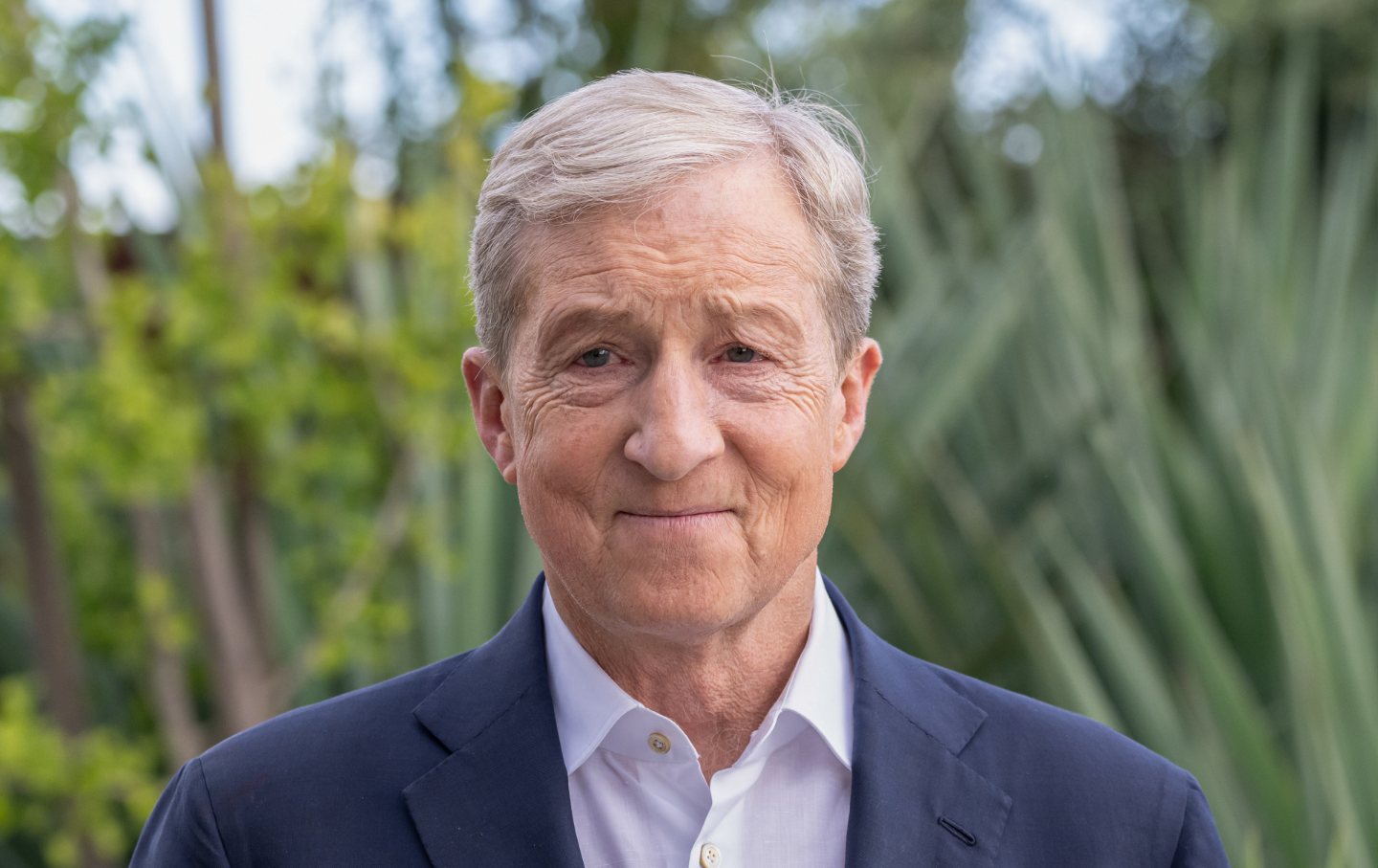
Tom Steyer in Santa Rosa, California, on May 27, 2026.
(David Paul Morris / Bloomberg via Getty Images)
Pope Leo’s groundbreaking encyclical on AI reminds us that the great debate of our moment is not really about technology. It is about the policy choices that will decide whether this new industrial revolution—which is destined to upend everything about how we work, communicate, organize society, and fight wars—will be made to improve the lives of ordinary people or the bottom-line interests of billionaires trying to become trillionaires.
Leo is clear about where he stands, writing, “Artificial intelligence needs to be disarmed.… The word is strong, I know, but deliberately chosen because this moment needs words capable of attracting attention, awakening consciences and indicating paths forward for humanity.”
The pope is right to be concerned and to be engaged in the debate about whether a handful of tech-bro CEOs will determine the future of this planet.
The question then becomes whether political leaders will challenge the rush by a few billionaires to both develop artificial intelligence and buy influence over the future of AI through massive political spending and lobbying efforts. So far, only a handful of elected officials and candidates have displayed the knowledge and the courage to join the debate on behalf of the many.
Vermont Senator Bernie Sanders has stepped up in a big way, calling for a moratorium on the development of AI data centers to slow the AI-driven rush toward the robotification of workplaces, the amplification of disinformation, the elevation of surveillance, and the acceleration of weaponization. So has US Representative Ro Khanna, the California Democrat who has proposed smart strategies for regulating AI, taxing tech billionaires, and ensuring that working-class Americans have access to the education, training, and opportunities they will need to get by in a future transformed by artificial intelligence and robots.
But they are the outliers in Washington, and it’s not much better in the states–except, perhaps, in California, where progressive philanthropist Tom Steyer is mounting a gubernatorial campaign arguing that “the people who stand to profit the most from this technology shouldn’t be making the rules about how it is used. Otherwise, the AI era will be another boom for billionaires—and a bust for everyone else.”
Current Issue

Steyer, a longtime advocate on climate issues and a billionaire who knows his way around Silicon Valley, has emerged as the major progressive Democratic contender ahead of Tuesday’s intense open primary for the most powerful governorship in the nation. Polls show that Steyer, who has self-funded much of his campaign, has a good chance of being one of the two candidates who get through the primary and go on to face each other in November. And AI policy is a key part of his agenda.
Steyer pulls no punches when he talks about taxing the wealth of the tech elite, holding the industry accountable, and using the power of the state so that working-class Californians are not left behind by the AI revolution. “Globalization displaced millions of workers, with no plan for what comes next,” he says. “We can’t allow that history to repeat itself in the AI era.”
With this in mind, Steyer has developed a bold, comprehensive plan to “make sure that all Californians benefit from AI.” He wants to provide smart job protections for workers and to retrain those who are displaced by AI. He also wants to ask voters to approve the creation of the Golden State Sovereign Wealth Fund. As his campaign explains, the fund would serve as “a dedicated investment vehicle funded by a ‘token tax’ on corporate AI use—a fraction of a cent for every unit of data processed by Big Tech.”
The resources in the fund would “help ensure everyday Californians share in the AI boom, through cash dividends, investments in education, training, and job opportunities to help workers succeed, and strategic investments to ensure broad-based economic growth so every Californian can get ahead.”
The clarity of this message helps to explain why Khanna and unions that are increasingly concerned about AI have backed Steyer. His other progressive stances—as a billionaire who wants to tax billionaires, and an enthusiastic supporter Medicare for All, building affordable housing, and making education affordable for every Californian—have attracted support from the California Nurses Association, the California Teachers Association, the California Federation of Teachers, the Service Employees International Union, International Alliance of Theatrical Stage Employees, the California Federation of Labor Unions, hotels workers and others organized by UNITE-HERE, the Sierra Club, Our Revolution, former secretary of labor Robert Reich, environmentalist Bill McKibben, and US Representatives Lateefah Simon and Jared Huffman.
Predictably, Steyer has also attracted desperate opposition from free-spending political action committees favored by the healthcare, utility, fossil fuel, and AI industries. Mark Zuckerberg’s Meta, for instance, recently steered $950,000 into a political action committee that backs Xavier Becerra, a former California attorney general, member of Congress, and Biden cabinet member who has emerged as the favorite of corporate interests in the race for governor.
Steyer’s response was blunt: “Mark Zuckerberg wants a friend in Sacramento. I won’t be.”
Steyer was equally blunt when I spoke to him recently about the race in general, and his stance on AI in particular. “You never know how anything is going to turn out, but the people running the biggest companies—the biggest large-language model [artificial intelligence algorithm] companies—believe this is a 30-foot tsunami coming at us at 100 miles an hour.”
Faced with this reality, the corporate-friendly AI policies adopted by the Trump administration and the disengaged responses of too many Democrats make no sense to Steyer. “Obviously, AI is overwhelmingly being developed in California,” he said. “It’s not ‘going to happen’—it’s happening. It’s absolutely happening.” That being the case, Steyer argued, progressives cannot be on the sidelines of the debate.
“Wait till it hits and see what happens? That doesn’t seem to me to be an appropriate response,” explained the candidate. “By the time the tsunami hits, it’s a little hard to get to high ground.”
So Steyer has met with key figures in the industry, as well as union leaders and experts on labor issues, to get a clear sense of what jobs are threatened by AI and robots—and how to address the circumstance of people who are displaced by technology. “We’ve talked a lot about protecting working people. We’ve talked a lot about real retraining to get people into real jobs.”
In addition, Steyer said, “We’ve talked about the people of California basically getting a token fee, for every calculation done by artificial intelligence—as a way of giving [Californians a piece of the largesse that comes from the transformation of their workplaces]. The people of California have to own part of this, because we can’t have 12 trillionaires and 40 million people who can’t make rent because they’re losing their jobs. It can’t happen, and we can’t let it happen.”
What’s striking about Steyer is the detail with which he has addressed issues that his fellow gubernatorial contenders–like most political figures nationwide—barely touch upon. For instance, Steyer’s campaign says:
Popular
“swipe left below to view more authors”Swipe →
- “Tom will make sure we protect workers and create hundreds of thousands of new jobs that AI can’t do. Regardless of its potential, AI will not replace all thinking and creative jobs. While it may make them faster or more efficient, no machine can replace our innate creativity, compassion, and experience—the uniquely human things we bring to our work.”
- “Tom will partner with labor to adopt reasonable guardrails for AI use in the workplace—especially when it comes to privacy, health, safety, and fairness.”
- “Tom will require social media platforms to conduct safety audits and strictly enforce age requirements, including requiring independent safety testing to make sure models are safe before they go on the market.”
- “Data centers should never cost California families a cent. Tom will mandate that data centers ensure energy prices for families go down—not up.”
- “Tom will ban social media for kids under 16, because the link between social media use and the youth mental health crisis is clear.”
- “There must be human oversight of AI with the ability to override, especially in critical areas.”
That’s not the final word on AI, and there are still plenty of questions that Steyer and other candidates, in California and nationally, should be answering about this technological revolution. But Steyer’s willingness to engage with the AI debate, and to propose savvy progressive responses to the issues it raises, distinguishes him as a candidate whose election could have a profound influence on a future that should choose people over profits.
Your support makes stories like this possible
From illegal war on Iran to an inhumane fuel blockade of Cuba, from AI weapons to crypto corruption, this is a time of staggering chaos, cruelty, and violence.
Unlike other publications that parrot the views of authoritarians, billionaires, and corporations, The Nation publishes stories that hold the powerful to account and center the communities too often denied a voice in the national media—stories like the one you’ve just read.
Each day, our journalism cuts through lies and distortions, contextualizes the developments reshaping politics around the globe, and advances progressive ideas that oxygenate our movements and instigate change in the halls of power.
This independent journalism is only possible with the support of our readers. If you want to see more urgent coverage like this, please donate to The Nation today.
John Nichols
John Nichols is the executive editor of The Nation. He previously served as the magazine’s national affairs correspondent and Washington correspondent. Nichols has written, cowritten, or edited over a dozen books on topics ranging from histories of American socialism and the Democratic Party to analyses of US and global media systems. His latest, cowritten with Senator Bernie Sanders, is the New York Times bestseller It’s OK to Be Angry About Capitalism.