

The administration is targeting travelers who criticize US policy.
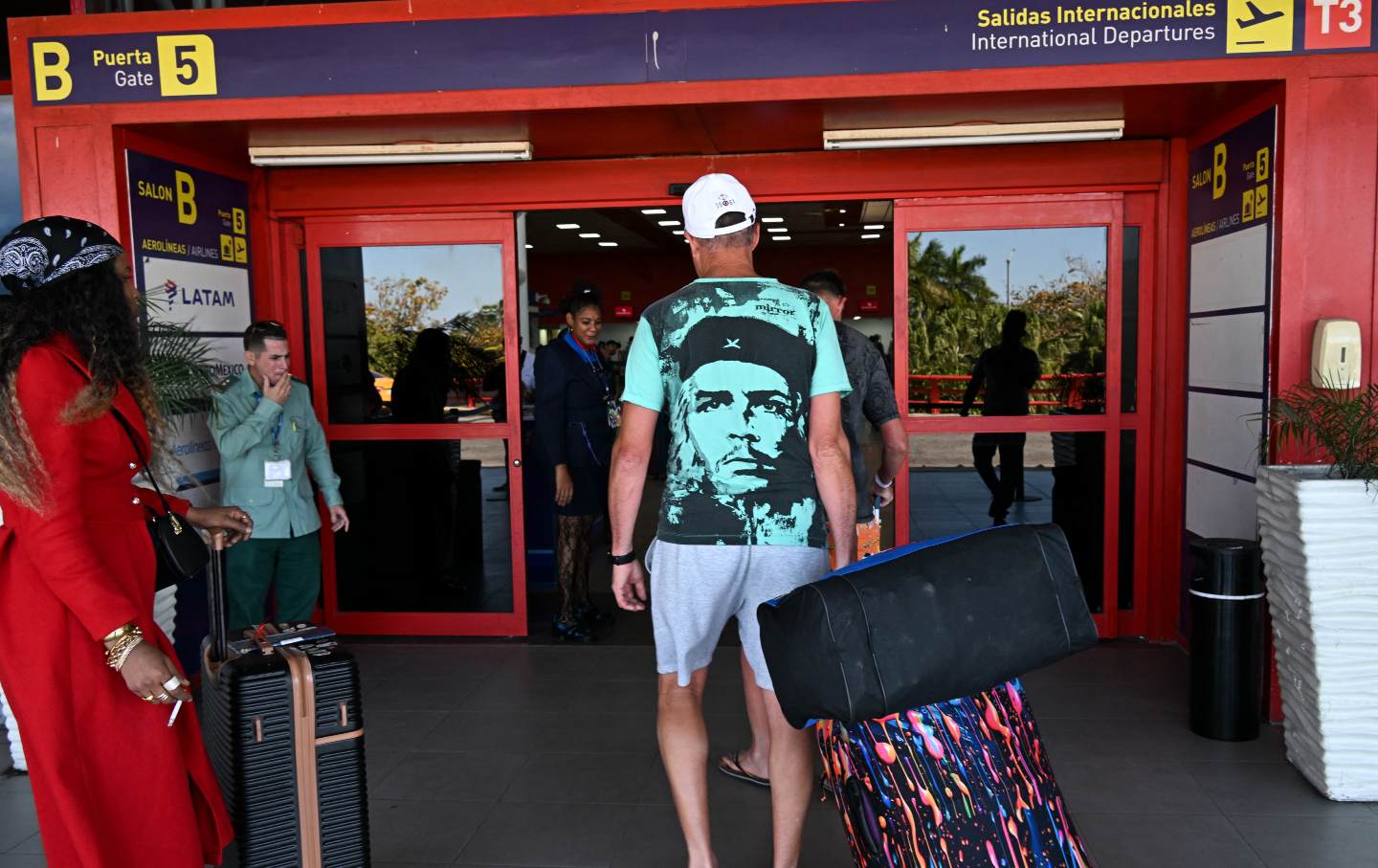
The Trump administration has begun to weaponize long-standing restrictions on freedom to travel to Cuba, focusing on travelers who criticize the US policy of asphyxiating the Cuban economy and threatening a military attack.
The Office of Foreign Assets Control (OFAC)—the arm of the Treasury Department that enforces US economic sanctions against other countries—has sent a “request for information” to the advocacy group Code Pink about its participation in the international humanitarian convoy that brought 500 people from more than 30 countries carrying an estimated 35 tons of food, medicine, solar panels, and other aid to Havana in March. As part of the convoy, Code Pink chartered a plane for 170 participants that also carried 6,300 pounds of medical supplies worth $433,000 arranged by Global Health Partners.
Treasury officials are demanding to know “everything you did while you were in Cuba, who went, how did you go, how did you pay for everything, all the receipts, the detailed description of everything you took for donations…what hotel did you stay in,” Medea Benjamin, cofounder of Code Pink, told The Nation.
Benjamin suspects the May 21 OFAC inquiry aims to quell dissent against President Donald Trump’s increasingly harsh approach to Cuba, which has triggered the worst humanitarian crisis on the island in memory. An American oil blockade imposed in January set off a chain reaction of daily blackouts, food shortages, water shortages, medical emergencies, and reported deaths. “I think it’s intimidation, totally, and we don’t want to be intimidated,” Benjamin said. “We’re telling all the people who went with us don’t be intimidated. Just use this as another spark in the fire to challenge this sadistic policy.”
Code Pink has started to compile the information requested by OFAC, Benjamin added. “We think we didn’t do anything wrong.”
Federal scrutiny of the trip has implications beyond one group’s mission to Havana. It’s another blow to Cuba’s already devastated hospitality industry—a major pillar of the economy—and represents an additional tool for turning up pressure on the Cuban government, according to experts in travel to Cuba. “This will certainly serve to chill travel to Cuba by well-meaning Americans who have every right under the current structures and categories to go to Cuba,” said Peter Kornbluh, co-author of Back Channel to Cuba: The Hidden History of Negotiations between Washington and Havana, who has led tours to the island. “But it also is a warning to anybody that opposes the cruel and anti-humanitarian nature” of the current approach to Cuba. “The Trump administration is weaponizing a humanitarian trip to Cuba to persecute, not just to prosecute, those who are speaking out against the cruel and malicious US policy and trying to help the Cuban people.”
Current Issue

The Treasure Department’s press office didn’t respond to e-mails seeking comment for this story. The existence of the inquiry was previously reported by Fox News Digital, which also said others received a “subpoena,” including left wing influencer Hasan Piker who traveled to Havana on the Code Pink charter. As of last week, “your boy has yet to receive a subpoena,” Piker told his audience on Twitch.
Official inquiries into American travelers’ activities in Cuba were not uncommon in the 1990s and early 2000s. However, since President Barack Obama sought to thaw relations between the nations and visited Havana himself in 2016, the assets control office has generally left travelers alone. “Obama basically decided that OFAC should be out of the travel curtailment business,” Kornbluh said.
Even during Trump’s first term, US travel to Cuba continued to soar, reaching a record 638,000 visitors in 2018, according to the Cuban government, despite Trump’s tightening some categories of travel. There were few, if any, reports of the US government demanding the records of travelers to Cuba during Trump’s first term and President Joe Biden’s term, said Robert Muse, a Washington, DC, lawyer with long experience counseling clients on OFAC compliance issues.
Americans can travel to Cuba for any of 12 authorized reasons, including “support for the Cuban people,” “humanitarian projects,” and “educational activities.” The Code Pink group traveled under the category of support for the Cuban people, Benjamin said. That means having a schedule of activities that yield meaningful interaction with the Cuban people, according to the regulations. Some members of the group spent all their time painting a mural with Cuban artists, as reported by The Nation from Havana, while others participated in a daily schedule of activities posted in their hotel, including visiting neighborhoods to meet residents, listening to speakers, and making art with children in a playground.
The March humanitarian aid convoy came under withering attack in right-wing news accounts and social media, with headlines like “The Flotilla of Shamelessness in Cuba.” The commentators highlighted a gathering of hundreds of convoy participants one afternoon in the Havana convention center, where Cuban President Miguel Díaz-Canel addressed the visitors: “Your presence on the island constitutes a profound demonstration of friendship, sensibility, and human commitment to the Cuban people.” The recent Fox News report on the OFAC inquiry claims it is part of a “broader dragnet…of anti-US Marxists, communists and socialists.”
Demands for records like the one to Code Pink “go through cyclical periods depending on US-Cuba relations generally, and we’re clearly in a downdraft here,” said Muse. The winds started to change again in June 2025 when Trump issued a national security memorandum that, in part, instructed the Treasury to ensure that travelers comply with regulations and keep records of their activities for five years. Indeed, participants in the convoy faced lengthy questioning when they landed in Miami on their return from Havana in March. At least 18 travelers had their electronic devices searched, and some phones and laptops were confiscated for several days.
The maximum civil penalty for, say, engaging in tourism, which is forbidden, rather than permitted activities is $111,000, while the criminal maximum is $250,000 and up to 20 years in prison—though lawyers say actual sentences would likely be far lower.
Popular
“swipe left below to view more authors”Swipe →
Muse is focused on whether escalating aggressive enforcement against travelers turns out to be the latest screw that Trump has found to tighten on Cuba, along with the oil embargo, the recent indictment of Raúl Castro, threats of military action on the island, and the campaign against Cuban doctors serving in other countries. “If they do an across-the-board set of administrative proceedings, maybe go criminal in a case or two, then they’re fitting it into maximum pressure,” said Muse. “Rights of US citizens then become implicated. This then extends the embargo beyond Cuba and brings it home in aggressive examination of broadly First Amendment–protected activity.”
Benjamin vowed that the scrutiny of the trip would not deter activists advocating for a change in Cuba policy. Last week, Code Pink has been on Capitol Hill advocating for resolutions in the House and the Senate that would force votes on requiring the Trump administration to win congressional approval to launch military action against Cuba. The federal inquiry “is taking time and energy and money,” she said, “but it’s not going not take us away from the main issue,” which is “Cuba and what they’re suffering.”
David Montgomery
David Montgomery, formerly a longtime staff writer for the Washington Post, is a freelance journalist in Washington.