

Activism / StudentNation / October 2, 2026
Representative Alexandria Ocasio-Cortez spoke to Ithaca students about tuition hikes, sexual violence, free speech, and university governance.
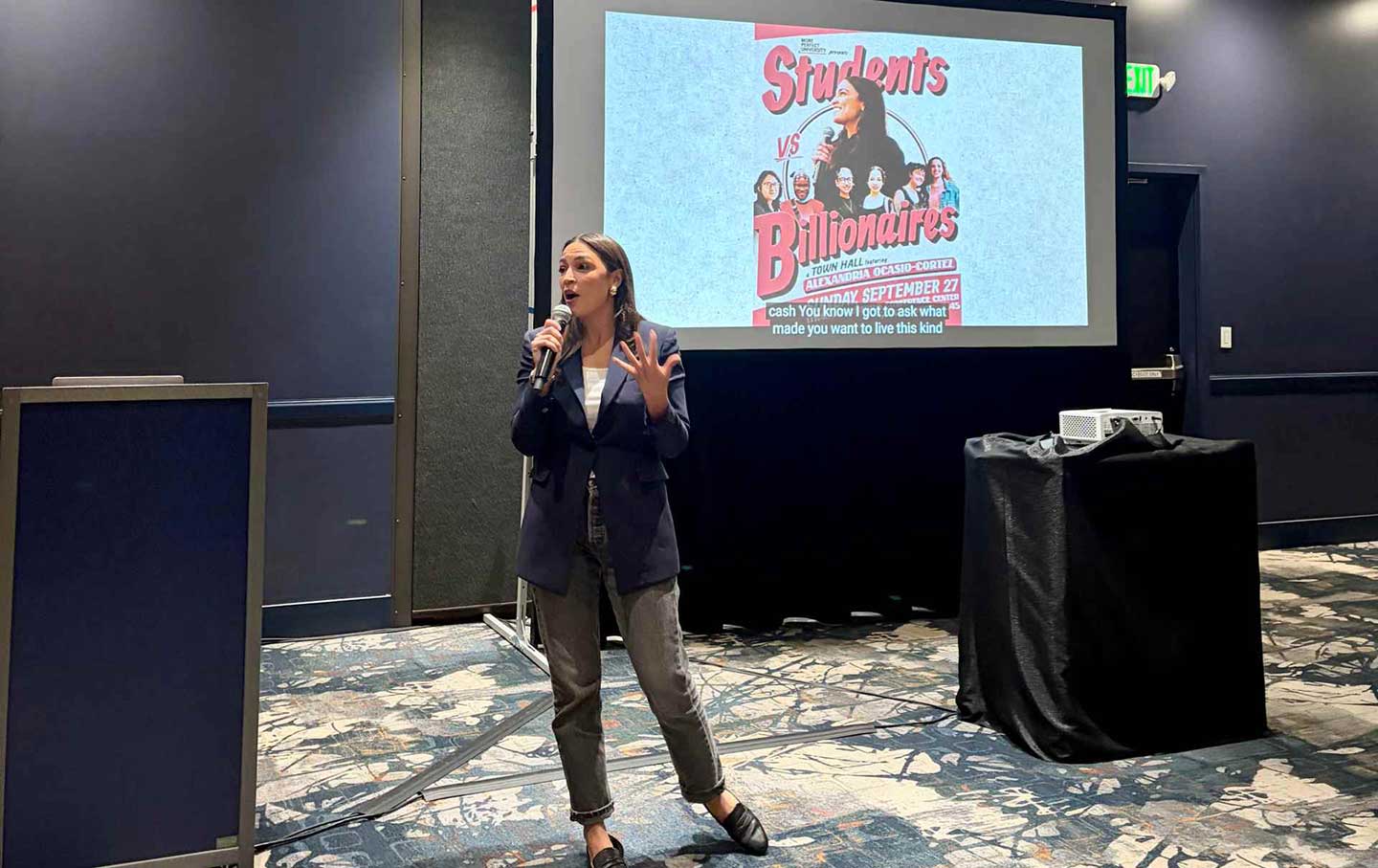
Inside the Ithaca Downtown Conference Center, the room buzzed with excited chatter as students packed the venue, eager to see Representative Alexandria Ocasio-Cortez speak at the “Students vs. Billionaires” town hall. About 1,200 people, some whom lined up hours in advance, attended the September 27 function. According to More Perfect University event host Elise Joshi, more than 900 additional attendees were turned away at the door.
For Joshi, the scale of the turnout reflected the premise of the event: Give students the microphone and let them decide what matters.
As Samuel Moyn posits in his new book Gerontocracy in America, an “oldigarchy” intent on hoarding wealth and power has come to determine how the US is governed. In this political landscape, young people have reported record levels of dissatisfaction with the rapidly ageing ruling class.
More Perfect University, a subset of the advocacy journalism nonprofit More Perfect Union, focuses on strengthening collective student power to challenge billionaire influence over political and economic systems. According to Joshi, “When you let students ask the questions that matter to them, they’re going to ask damn good questions.”
Joshi opened the evening by describing the group’s mission: using storytelling and advocacy journalism to spotlight issues students face—from rising tuition and housing costs to restrictions on free speech—and to connect those experiences across campuses. Pulling it off, she said, “takes a village.”
This is especially true when, according to Students for a Democratic Cornell (SDC) chair Matthew Knudsen, “Campus has been forcefully depoliticized, with bans on protests and attacks on historically political cultural organizations.”
Current Issue

“The university wants students to view the world through an apolitical lens, but as students we have a responsibility to understand how systems driven by politics and ideology impact every corner of our lives. By drawing mass crowds, people will hopefully repoliticize and understand that students are needed to make true change in this country and world,” continued Knudsen, who cohosted the event alongside Cornell Graduate Students United Union, and Cornell Young Democratic Socialists of America.
Before her prepared remarks and student questions, Ocasio-Cortez turned to an issue that consumed Cornell in the days leading up to her appearance: the lawsuit alleging that a former Cornell student, identified as Jane Doe, was gang-raped at the Chi Phi fraternity house in 2024.
“Jane Doe, that survivor, lost her education because you can’t stay in school when something like that happens to you,” Ocasio-Cortez told the crowd. “She had to lose her education, and those men were protected by an institution and granted an Ivy League degree as a reward. Never again.”
She then made the issue personal.
Ocasio-Cortez, a Boston University alumna, recalled arriving at her first college party and almost immediately being inappropriately touched. She also described attending a party at MIT where she saw men taking advantage of an incapacitated woman and feeling as though she was in a “factory of sexual assault.”
“The culture of rape, sexual assault and pedophilia is protected in elite institutions across the United States.… it has got to stop,” Ocasio-Cortez said. “This entire country is sick and tired of not just financially corrupt but morally corrupt leadership.”
For Knudsen, the connection between Cornell’s response to the Chi Phi case and its harsh restrictions on free speech became a recurring theme throughout the evening, echoed by other speakers and by Ocasio-Cortez herself, who also pointed to what she described as a double standard in the university’s responses.
“When AOC mentioned how we give rapists a pass for horrific and violent acts, yet people who express themselves peacefully about the genocide in Palestine are being suspended, that really stuck with me,” Knudsen said. “The purpose of Cornell’s judicial system is not justice. It is whatever benefits the university and its donors the most.”
Popular
“swipe left below to view more authors”Swipe →
Saya Taylor, SDC’s co-chair of public relations, kicked off the questions by asking what students ought to do about university governance dominated by boards of trustees and business interests. “Student activism is gone because of Cornell’s harsh restrictions against free speech in their Code of Conduct,” said Taylor. “When you ask someone as powerful as AOC what we should do about it, her answer ignites a movement that can’t be ignored.”
Another student question focused on the cost of attending Cornell, “I also really liked the one question someone asked AOC about Cornell tuition being over $100,000. It’s beyond insane for Cornell’s cost of attendance to be this high, especially when that money is being spent to violate their rights and safety as well as given to fund research for the industrial military complex,” Taylor said.
The town hall ended where it began: with students asking what power they have, and what they are supposed to do with it.
“That was precisely the point,” Joshi said. Students vs. Billionaires was not just an opportunity to hear from a member of Congress but also an attempt to give students a forum to connect the issues affecting their daily lives—tuition, sexual violence, free speech, university governance—to larger questions about who holds power and who gets heard.
For Joshi, Knudsen, Taylor, and other organizers, getting more than a thousand people into one room was itself part of the answer: Student political power begins when students come together and decide that the institutions around them are not beyond questioning.
Jeannine Chiang
Jeannine Chiang is a sophomore at Cornell University and a student journalist who has been featured in The Wall Street Journal and on PBS VOCES.